
You tried AI for your marketing. Maybe some posts, maybe an email sequence. The output was fine but generic, you edited it, posted it, and three months later you are not sure if it actually helped anything. That is not a tool problem. That is a sequencing problem. I built Shnoco to 50,000 monthly readers without a single paid ad, personally tested hundreds of tools, and now advise AI product companies on content-led growth. The gap between AI marketing that compounds and AI marketing that wastes hours is almost never which tool you chose. It is what you decided before you opened the tool.
AI Does Not Fix Unclear Marketing. It Amplifies It.
When most small business owners start with AI marketing, the first question they ask is which tool to use. They pick ChatGPT or one of the many AI writing platforms, type something like “write me five Instagram captions for my business,” and wait. The tool delivers five captions. They publish them, check the numbers a few weeks later, and find nothing has changed. So they try a different tool. Same result. After enough of this, they either give up on AI marketing entirely or accept that it mostly produces mediocre content they have to heavily edit before it is usable.
The tool is not the problem. The tool is doing exactly what it was asked to do. AI generates content by producing statistically likely output given the input it receives. If the input is a bare task, the tool fills every missing piece of context from its training data: a blend of everything ever published about that kind of business. The output is, by design, average. Not wrong. Not broken. The statistical center of all similar content that exists on the internet, applied to your topic. If your marketing was already unfocused before you opened the tool, AI produces unfocused content at higher speed and volume. That is what amplification means.
AI does not fix unclear marketing. It amplifies it.
The AI marketing adoption data shows that 90% of small businesses were using at least one AI tool by fall 2025, yet most early adopters still list generic output as their primary complaint. That is not a coincidence. It is a pattern with a specific cause: almost every small business that adopted AI marketing started with the tool, not with the decision about what the tool was supposed to solve.
I have personally tested and reviewed hundreds of tools building Shnoco. The single most consistent pattern across tools that produced useful output versus tools that produced noise was not the model, not the interface, and not the price point. It was whether the person using it had a specific brief before they opened the prompt. The same tool, given a vague task, produces generic output. Given a specific brief, it produces something worth editing. The brief is the variable. The tool is the machine.
The fix is not a better tool. The fix is a prior decision. Before opening any AI marketing platform, there is a specific set of questions to answer about the activity you are about to use it for. I call that set of questions the Upstream Decision. The reason most guides never get here is that it is less exciting to write about than tool lists. But it is the difference between AI marketing that compounds and AI marketing that costs you a subscription you eventually stop opening.
The Upstream Decision: Three Questions That Make AI Marketing Work
The Upstream Decision: the three questions every small business must answer before opening any AI marketing tool, because AI amplifies whatever it is given and vague input produces vague output at higher volume.
The standard move is to open the tool and start with the task. “Write me some social media posts.” “Draft an email campaign for my new product.” “Create a blog post about [topic].” These are tasks, not briefs. They tell the tool what format to produce but nothing about who the content is for, what behavior it is supposed to change, or what makes this business different from every other business in the same category. The tool fills those gaps from training data. The result is content that could have come from any competitor who typed the same task.
A task tells AI what to write. A brief tells AI what to say, to whom, and why. AI has no access to your customers, your history, your point of view, or your specific context unless you supply it. When you do not, the model defaults to the most statistically common version of whatever you asked for. “Write a friendly email about my new service” produces the averaged version of every friendly email about every new service ever written. That is what “friendly” means to a model with no other context to work from.
Here is the comparison I ran at Shnoco. I gave the same tool two inputs for the same content topic. The first was: “write a post about no-code tools for beginners.” The second included three pieces of context: a one-sentence description of the specific reader (a non-technical professional trying to build a client reporting dashboard without hiring a developer), the specific belief I was arguing against (that no-code tools are only for simple projects), and one sentence from a previous Shnoco post that already sounded like the voice I wanted. The first output was something any no-code publication could have published. The second required about ten minutes of editing before it was ready to go live. Same tool. Same topic. Completely different output quality. The only variable was what went in.
The Upstream Decision has three questions. First: who specifically is this piece for, described by their situation rather than their demographic. Not “freelancers” but “freelancers losing hours weekly to manual client reporting who cannot afford a developer.” Second: what specific belief or behavior does this piece need to change. Not “awareness” but a named thing the reader currently believes or does that you want to shift. Third: what is the one thing about your business that a direct competitor could not honestly say. Not “we care about quality” but a specific capability, result, or point of view that belongs to you. Feed those three answers into every prompt before writing the actual task instruction. The output becomes yours.
What a Good AI Marketing Brief Actually Looks Like
Vague brief (what most people type):
“Write five Instagram captions for a local coffee shop. Keep it friendly and casual.”
Upstream Decision brief (what actually works):
Reader situation: a regular who comes in for the 8am quiet hour before the rest of the cafe fills up. A remote worker who values the routine and the silence more than the coffee itself.
Belief to shift: they think of the coffee shop as a utility, not a community. This caption should begin to shift that.
One thing a competitor cannot honestly say: we intentionally left half the tables without power outlets so people come here to disconnect, not to grind.
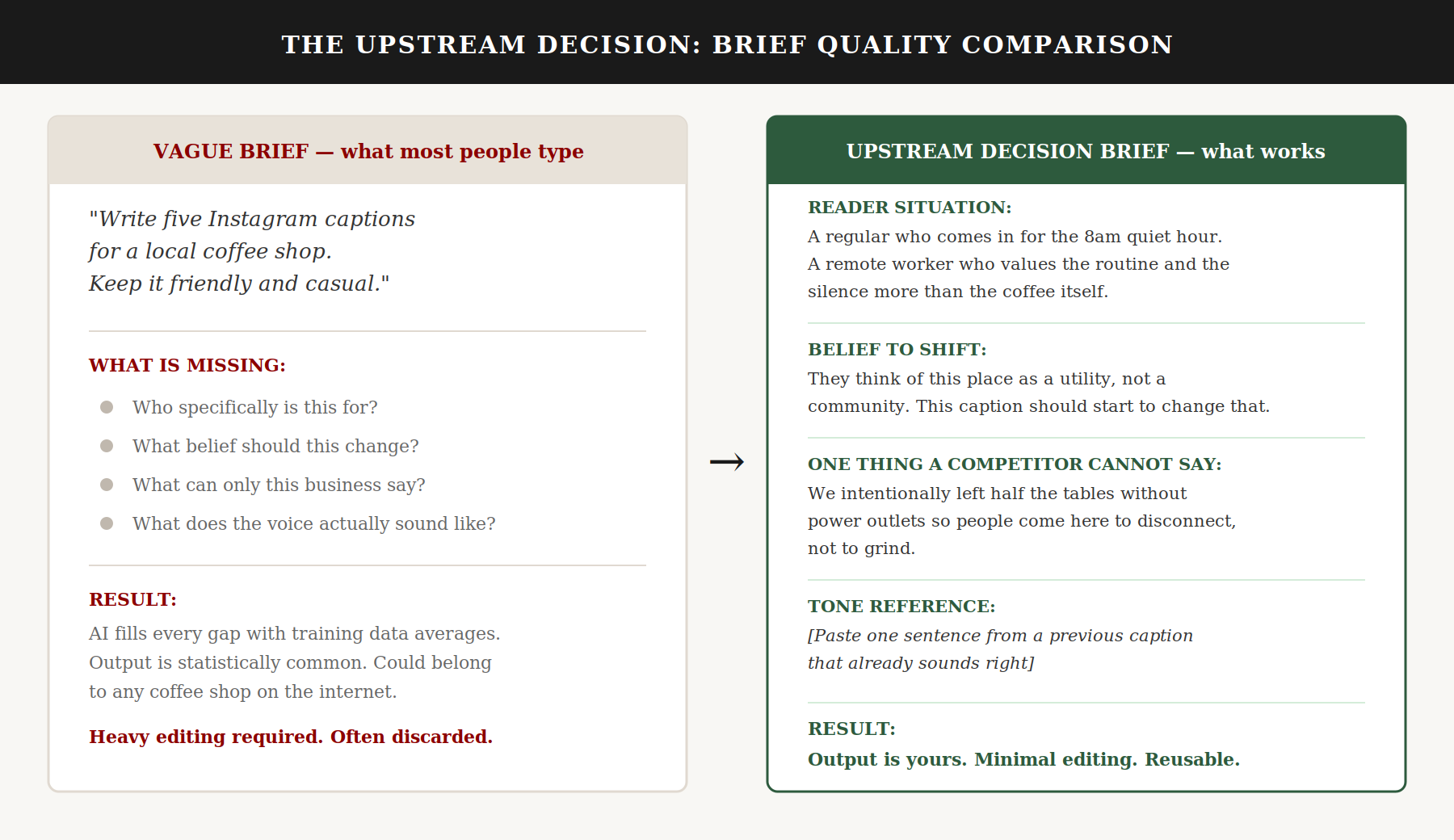
The second brief takes five to ten minutes to complete the first time. Once you have the reader description and the brand-specific element established, both can be reused in every subsequent prompt for that channel. The setup cost is front-loaded. After that, every output you produce from that brief is substantially better than anything the bare task generates.
With the Upstream Decision answered, you have what you need to use any AI tool productively. The question is where to start.
The Four AI Marketing Tasks Worth Doing First
Every guide on AI marketing for small businesses gives you a list of fifteen things AI can do: content creation, email, social media, ad copy, SEO research, chatbots, analytics, competitor research, personalization, customer service. The list is accurate. Every item on it is genuinely possible. The problem is that presenting them as equivalent options implies you should attempt all of them. Most small business owners who follow this advice end up doing eight things at 20% effort each, producing output that is marginally better than before but too scattered to produce a clear signal.
The cost of spreading attention too early is not just wasted time. It is also wasted learning. When you are running five AI marketing activities simultaneously, you cannot tell which one is producing results and which is producing noise. You lose the feedback loop that tells you whether your approach is actually working. A small business with one person doing the marketing needs concentrated bets, not diversified ones.
When I run content strategy for early-stage SaaS companies on an advisory basis, the first instruction is always the same: pick one channel and one content type, push it to consistent performance, then add the second. The clients who ignored this and launched AI marketing across multiple channels simultaneously consistently took longer to see results. The concentrated approach produces visible wins faster and builds the confidence to expand. The distributed approach produces mild improvement everywhere and confusion about what is actually driving it.
The CoSchedule 2025 State of AI in Marketing Report found that 85% of marketers now use AI tools for content creation. And adding more AI tools does not mean more efficiency: teams that layer tools without a clear underlying workflow often see output quality decline before it improves.
The four starting points, in order of setup simplicity and speed of feedback:
Start with first-draft content. It has the highest ceiling, the clearest feedback loop, and the most direct connection to the Upstream Decision work you have already done. Variation generation is the fastest to set up if you already have a baseline to test against. Research and synthesis requires almost no brand-voice alignment, which makes it the safest entry point if you are not yet comfortable with AI producing customer-facing content unsupervised.
All four starting points can be executed with a single ChatGPT or Claude subscription at around $20 per month. You do not need a specialized AI marketing platform to start. The tool matters less than the brief. Once your workflow is established and you want to go deeper on specific tool selection, I have a full comparison of AI marketing tools built for small businesses covering what each does, what it costs, and when it is worth paying for.
A word on AI marketing automation: that is the next conversation after this, not before. Automation is what you do when the manual workflow is working and you want to remove yourself from the repetitive steps. If you automate before the workflow is working, you scale the problem.
The first starting point, first-draft content, is also the entry into a much larger practice. Once the brief format is established and repeatable, the full treatment of AI content marketing covers how to expand it into a complete content program.
Read next: AI marketing tools built for small businesses
Once you are producing AI output consistently, a new problem appears. The content starts to look like every other business in your category.
Why Your AI Content Sounds Like Everyone Else’s
Most small business owners who have been using AI marketing for a few months hit the same wall. The content is fine. Technically correct. Not embarrassing. But it sounds like it could have come from any competitor. The usual response is to add tone instructions. “Write this in a conversational, authentic voice.” “Keep it casual and human.” “Add more personality.” These instructions produce slightly friendlier averages. They do not produce voice.
Voice is the accumulated product of specific beliefs, specific references, and specific ways of saying things that belong to one business and not the next. An AI model cannot generate your voice from a mood instruction. It has no idea what you specifically believe about your category, what you have seen fail and why, or what specific framing your best customers actually respond to. When you ask for “authentic,” you get what authenticity looks like statistically. That is not authenticity. It is the simulation of it, assembled from training data.
When I was building content at Shnoco, I ran a comparison I now repeat with every advisory client I work with. Same tool, same topic, two different prompts. The first included only the topic and a tone instruction. The second included the reader situation, a sentence from a previous Shnoco post that already sounded right, and one piece of information only I could include: a specific observation from personally testing a tool that contradicted the conventional advice in the category. The first output was something any no-code publication could have published. The second was recognizably from Shnoco, because it contained something only Shnoco could say. The distinctive element was not long. One sentence. But it changed the entire character of the output.
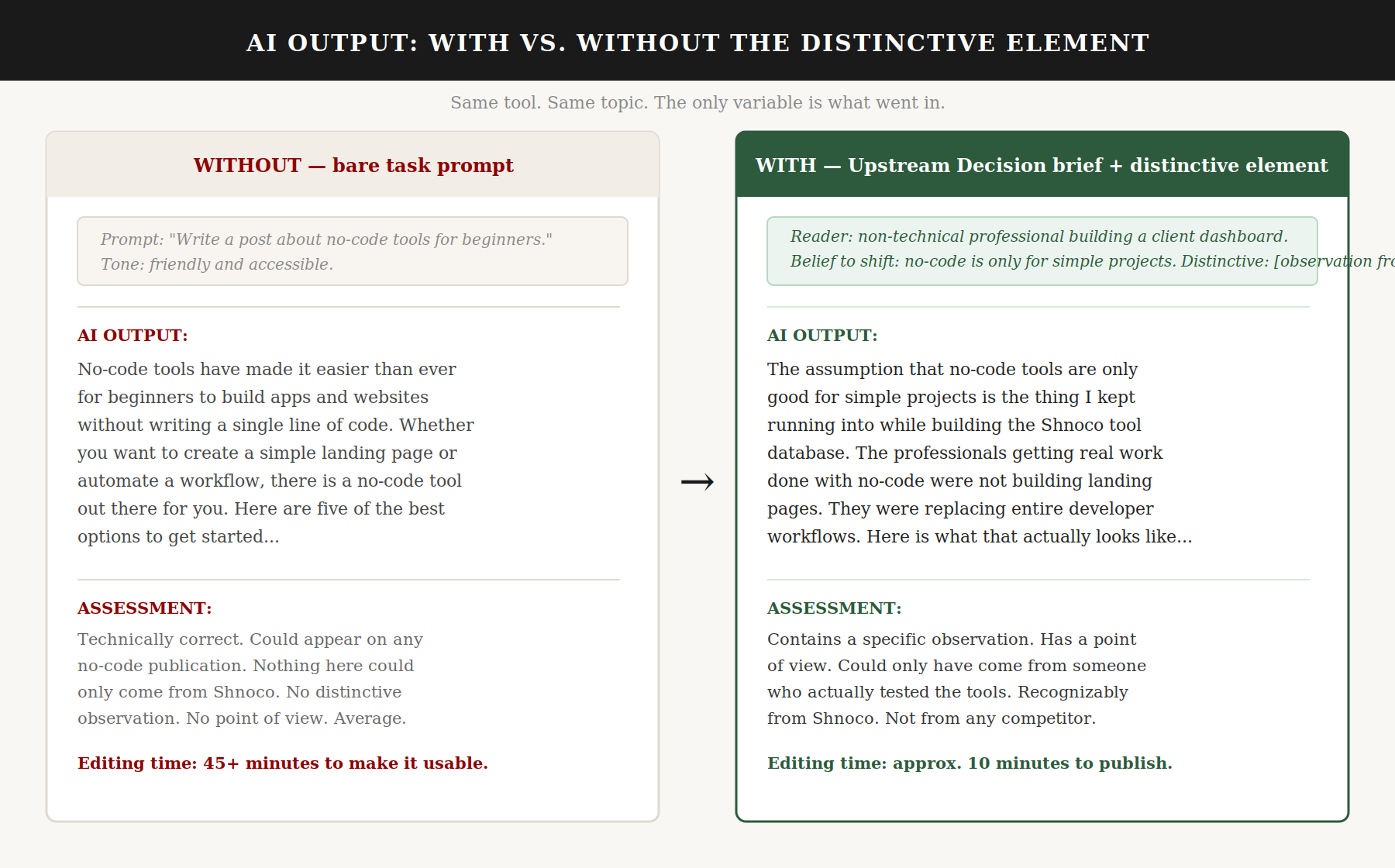
Before prompting AI for any customer-facing content, supply three things beyond the task description. First: the Upstream Decision brief for this specific piece. Second: one sentence from a past piece of content that already sounds like you at your best. Third: one piece of information that a direct competitor could not honestly include in their version of this content. That third element is the most important. It is what turns AI output from everyone’s into yours.
Once you have a consistent AI workflow producing content at this level of specificity, the next question is whether it is working. The full framework for measuring AI marketing ROI covers the metrics and review cadence in detail.
The framework in this article is usable today. It does not require a new tool or a budget increase. Five steps to apply it this week:
- Write out the three Upstream Decision questions for one specific marketing activity you are currently running. Do not open any AI tool until all three are answered. If you cannot answer them, that is the problem: answer them before generating anything.
- Look at the last AI-generated piece of content you published. Find whether it contains even one piece of information that a direct competitor could not have included. If not, that is the gap.
- Pick one of the four starting points from the table above and apply it to one specific asset this week. One asset. The goal is one successful, repeatable workflow, not maximum coverage.
- Before your next AI prompt for customer-facing content, add the one thing only your business can say. Feed it as context before the task instruction, not as a tone request at the end.
- At 30 days, ask one question: is the AI output requiring less editing than it did in week one? If yes, the sequence is working and you can expand to a second use case. If no, the problem is in the brief. Check the Upstream Decision answers before changing the tool.
If you want help building this into a repeatable workflow for your specific business, drop a note at shankar@shno.co.