
Your team is publishing more content than ever. Using the AI tools every guide recommends. And your organic results are flat. That is not a prompting problem. It is a deployment problem. Most AI content advice was written to get you to adopt AI tools, not to help you use them strategically. Every stage of a content program is treated as equally AI-compatible, and none of them are. I advise SaaS companies on content-led growth and grew Shnoco, a no-code content community, to 50,000 monthly readers using content and search alone. What I have found: AI creates compounding leverage at two or three specific workflow stages and actively destroys what makes content worth reading at the others.
The Volume Trap: Why More AI Content Does Not Mean Better Results
Most teams that adopt AI for content hit the same milestone first. Publishing cadence increases. Articles per month doubles. The content calendar fills up. Someone in a planning meeting says “we’re finally operating at scale” and everyone agrees. The dashboard looks healthy. The organic results do not move.
The problem is treating volume as a proxy for performance. They measure different things. Volume is a production metric. Rankings, click-through rates, and content-driven pipeline are differentiation metrics. AI makes volume cheap for everyone simultaneously. When every competitor in your category can produce a structurally complete 1,500-word article on any topic in under ten minutes, publishing more articles does not create a relative advantage. It adds more entries to a category that is already crowded.
The search engine does not reward output volume. It rewards content that is specifically useful for a specific query. And “specifically useful” is the one thing AI tools, deployed without a strategic framework, consistently fail to produce.
The data confirms what most AI-assisted content teams are quietly experiencing. According to the B2B Content and Marketing Trends: Insights for 2026 report from Content Marketing Institute and MarketingProfs, sponsored by Storyblok, 87% of B2B marketers say AI has improved their productivity. Only 39% say it has improved their content performance. That gap, 87% productivity versus 39% performance, is the deployment problem in a single number. AI is making teams faster. It is not making their content better.
A CoSchedule survey of 911 marketing professionals from December 2025 reinforced this: 31.4% of marketers identify organic search as their biggest performance decline area after AI adoption. Meanwhile, according to Canto and Ascend2’s State of Digital Content 2026, which surveyed 434 content professionals, 75% say AI has increased the volume they produce.
More content. Lower performance. The gap between those two facts is not a coincidence. It is what happens when teams measure the wrong metric.
Volume is up across the board. Differentiated performance is not following.
The full picture is in the AI content marketing statistics roundup. But the short version is this: adoption is near-universal, output has scaled, and the teams seeing actual results are a small minority. The difference between that minority and everyone else is not the tools they use.
The fix starts with a measurement shift. Stop reporting how many articles you published. Start reporting the percentage of published content that ranks in positions one through ten, earns backlinks from independent sites, or generates qualified clicks from your target buyer. If AI is not moving those numbers after 90 days of deployment, the deployment is wrong, not the tool.
That reframe makes the rest of this article useful. Because what follows is the framework for diagnosing where the deployment went wrong. It is called the Stage Map.
The Stage Map is a workflow-level decision framework that assigns each content production stage either AI-appropriate, human-required, or AI-assisted designation, based on the type of output that stage must produce. The rest of this article builds that map.
The Stage Map: Where AI Creates Real Leverage
Pick up any AI content marketing guide, including the ones from well-known software companies and marketing publications, and you will find the same structure. A list of eight to twelve places AI can help: ideation, keyword research, research, outlining, drafting, editing, SEO optimization, social distribution, email repurposing, analytics. The implicit message is that you should be deploying AI throughout your workflow. The more stages you automate, the better.
This is the equivalent of saying “use electricity wherever it helps.” Technically accurate. Strategically useless without specificity.
Different workflow stages require fundamentally different types of output. Some stages require processing, pattern recognition, and structural synthesis: taking large amounts of input data and producing a coherent, organized output. AI does those things well. Other stages require judgment, original expertise, and the kind of domain-specific insight that only comes from having spent real time solving the problem the reader is trying to solve. AI does not have those things. Applying AI indiscriminately means deploying it at stages where it cannot produce good output, while potentially under-using it at stages where it genuinely saves time and produces useful results.
I ran into this directly at KoinX, a crypto tax SaaS with over 1.5 million users. The category is crowded and the regulatory landscape shifts constantly. Early in that engagement, AI was used the way most teams use it: generating first drafts and speeding up the writing process. The output looked fine. The rankings did not move. When I shifted the deployment model, keeping AI for research synthesis, brief structuring, and distribution copy, but returning the core writing and argument framing to a human with real knowledge of crypto taxation, the content started ranking. The difference was not the quality of the prose. It was whether the piece was built around a specific, defensible argument or around AI’s pattern-matched version of what a crypto tax article should say.
The same principle held at GrowthMentor, where I was part of the marketing team for roughly three years, building the content engine that drove organic signups. The audience is experienced practitioners. They detect generic advice immediately. Every piece that performed was human-written, grounded in genuine expertise on the practitioner problem it addressed. AI helped with research speed. It never touched the argument.
Four content workflow stages reliably benefit from AI deployment. Research synthesis, outline generation, content optimization, and distribution copy adaptation. At each one, something important is true.
The One Characteristic All AI-Appropriate Stages Share
There is a pattern across these four stages. At each one, the quality of the output is determined entirely by the quality of the input, not by any generative capability of the AI.
When you feed well-structured SERP data and a clear reader intent into an AI tool and ask it to synthesize a content brief, the brief quality reflects your input quality. The AI is organizing and summarizing what you gave it. That is processing speed, not intelligence. When you feed a clearly defined human argument into an AI tool and ask for an outline, the outline reflects those constraints. When you run a finished draft through an SEO optimization tool, the suggestions reflect the coverage gaps in what was already written.
At research synthesis, outline generation, content optimization, and distribution copy: AI is functioning as a processor. You are providing the signal.
The stages where AI fails are the stages where the quality of the output would need to come from the AI itself: original insight, expert judgment, contrarian positioning, genuine domain knowledge. No amount of better prompting changes this. You are not extracting expertise from an AI. You are asking it to synthesize the statistical average of everything already written on the topic. That is not the same thing, and the difference shows in the content.
Read next: AI content strategy to plan your content calendar using AI at the right stages.
Where AI Eliminates Differentiation
Ask most content teams how they use AI and the answer is some version of the same workflow. They open a tool, describe the article they want to write, and use the output as a starting point. Sometimes they write a detailed prompt. Sometimes they attach a brief. The tool generates a draft. The writer edits it. The editor reviews it. The piece publishes. Most AI content guides recommend this workflow. It is also the workflow producing the performance gap described in the first section.
Large language models are trained on existing content. All of it. The output they generate is, structurally, the statistical average of every article ever written on a given topic. When the topic is content marketing, or SaaS growth, or crypto taxation, or any competitive category where hundreds of articles already exist, the statistical average is a well-organized, competently written piece that says what most other competently written pieces say.
It uses similar subheadings. It arrives at similar conclusions. It covers the same examples. It does not have a point of view that is genuinely its own, because AI does not have genuine points of view. It has pattern-matched approximations of them.
The reader who finds your article after reading five others on the same topic does not experience this as acceptable quality. They experience it as more of the same. They leave. They do not bookmark it. They do not share it. They do not link to it. And Google, watching that behavior across millions of searches, concludes that your piece does not deserve a better ranking than the other indistinguishable pieces competing for the same query.
A Search Engine Land analysis of 42,000 blog pages across 20,000 keywords found that human-written content is 8 times more likely to rank in position one than AI-generated content. The same study found that only 19% of marketers say AI improves content quality. The mechanism is structural: encoding genuine expertise into the piece at the source, rather than hoping AI generates something original, changes the fundamental nature of what gets produced.
The evidence from building Shnoco points the same direction. Shnoco reached 50,000 monthly readers at its peak, built entirely on content and search, with no paid acquisition. The content that drove that growth was not produced at volume. It was produced with specificity. Every tool review involved personally testing the tool. Every use case article described a real scenario with real tradeoffs. Readers stayed because the content was specific enough to be useful, not just competent enough to exist. That specificity does not come from AI. It comes from time spent inside the problem the reader is trying to solve.
Using AI to write content is not an AI content marketing strategy; it is a shortcut that makes your content indistinguishable from every other brand using the same tools on the same prompts.
Protect three stages from AI involvement. The first is insight generation: the original observation, contrarian position, or data point the article is built around. This must come from a human with real experience in the domain. The second is expert framing: the positioning of the argument relative to what the reader already believes and what competing content already says. The third is primary draft voice: the writing that carries the author’s perspective and earns trust from a reader who has already skimmed a dozen generic articles on the same topic. Use AI downstream of all three. Not upstream.
For teams thinking about specific tools for the downstream work, that question is covered separately in the AI content generation breakdown. The distinction matters there too: these tools are useful for the stages AI belongs in. They are not useful as the source of the argument itself.
Why Editing AI Content Is Not the Fix
The most common response to generic AI output is post-production editing. Add a personal anecdote. Vary sentence lengths. Replace corporate phrasing with something more conversational. Make it sound less like a robot wrote it.
This fixes the symptom, not the problem.
Generic AI content sounds generic because it was built on a generic argument, not because the prose is too formal. No amount of editing turns a structurally average take into a specific, well-evidenced one. You can rewrite every sentence and still be left with an article that makes the same points as everything else ranking for the query.
The only fix is building the piece around a human-generated insight before any AI is involved. Editing is a downstream activity. The argument is set before the first sentence is written. Trying to work backwards from an AI draft to an original argument is like trying to un-bake bread. The structure is already set.
Building the Workflow: A Practical Stage Map for Your Content Program
The default approach to AI integration in content teams is what I think of as prompt-and-pray: each writer uses AI however seems helpful, with no shared framework for which stage it touches, no governance for what gets reviewed before publishing, and no measurement of whether the AI-assisted content performs differently from the human-written baseline. Different team members deploy it differently. The same brief becomes different articles depending on who runs it through which tool. The inconsistency is invisible until someone pulls the performance data and finds that some AI-assisted content works and some does not, with no obvious explanation for the difference.
AI amplifies whatever goes into it. That is not a metaphor. A vague brief produces a vague outline, which produces a generic draft. A brief with a specific argument, a defined reader problem, and a clear differentiation from what is already ranking produces an outline that actually reflects those constraints. The quality decision happens before the AI stage, not during it.
Most teams run their existing human briefs through AI tools and wonder why the output is weak. The existing human brief was fine when a skilled writer used judgment to fill the gaps. AI does not fill gaps with judgment. It fills them with statistical averages. The brief that worked for a human writer is not the same document that works for an AI tool.
Research from Stellar Content on AI content production workflows identified the most predictable failure point as not the AI tool itself but the handoff between stages, where assumptions go unverified and problems compound before anyone catches them. The documented failure pattern: agencies that kept their existing brief format but switched to AI-assisted drafting consistently produced work that clients identified as lower quality. Trust eroded. The efficiency gains disappeared into rework. The problem was not the AI. It was that the brief was built for a human to interpret, not for a model to execute.
Across the KoinX engagement, the GrowthMentor content operation, and other advisory work, the pattern is consistent. Teams that struggled with AI content had deployed it at the drafting stage with no changes to their brief process. Teams that saw results had rebuilt the front end first: tighter briefs, clearer angles, a defined argument before AI touched anything. The AI was faster downstream specifically because the upstream inputs were better.
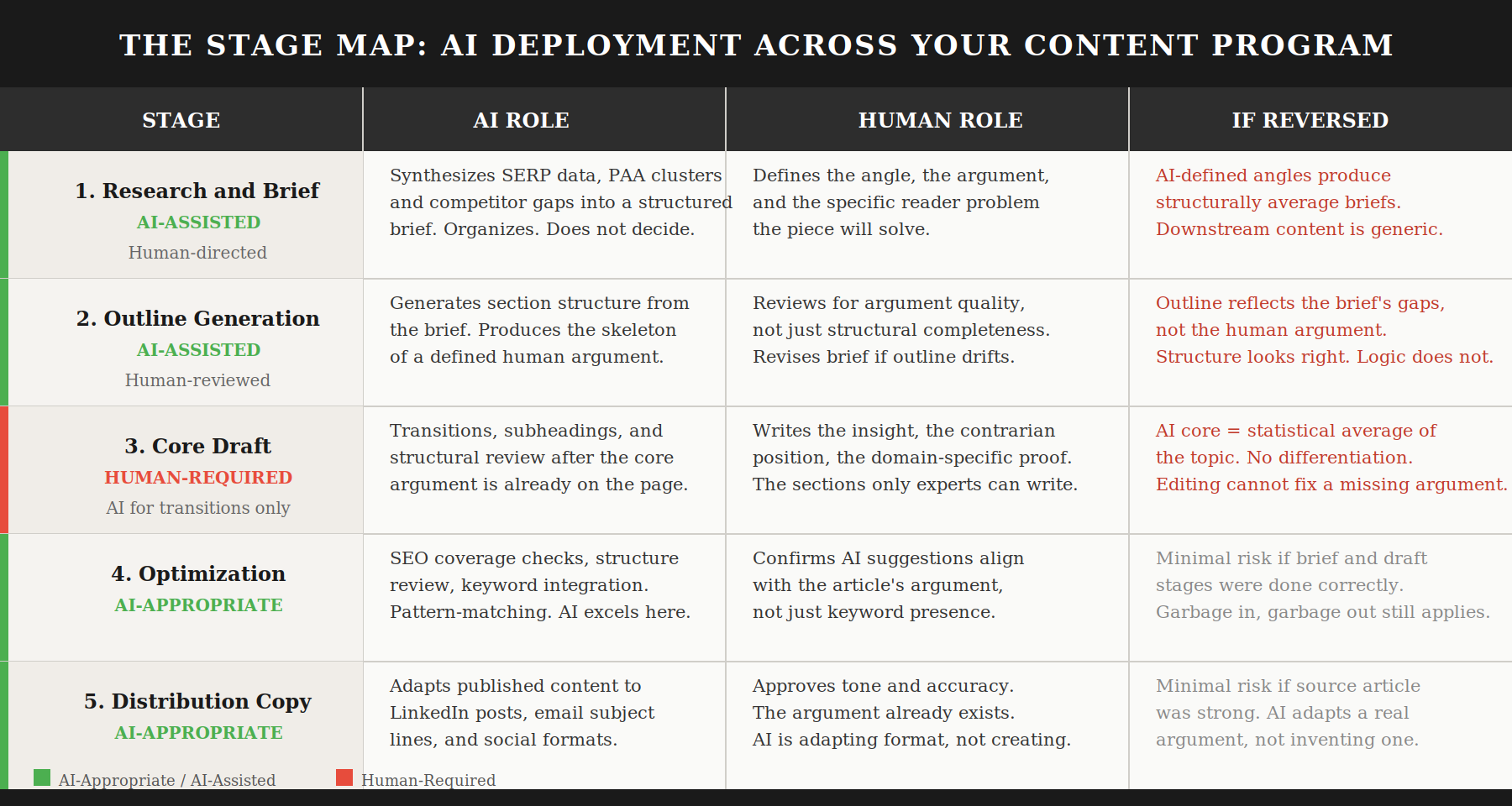
The Stage Map in practice covers five workflow stages.
Research and brief (AI-assisted, human-directed): AI synthesizes SERP data, PAA clusters, and competitor coverage into a structured brief. A human defines the angle, the argument, and the specific reader problem the piece will solve. The AI organizes. The human decides.
Outline generation (AI-assisted, human-reviewed): AI generates an outline from the brief. A human reviews it for argument quality, not just structural completeness. If the outline does not reflect the human argument from the brief, the brief needs revision, not the outline.
Core draft (human-required): The author writes the sections that require genuine expertise: the insight, the contrarian position, the specific examples, the sections that could not have been produced by someone who has not actually worked in this domain. AI can help with transitions and subheading suggestions after the core is on the page.
Optimization (AI-appropriate): Run the finished draft through SEO tools for coverage, structure, and keyword integration. This is pattern-matching work. AI does it well.
Distribution copy (AI-appropriate): Adapt the published piece into LinkedIn posts, email subject lines, and short-form social cuts. The argument already exists. AI is adapting it to format, not generating it.
For teams ready to operationalize this at volume, the guide on how to scale content production with AI covers the systems and tooling side in detail.
The decision table below maps each stage to its AI role, human role, and the failure mode when the designation is reversed.
The Brief Is the Leverage Point, Not the Tool
If there is one change a content team can make before anything else, it is this: stop using briefs designed for human writers and start writing briefs designed for AI execution.
A human writer uses judgment to fill in what a brief does not say. They know from experience what kind of angle works for this audience, what the competitor articles get wrong, and what the reader actually wants to know. A brief that says “write about AI content marketing strategy” is interpretable by a skilled writer. For an AI tool, it produces the statistical average of all articles about AI content marketing strategy.
An AI-ready brief specifies the argument in one sentence. It names what the article will not cover. It describes the one thing the reader should believe after finishing that they did not believe before. It takes longer to write than a traditional brief. It also produces dramatically better output at every downstream stage. The brief is where content quality is set. The AI tool is where it gets executed.
Here is a five-step diagnostic you can run against your current content program today.
1. Audit the last five pieces your team published with AI involvement. For each one, identify the stage at which AI was first used. If the answer is “before the angle was defined,” you have a deployment problem, not a prompting problem.
2. Pull organic performance data for AI-assisted versus human-written content from the last six months. Compare rankings, click-through rates, and time on page. Not word count or publication count. If the AI-assisted content is performing at the same level as the human-written baseline, it is not differentiated enough to matter.
3. Write the core argument of your next planned article in two sentences before opening any AI tool. If you cannot state the argument in two sentences, the angle is not defined yet. Return to research. AI will not find the angle for you.
4. Assign a brief owner for every piece. Their job is to define the angle, the reader problem, and the one thing the piece proves, before AI enters the workflow. This is a strategy role, not a writing role. It is the highest-leverage position in an AI-assisted content team.
5. Run one piece through the full Stage Map. AI for research synthesis and brief structuring. Human for the argument and core draft. AI for optimization and distribution. Measure that piece’s performance at 60 days against your AI-everywhere baseline. The gap will tell you whether the workflow change is worth making.
If you are still determining which tools belong at which stages, the AI content marketing tools breakdown is the right next stop.