
You’ve read the listicles. You’ve tried a free trial or two. You still have no idea which tool to actually use or whether any of it is worth paying for. The problem is not the tools. It’s that every guide treats tool selection as a catalog problem when it’s a sequencing problem. I’ve personally tested hundreds of marketing tools over several years, run content strategy for companies from a 1.5-million-user crypto SaaS to enterprise retail brands, and built Shnoco, a no-code community that reached 50,000 monthly readers, using exactly the kind of stack this article covers. Here’s the honest version.
Every List You’ve Read Made Your Decision Harder, Not Easier
The typical move is to search for “best AI marketing tools,” land on a listicle of 15 options organized by category, and spend the next two weeks signing up for free trials. Most people try two or three tools simultaneously. They use each one for a few days, never commit to a workflow, and eventually stop logging in. The tools expire or autocharge. They walk away with a longer reading list and no actual change to how they work.
This is not a discipline problem. It is a structure problem. When you add multiple tools to a workflow that is already fragmented, you do not get more output. You get more context switching, more logins to manage, and more time spent evaluating tools instead of using them. According to Gartner’s 2023 Marketing Technology Survey, organizations are using only 33% of their martech capabilities, down from 58% in 2020. That utilization gap does not improve at smaller organizations. It gets worse. A one-person business has no dedicated ops person to integrate tools, no IT support to maintain them, and no team to absorb the learning curve. Adding five tools in week one is not ambitious. It is friction.
The AI adoption in marketing statistics confirm a version of this at scale: a majority of businesses report using AI in at least one marketing function, but fewer than one in five have it genuinely embedded in a daily workflow that produces measurable output. The gap between “we tried it” and “we use it” is where most small businesses live.
I’ve watched this pattern play out repeatedly in advisory work with early-stage founders. The ones who start by picking one tool for one problem and using it daily for 30 days outperform the ones who sign up for five tools in the first week. Every time. The tool count is not the variable. The problem definition is.
Most AI marketing tool guides make your decision harder, not easier, because they are built to expand your list when your real problem is that you need to shrink it to one.
What a Real Utilization Rate Looks Like
The martech adoption statistics consistently surface the same pattern. According to B2B martech stack research from 2025, the average B2B organization now operates with 12 to 20 marketing technology tools, while data integration difficulties plague 65.7% of organizations, making it the top operational challenge in martech. For a larger team, this is inefficient but manageable. For a solo founder or a two-person operation, 12 or more tools means 12 renewal dates to track, 12 onboarding curves to absorb, and 12 places where something can break.
The small business AI tools problem is not a shortage of good options. It is that the default advice, here are 20 things you could try, makes the problem worse. The task that appears most frequently or feels most draining is the Bottleneck, and it is the only thing that should determine your first AI tool purchase, not a comparison chart.
The section below gives you a method for finding that bottleneck. Do that before you read the tool recommendations.
The Bottleneck-First Method: One Question Before Any Purchase
The default framing for AI tool selection is: what tools exist, and which ones are most popular? It is the wrong question. It produces a list, and lists are not decisions.
Bottleneck-First Method: the practice of identifying the single marketing task consuming the most time or creating the most friction before selecting any AI tool, then choosing exactly one tool that solves that specific problem before adding anything else.
The first question should be diagnostic, not comparative: what is the one marketing task consuming the most hours this week? A service business owner spending four hours per week on client email follow-ups has a different first tool than a product business owner spending three hours writing social captions. Neither of them should start with the same tool, regardless of what any comparison chart recommends.
The mechanism behind why this matters is simple. Tool fit is specific to bottleneck type. An AI writing assistant does not help if your bottleneck is not writing. It helps if your bottleneck is knowing what to write. A social scheduling tool does not help if your bottleneck is creating visuals. It helps if the creation is already done and the friction is coordination. When you skip the diagnostic and go straight to the tool, you often solve the wrong problem with a subscription you will resent in 90 days.
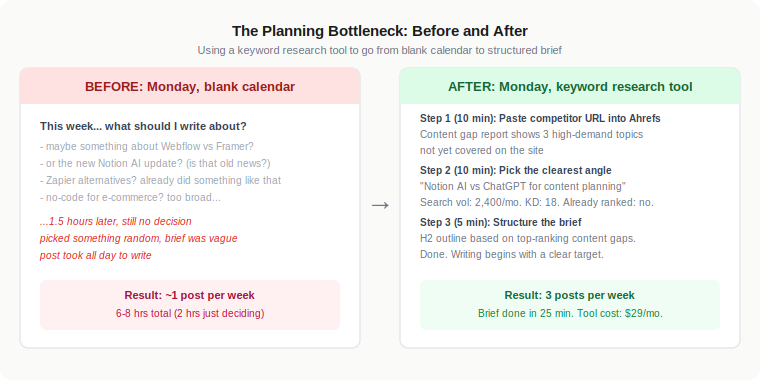
I ran into this directly when I was building Shnoco. The site covers no-code and builder tools, and I was personally reviewing and testing hundreds of them: writing genuine use cases, real tradeoffs, and honest takes on what was worth paying for. Early on, my biggest time drain was not the writing itself. It was the planning: staring at a blank content calendar every Monday, trying to decide which tool to cover, which angle to take, which search terms actually had demand. I was spending more time deciding what to write than writing. The fix was not a writing tool. In early 2021 I started using Ahrefs to solve this specifically. I would paste in a competitor’s URL, run a content gap report, and have three specific angles I had not covered within about 15 minutes. Structuring a brief from there took another five. Publishing frequency went from roughly one post per week to three within a month. The writing tool came later, as a second purchase, once the planning bottleneck was actually solved.
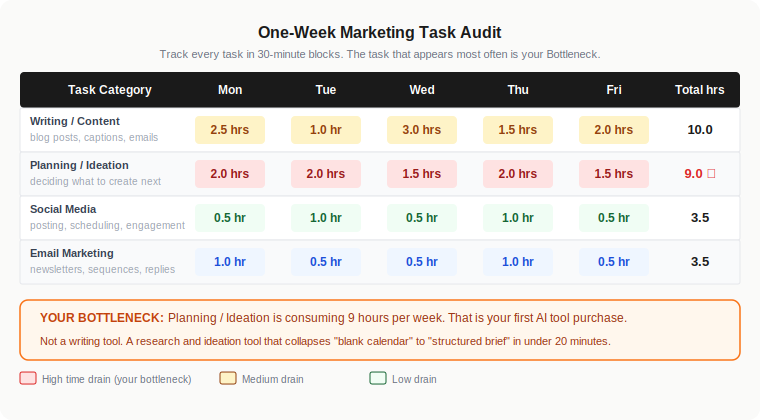
Run a time audit before buying anything. Track every marketing-adjacent task you do in 30-minute blocks for five working days. Write them down in a simple spreadsheet or even on paper. The task that appears most often or that you actively dread is your Bottleneck. That finding should drive your first purchase.
A Quick Diagnostic by Business Type
Different businesses have different default bottlenecks, and knowing your type speeds up the audit.
If you are a solo service provider (consultant, coach, freelancer, agency owner), your bottleneck is most likely content creation or client communication. You have ideas but not time to produce or distribute them. Start with the content creation category in the next section.
If you run a product business (e-commerce, physical goods, subscriptions), your bottleneck is most likely email marketing or social media. You have an audience but are not using it consistently. Start with the email category.
If you run a local business (restaurant, salon, clinic, retail shop), your bottleneck is most likely social content and online presence. You need a steady stream of visual content without a design background. Start with the design and social categories.
If you are building a SaaS or content-driven digital product, your bottleneck is most likely SEO and content strategy. You need organic traffic and do not yet have the volume to justify a dedicated hire. Start with the SEO category.
None of these are absolute. They are starting points. The audit is still necessary. But if you genuinely do not know where your biggest time drain is, this gives you a direction.
The Actual Short List, by Bottleneck Category
Most AI tool lists cover every category simultaneously. The result is a 3,000-word article where someone whose bottleneck is email ends up reading about AI ad creative tools designed for DTC brands spending $50,000 per month on paid social. That is not a useful article. It is a catalog.
The honest problem with recommending tools indiscriminately is that tool fit depends on what the tool was actually built for, at what scale, and at what budget. Jasper is built for marketing teams producing high volumes of content across multiple brands. It has templating features, team collaboration, brand voice settings, and workflow integrations that make sense if your team is publishing 20 pieces per week across five client accounts. For a solo founder publishing two blog posts per month, that feature set is overhead. Recommending it as a general-purpose AI writing tool is not lazy. It is counterproductive. The founder buys it, uses 10% of its capability, and concludes AI tools are not worth it. That conclusion is wrong but entirely understandable.
The short list below is built from years of testing tools personally for Shnoco: not reading vendor pages, but building things with them and watching where they break. It is organized by bottleneck category. Each entry covers what the tool does, who it is genuinely built for, its honest limitation at the small business stage, and whether the free tier is a real starting point or just a teaser.
Running AI-assisted SEO and content strategy for KoinX, a crypto tax SaaS with 1.5 million users, sharpened one observation I use as a filter for every tool recommendation: the AI tools that work in a small team context are the ones that collapse the distance between a problem and a structured response to it. They accelerate research and brief creation. They do not replace judgment. If a tool is being sold primarily as a replacement for human thinking rather than as a complement to it, it is usually the wrong tool for a small operator who cannot afford to outsource the judgment.
Content Creation: Start Here if Writing Is Your Bottleneck
The most common bottleneck for solo founders and small teams is content production. Not the ideas. The time it takes to turn an idea into a published piece.
The de-selection call first: If you are a solo founder writing fewer than five pieces of content per month, you do not need Jasper. Jasper’s Creator plan starts at $39 per month for a tool that does what ChatGPT does for $20 per month, with the added friction of a proprietary interface you will need to learn. Its differentiation is team collaboration features and enterprise integrations. At solo-founder scale, those features sit unused.
Start with ChatGPT. Use it for ideation, outlining, turning rough notes into structured first drafts, and repurposing a single piece across formats. The free tier is limited in speed and context window but usable for most writing tasks. The $20 per month Pro tier is worth it if you are writing three or more times per week. The improved model quality and longer context window materially improve output quality for longer-form work.
If you are already inside the Notion ecosystem for notes and project management, Notion AI ($10 per month as an add-on to a paid Notion plan) is worth evaluating because it works directly within your existing workflow rather than requiring a context switch to a separate tool. Its limitation is that it works best when given source material to transform. It is less effective as a from-scratch generator.
Read next: AI content marketing tools for a more detailed breakdown of content creation platforms by use case and team size.
Email, Social, SEO, and Design: The Rest of the Short List
For the remaining four bottleneck categories, the recommendation logic is the same: start with the free tier of the simplest tool that solves the specific problem, and do not add a second tool in the same category until the first one is producing consistent output.
Email marketing: If you have under 500 email subscribers, start with Mailchimp’s free plan. It handles up to 500 contacts and 1,000 sends per month, includes basic AI subject line suggestions, and requires no configuration expertise to use. The limitation to know: Mailchimp’s free plan has significantly reduced its features over the years, and its e-commerce segmentation is weak compared to tools built specifically for product businesses. If you sell products, start with Klaviyo instead. Its free plan covers up to 250 contacts and is built around purchase behavior and revenue attribution from day one. Skip HubSpot Marketing Professional entirely until you are running multi-channel campaigns with a team. Its starter-tier automation is useful; its Professional tier at $890 per month is not sized for small businesses.
Social media: Buffer’s free plan (3 channels, 10 scheduled posts per channel) is the right starting point for scheduling. Pair it with Canva’s free plan for visual creation. Canva handles 90% of small business visual content needs: social graphics, simple video clips, email headers, and basic ad creative. If AI caption generation is a specific bottleneck on top of scheduling, FeedHive at $19 per month adds that capability. Skip Hootsuite at this stage: its pricing starts at $99 per month for features that overlap heavily with Buffer at a fraction of the cost, and it discontinued its free plan in 2023.
SEO and content strategy: Google Search Console is free and should be the first SEO tool any small business installs, before any paid alternative. It gives you keyword performance data for your existing content and pages within 48 hours of setup. For keyword research and competitive analysis, Ahrefs Starter at $29 per month is the best value at the small business tier. Ahrefs released this tier in 2024 specifically to serve operators who needed keyword data without the full feature set of the professional tier. Semrush’s free plan allows 10 keyword queries per day, which is enough for monthly planning sessions. Skip Semrush Pro at $139.95 per month until you have at least 20 published pieces of content and a clear publishing cadence. The tool’s value compounds with content volume. At zero content, it is expensive research software with no place to deploy the findings.
Design and visual: Canva is the only recommendation here at the small business stage. Canva Pro at $15 per month unlocks the brand kit, background remover, and scheduling features that make it genuinely useful as a daily workflow tool. Adobe Express and Figma both require more design judgment than most small business owners have time to develop. The output difference between them and Canva does not justify the additional investment unless design is a core part of your business’s product.
Read next: AI email marketing tools for a deeper comparison of platforms at every pricing tier.
What a Real Stack Costs and What the Honest ROI Looks Like
Most AI marketing tool articles do one of two things with pricing. They list individual tool costs without ever adding them up, leaving readers to do the math themselves and often underestimating the total. Or they cite ROI statistics that no small business can actually replicate: percentages from enterprise deployments with dedicated automation teams and six-figure software budgets.
The result is that small business owners either overbuy (subscribing to four tools because each seemed affordable individually, never noticing that they are now paying $300 per month for tools running at 30% utilization) or dismiss the category entirely after pricing a mid-market platform and concluding AI marketing tools are out of reach. Both mistakes come from the same information gap.
Here is the real number: a genuinely useful AI marketing setup for a solo operator or two-person team costs between $50 and $150 per month at the growth tier. At the starter tier, the free plans across Mailchimp, Canva, Buffer, and ChatGPT get you a functional stack at zero monthly cost. The upgrade threshold is when a single subscription saves you three or more hours per week. That math works out quickly if the tool is solving the right bottleneck.
The harder question is ROI. And the honest answer is that revenue attribution at small business scale is unreliable. If you grow from 200 to 350 email subscribers over six months while using Mailchimp and also posting more consistently on Instagram and also improving your SEO, you cannot cleanly attribute revenue to any single channel. Anyone who tells you otherwise is selling something.
The correct measure is simpler. How many hours per week did this tool recover? Did those hours go to something higher value than the task the tool replaced? If you recovered two hours per week but spent one of them managing prompts and reviewing AI output, the net recovery is one hour. If that one hour goes back into client work at your hourly rate, the math justifies the subscription cost at any reasonable price point.
Budget for exactly three subscriptions to start. Pick three tools that each address a different bottleneck. Evaluate after 60 days with one question: are these tools actually embedded in a weekly routine, or are they sitting in browser tabs I open once a month? The ones embedded in routine stay. The ones that require periodic rediscovery do not.
The Three-Tier Stack: Starter, Growth, and When to Hire Instead
The “hire instead” row is the one most articles never show. There is a point at which adding another tool is the wrong answer. If you are managing five subscriptions, spending two hours per week reviewing AI output, and still feeling like your marketing is not working, the problem is not that you need a sixth tool. The problem is that you have reached the limit of what AI tools can do without someone providing the strategic direction behind them. That is when a part-time contractor or fractional marketer makes more sense than another subscription.
Start Here: A Five-Step Diagnostic
- Track every marketing task you do this week in 30-minute blocks. Write it down. Do not rely on memory.
- At the end of the week, identify the single task that appears most often or that you spend the most total time on. That is your Bottleneck.
- Match your Bottleneck to one category from Section 3 (content, email, social, SEO, or design) and start with the first recommended tool in that category only.
- Use the free tier of that tool for 14 days, applied exclusively to the Bottleneck task. Do not evaluate any other tool during this period.
- After 14 days, answer one question: how many hours did this recover per week? If the answer is two hours or more, subscribe to the paid tier. If not, try the next option in the same category before moving to a different category.
That is the Bottleneck-First Method applied. It takes 30 minutes to set up and eliminates the decision paralysis that most listicles create.
If you want help mapping your specific bottleneck to the right starting tool, reach out at shankar@shno.co.