
You brought AI into your marketing workflow and things moved faster. Then something slipped through: a fabricated statistic, a campaign that fired at the wrong moment, copy that passed every review and still read like a robot wrote it. That is not an AI problem. It is that the review process you are running was designed for human writers, not for the ways AI specifically fails. I have run AI-assisted content strategy for KoinX and personally tested hundreds of tools in the no-code and AI space. Here is where the real risk sits.
Most AI Marketing Failures Happen After Publishing, Not Before
Most marketing teams treat AI adoption as a production decision and leave the review process untouched. The workflow is: generate with AI, do a quick read, publish. The assumption is that a standard editorial pass will catch whatever the AI gets wrong, the same way it catches what a junior writer gets wrong. That assumption is what gets brands into trouble.
The biggest AI marketing risk is not that the AI will produce obviously bad content. It is that your review process was not designed to catch what AI gets confidently wrong.
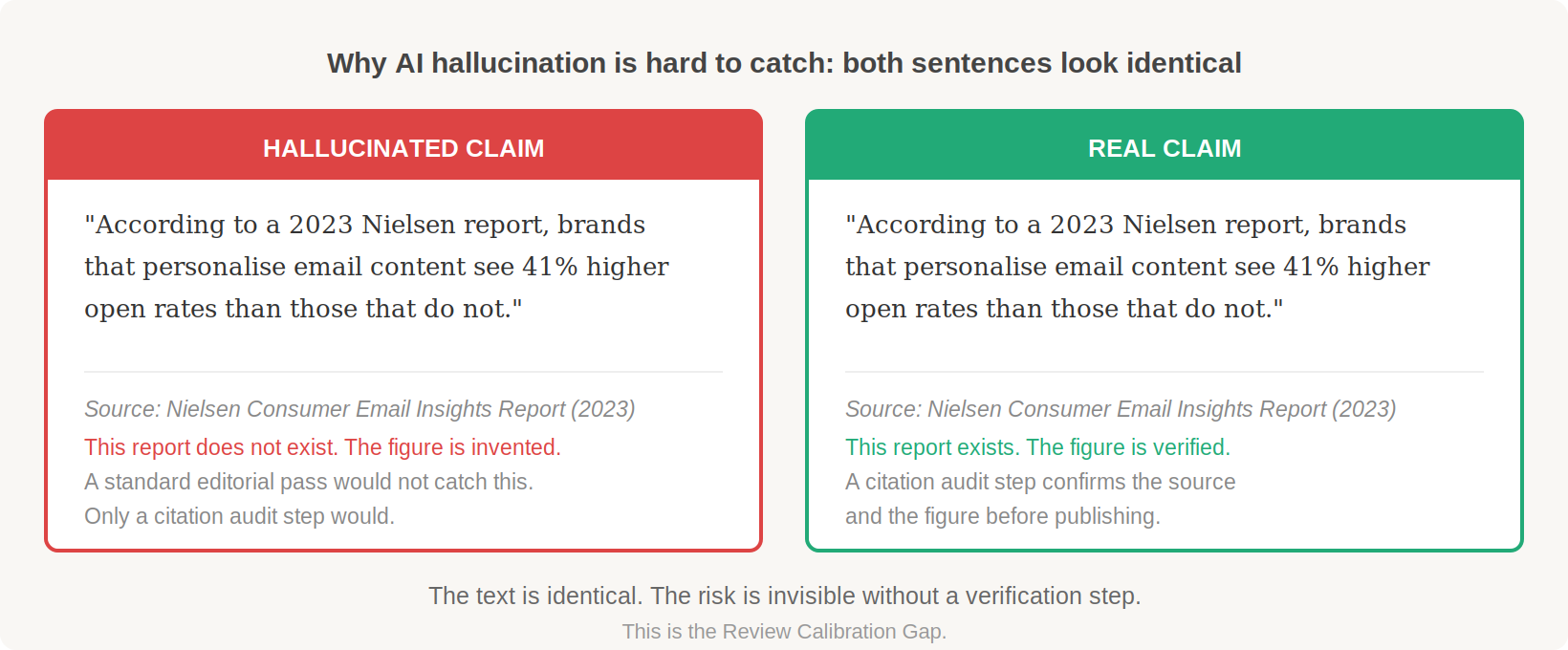
A human writer who gets a fact wrong usually gets the tone and context right. Their error is detectable because something else in the piece signals it. AI flips this. It gets the tone right and the facts confidently wrong. A hallucinated statistic reads identically to a real one in terms of sentence structure, confidence, and presentation. Standard editorial review checks for clarity, grammar, and general coherence. It does not check whether every cited figure points to a real source. That is the gap. The failure does not look like a failure when it passes review. It looks like a failure when a reader finds it and screenshots it.
The mismatch has a name: Review Calibration Gap: the mismatch between what standard editorial review is designed to catch (human writing errors) and what AI actually produces (confident factual misinformation that passes stylistic review).
Deloitte’s research on generative AI risks found that 77% of enterprise AI users are concerned “to a large extent” about hallucination risks in their AI deployments, yet most have not built a verification layer into their content workflows to address it. Microsoft’s 2025 workplace data puts a cost figure on this: knowledge workers now spend an average of 4.3 hours per week verifying AI outputs, a burden that compounds with every piece of unreviewed AI content that ships. The failure mode is widely acknowledged. The operational response is not in place at most teams.
The fix is not to stop using AI. The review process needs a second layer built specifically for AI output: a fact-verification step where every statistic, citation, and factual claim in an AI-produced piece is traced to a primary source before publishing. This is structurally separate from the existing editorial pass. It has a different objective and cannot be absorbed into a general re-read.
The most visible version of the Review Calibration Gap is what happens with hallucination. That is where it is worth spending time next.
Hallucination Does Not Look Like an Obvious Mistake
When marketers hear “AI hallucination,” most picture the AI producing something obviously wrong: a nonsensical sentence, a clearly invented name, a statistic so round it reads as approximate. The mental model is: review the draft, catch the obvious errors, publish. The problem is that this is not what hallucination looks like in a production context.
What makes hallucination dangerous in a marketing context is not that the AI says something implausible. It is that the AI cites a plausible, specific, authoritative-sounding figure that does not exist, or attributes a quote to a named source who never said it. The figure reads credibly. The structure is correct. The tone is confident. Nothing on the surface of the sentence flags it as invented.
The Sports Illustrated AI bylines incident is the reference case. In November 2023, AI-generated articles ran under fake author bylines, complete with AI-generated profile photos purchased from digital marketplaces. The content passed internal review. Readers and journalists, not editors, identified the problem. The Arena Group removed the content, terminated its contract with the third-party AI content vendor within days, and its CEO was out of the company weeks later. The editors were checking for what they always check for. They were not running a citation audit. That is the Review Calibration Gap playing out at scale.
I run SEO and content strategy for KoinX, a crypto tax SaaS with 1.5M+ users. The category is financially literate and regulatory-adjacent. A hallucinated statistic about tax liability thresholds or capital gains treatment does not just read wrong to this audience. It creates compliance exposure. Readers catch it fast, and they do not give the benefit of the doubt.
What this forced us to do is build the fact-audit habit from the start of the AI workflow, not as an afterthought. Every AI-produced piece that contains a specific claim, a percentage, a named regulation, a product feature, gets a citation pass before it moves to editing. Not because the AI is usually wrong. Because when it is wrong, it is wrong in a way that reads exactly like being right.
I have seen an AI draft a specific statistic with a plausible-sounding source name, correct citation format, and a figure that fit the article’s argument cleanly. The source did not exist. The figure was invented. The paragraph around it was otherwise accurate. A standard editorial pass would have published it.
The practical intervention is a citation audit step, not a general re-read. For every specific figure, study name, or attributed quote in an AI-produced piece, trace it to a named, accessible primary source before the piece publishes. If the source does not exist or does not say what the AI claims it says, the claim is removed or replaced. This step is separate from copy editing and cannot be delegated to the same person doing the stylistic pass.
Understanding the AI content generation process makes the hallucination mechanism clearer: the model is predicting the most plausible next token, not retrieving verified facts from a database. Knowing this changes how you think about the review task entirely.
Hallucination is the risk that surfaces fast because readers catch it. Brand voice drift is the risk that accumulates quietly and is usually harder to reverse.
Brand Voice Drift Is the AI Risk Nobody Tracks Until a Client Complains
Most teams believe they have the brand voice problem handled. They have given the AI a style guide, a few content examples, and a tone-of-voice brief. The assumption is that the AI has absorbed the brand voice from these inputs and will maintain it consistently at scale. In my experience, that assumption holds for about three to four weeks of production.
AI trained on a style guide reproduces surface patterns: vocabulary, sentence length, punctuation preferences. What it does not reproduce is the underlying reasoning that makes a brand voice feel distinct. The counterintuitive position. The dry observation. The specific way the brand acknowledges something most brands avoid saying. These are implicit. They are not in any style guide because the people writing the style guide do not think to articulate them. They just know when something sounds right and when it does not.
Then there is the compounding problem. Brand voice drift happens gradually. A single AI-produced piece reads fine. Twenty pieces read slightly flat. Fifty pieces and the content sounds like it was produced by a committee that understood the rules but not the spirit. Contently calls this tone drift: the phenomenon where “an AI’s voice gradually veers off-brand over time,” using phrases and structures that sound professional but do not sound like you. The damage accumulates before it becomes visible.
The Coca-Cola AI-generated Christmas ad became the reference case for this in late 2024. The ad was technically competent: correct colour palette, correct brand elements, correct product placement, trucks driving through snowy streets. What it lacked was the specific emotional warmth that made the original Christmas campaigns memorable, the thing that is too implicit to put in a brief. Audience reaction was pointed and public. Viewers called it “soulless” and “devoid of any actual creativity.” The campaign became a shorthand in marketing circles for what AI-assisted creative gets wrong when the brief captures what the brand does but not how it feels. The internal review process approved the ad. The audience rejected it.
I have run AI-assisted content for SaaS clients with technically literate, opinionated audiences. The risk in that context is not that any single piece reads wrong. The risk is that the content programme gradually loses the quality signal that makes it trustworthy to a specific reader. That signal is not recoverable with a style guide revision. It requires a human who knows the subject and the audience well enough to catch when the voice is going through the motions, even when no individual sentence is wrong.
A brand voice audit pass, separate from copy editing, on every fifth piece in a high-volume AI content programme addresses this. The auditor is not checking grammar. They are checking whether the content contains a position, an observation, or a specific piece of knowledge that an informed generalist could not have produced from 30 minutes of searching. If the answer is no for three consecutive pieces, the AI workflow is producing surface content, not brand content, and something in the brief or the oversight model needs to change.
Both hallucination and voice drift are problems that a better review process can catch. The reason most teams are still getting burned is that their review process was not built with either failure mode in mind. That is a fixable problem, but only if the fix is specific about what the two-pass model actually involves.
What an AI-Calibrated Review Actually Looks Like
The standard advice when marketers raise concerns about AI content quality is: “make sure a human reviews everything before it goes out.” This advice appears in almost every article on AI marketing risks. It is also the advice that consistently fails in practice, because a human reviewing AI content for grammar and clarity is not catching hallucination or brand voice drift. The review exists. The failure still happens. The problem is not the presence of a human reviewer. It is the objective they are reviewing for.
A general editorial pass is optimised for one objective: does this piece read well? It catches poor phrasing, grammatical errors, structural problems, and obvious factual howlers. It does not catch a plausible statistic that traces to a non-existent study, because that requires a different objective entirely: does every specific claim have a verifiable source? It does not catch tone drift, because that requires comparison across pieces over time, not evaluation of the single piece in front of the reviewer.
Two different failure modes. Two different objectives. The same review pass cannot address both, and the current industry default, a single editorial pass, addresses neither of the AI-specific ones.
At Hansa Cequity I spent two years in rooms where marketing decisions for brands like Westside, TataSky, and Axis Bank were made based on analytical output that had to be defensible. The standard applied to every client-facing document was specific: any number in the deliverable could be traced back to its source, named, and explained in a client meeting. You did not publish a figure without knowing exactly where it came from and what it meant.
That standard applies directly to AI-generated marketing content. If you cannot point to the source of a figure in an AI draft, that figure does not belong in the piece. This is not a new principle. AI makes it harder to apply because the figures sound as credible as ones that have been properly sourced. The principle is unchanged. The verification step has to become explicit rather than assumed.
The fix is a two-pass review model: one pass for factual accuracy, one pass for brand signal. These are different tasks with different objectives, and they cannot be performed by the same reviewer in the same read.
The One Situation Where Standard Review Is Enough
Not all AI content carries the same risk profile. Commodity content, product descriptions, structured data, highly templated formats with no original claims, carries low hallucination risk because it contains no original factual assertions. The AI is filling a format, not making a claim.
Any AI content that makes an original factual claim requires both passes. Content that contains no factual claims requires only the brand signal check. This keeps the model workable at scale. It is the right level of process for the actual risk level, not more process for its own sake.
Managing the AI marketing automation layer, particularly email sequences and campaign triggers, follows the same logic. The human checkpoint between AI generation and send exists not to catch grammatical errors but to catch the content that is contextually wrong for the moment: the tone-deaf message, the triggered sequence that fires during a public incident, the wrong product featured for the segment. No review process catches everything. A process calibrated to AI failure modes catches the ones that cost the most.
Read next: building AI marketing workflows covers how to design checkpoints into your AI workflow architecture from the start, rather than adding them after the first avoidable failure.
Here is what to act on today.
- Pull your last five AI-assisted published pieces. For each one, count the specific factual claims: statistics, citations, attributed quotes. Check whether each traces to a named, accessible primary source. If any do not, you have a fact-audit gap that has already published.
- Build a fact-audit step into your AI content workflow as a separate, named stage between first draft and publication. Assign it explicitly, to the editor or a second reviewer. Do not absorb it into the existing copy edit pass. These are different tasks with different objectives.
- Read your last ten AI-assisted pieces back to back. Ask one question per piece: does this contain a specific position or piece of knowledge that a generalist could not have produced after 30 minutes of searching? If fewer than seven out of ten pass, your AI workflow is producing surface content. The brief or the oversight model needs to change.
- For any AI-automated campaign, email sequences, social scheduling, triggered messages, identify the human checkpoint between generation and send. If there is no checkpoint, add one. The risk is not a grammatical error. The risk is a confidently wrong or contextually inappropriate message with no one watching.
- Set a calendar reminder for 90 days from today to re-run steps 1 and 3. AI risk in marketing does not resolve once. It compounds at the speed of your publishing cadence.
Two things this article leaves out deliberately: for the legal and regulatory dimension, FTC guidance, data privacy requirements, copyright questions, the AI marketing compliance piece covers that territory specifically. For ethical principles and responsible practice, AI marketing ethics addresses those questions separately.
If you want help building a calibrated review framework into your team’s AI workflow, you can reach me at shankar@shno.co