
Most AI marketing ethics guides hand you a principle list and stop there. You already know transparency, fairness, and accountability. The problem is not missing principles. It is that the industry has spent three years conflating legal compliance with ethical practice, and those are not the same thing. I spent a decade making real segmentation and targeting decisions for retail, FMCG, and financial services brands at Hansa Cequity, where these tradeoffs were not theoretical. This article draws the line the principle lists refuse to draw and gives you a test you can apply to a live campaign brief.
Compliance Is the Floor, Not the Ceiling
Most marketers I talk to have a version of the same answer when I ask how they handle AI ethics in their campaigns. They point to a GDPR-compliant consent framework. They mention the responsible AI policy that legal or HR approved last year. They say the campaign went through review. And they mean it sincerely. The compliance box is checked, so the ethics box is checked too.
That equivalence is the problem.
Compliance frameworks were built by lawyers to define legal exposure. They were not built to ask whether a targeting decision respects consumer autonomy, whether a personalization model creates genuine value for the customer, or whether an AI-optimized campaign exploits someone’s moment of weakness. A consent banner tells you a user clicked a button. It tells you nothing about whether they understood what they agreed to, or whether the AI used that data in a way they would recognize as fair.
It has never been sufficient proof of ethical behavior in any professional domain, and marketing is no different.
The rate of AI adoption in marketing makes this conflation not an edge case but a structural risk across the industry. According to Salesforce’s State of Marketing report, 75% of marketers are either experimenting with or have fully implemented AI in their operations, with one in five now allocating more than 40% of their marketing budget to AI-driven campaigns. At that scale, the gap between legally compliant and ethically defensible stops being a philosophical concern. It becomes a brand risk problem. The brands that have been caught running campaigns their customers would not recognize as fair have paid for it in customer trust data that is difficult to reverse.
Your AI marketing ethics framework is probably just a compliance checklist wearing an ethics costume, and that distinction matters because the practices it fails to catch are the ones that will actually harm your brand.
Before the next campaign launches, run two questions separately. First: is this compliant? Second: if a customer saw exactly what the AI was doing with their data and why, would they consider the use reasonable given what they thought they were agreeing to? If the first question has an answer and the second feels uncomfortable to ask, that discomfort is not a compliance gap. It is an ethics gap. Compliance will never close it.
The uncomfortable question is not abstract. There are specific practices running in AI marketing right now that pass every compliance review and fail every reasonable test of whether they are actually ethical.
The Practices Nobody Names
Every AI marketing ethics guide I have read describes risk in the same way. “Bias can emerge in algorithmic systems.” “Manipulation is a potential concern.” “Privacy may be affected.” These statements are technically accurate and practically useless. A marketer reading them walks away knowing that bad things can theoretically happen. They do not walk away knowing whether anything their team is currently doing falls into those categories.
Abstract risk descriptions give organizations permission to believe they are not the problem. When a guide says “AI can be used to target vulnerable consumers,” every reader nods and thinks of someone else’s campaign. Specificity is what creates accountability. When a practice is named, it can be recognized. When it can be recognized, it can be evaluated. The genre of responsible AI content has been systematically avoiding specificity, and the result is that specific harmful practices keep running because nobody has told a marketer what they actually look like in their own tools.
The evidence in marketing personalization statistics shows consumers are simultaneously more receptive to personalization and more sensitive to the perception that it crossed a line. The gap between those two responses is exactly where the unnamed practices live.
Here are three of them.
Vulnerability targeting. AI systems that infer emotional or financial distress from behavioral signals (late-night browsing, searches related to debt, job loss, illness, or relationship breakdown) and serve ads calibrated to that state. The data collection is covered by consent. The inference is the AI’s work. The targeting is optimized for conversion at the moment of lowest consumer resistance. Nothing in a GDPR-compliant framework prevents this. The campaign runs.
Discriminatory proxy targeting. AI models trained on historical campaign performance data can learn that certain demographic groups convert at lower rates and begin suppressing ads to those groups as a conversion optimization move. The protected characteristic is never explicitly in the model. The outcome is discriminatory. The DOJ settlement with Meta over housing ad discrimination established this pattern publicly, finding that Meta’s algorithms relied in part on characteristics protected under the Fair Housing Act to determine which users saw housing ads. It was the DOJ’s first case challenging algorithmic bias under the Fair Housing Act. The underlying mechanism is present in any conversion-optimized targeting system that is not explicitly audited for disparate impact.
Dark pattern personalization at scale. AI-driven interfaces that use behavioral data to identify decision-making friction points and then design experiences to move users past those points faster than they would move on their own. This is not persuasion. It is architecture designed to reduce deliberation time. The FTC’s report Bringing Dark Patterns to Light documented how companies increasingly deploy sophisticated design practices to manipulate consumers into payments, subscriptions, and surrendering personal data, a pattern now being scaled and accelerated by AI.
When I was building lifecycle campaign frameworks for financial services clients at Hansa Cequity, this distinction was not theoretical. The behavioral data was always there to target customers at moments of maximum financial stress. A customer whose salary account had just gone below zero. A customer who had just triggered a late payment on a credit product. These moments converted. The loan offer that reached someone during a salary shortfall produced a better response rate than the same offer sent mid-month.
The question I kept coming back to was not whether the targeting was legal. It was this: is a higher response rate in a moment of financial stress proof that we served the customer, or proof that we found them when their judgment was compromised? Those are not the same thing. The campaigns that held up under scrutiny were the ones where I could honestly say we showed up with something the customer needed at a time they could fairly evaluate it, not something they were least equipped to refuse. That distinction never came from the compliance framework. It came from asking a different question entirely.
When Personalization Becomes Exploitation
The scale of AI-driven personalization today, visible in AI personalization statistics, makes the ethical question not just philosophical but urgent.
Personalization and exploitation are not opposites. They sit on a spectrum. Personalization that reflects what a customer genuinely wants, at a moment when they are in a reasonable position to evaluate an offer, is valuable. It reduces irrelevance. It saves the customer time. It can serve their actual interests.
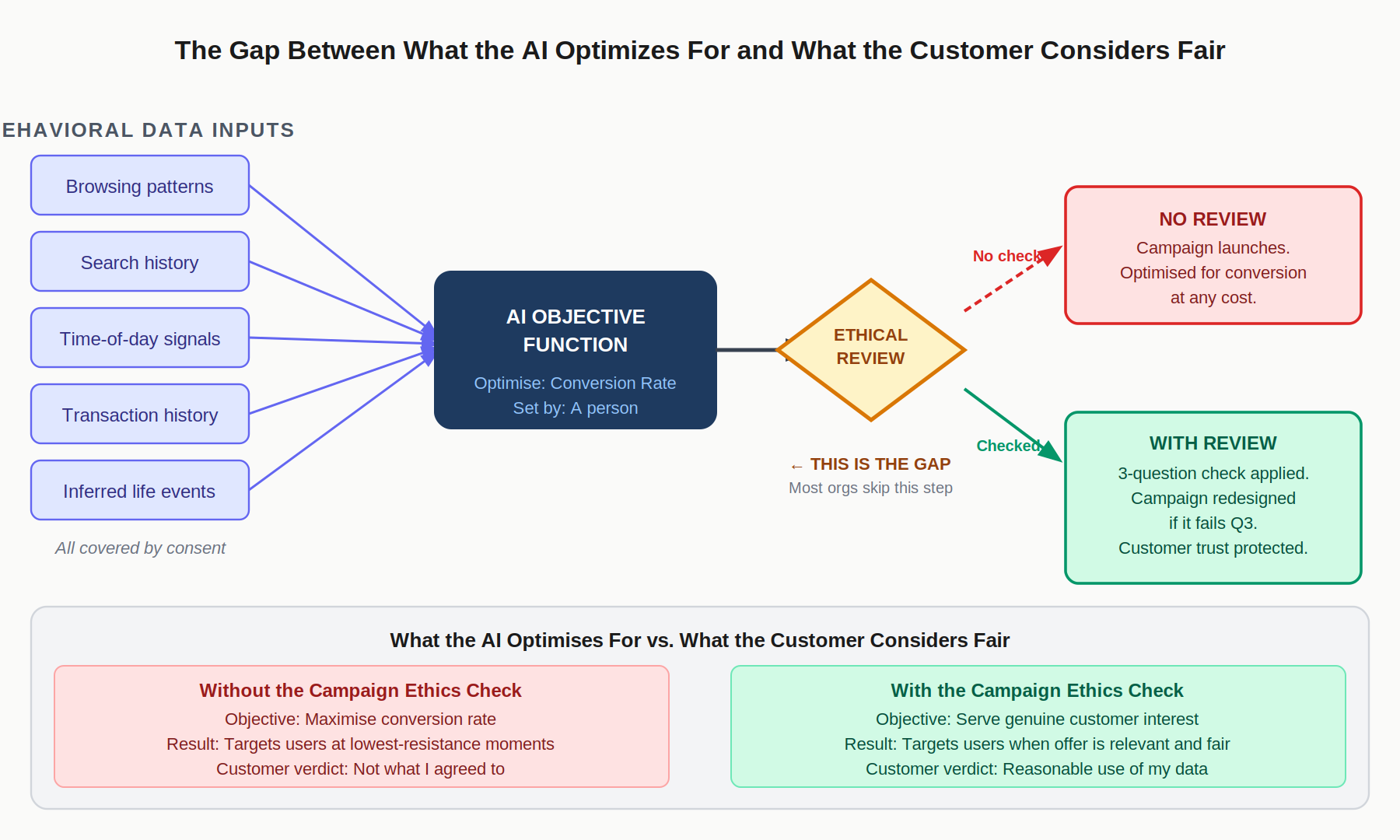
Personalization that identifies what a customer wants at the moment they are least equipped to evaluate it, then optimizes specifically for that moment, is exploitation. The data used in both cases can be identical. The AI model producing both results can be the same model. The difference is entirely in what the objective function was told to optimize for. And that decision was made by a person, not an algorithm.
The line between useful personalization and exploitation is not a technical question. It is a design question. Compliance frameworks are not built to answer it.
Naming the practices is necessary. But it does not solve the underlying problem. Behind every one of these practices is the same question: who was accountable for the decision that launched it, and who had authority to stop it?
Who Actually Owns This When It Goes Wrong
When an AI-driven campaign produces a discriminatory outcome, targets vulnerable users, or generates content that misleads customers, the organizational response follows a predictable script. “The algorithm did it.” “The model wasn’t trained to do that.” “We’ll retrain the system.” These responses have become a genre in AI ethics coverage. They are structurally identical to “the intern sent that email.”
The AI did not set the objective function. A person did.
The AI did not decide which datasets to train on. A person did. The AI did not define success as conversion rate instead of customer value. A person did. “The algorithm did it” is not an accountability structure. It is an accountability void dressed up as a technical explanation.
That matters in a practical sense. Organizations with no clear human owner for AI marketing decisions have no mechanism for catching ethical failures before they become public. They have no escalation path when someone on the team senses a campaign feels wrong. And they have no way to build the institutional learning that prevents the same failure twice. The accountability structures that work for data-driven marketing decisions generally are the same ones needed here: named owners, defined review criteria, and authority to stop.
Every AI-driven marketing system needs three named roles. A decision owner: the person who set the objective function and approved the data sources. A review owner: the person responsible for auditing outputs against ethical criteria, not just compliance criteria. And an escalation path: a named person with authority to pause or stop a campaign when the review owner raises a concern.
These are not new roles invented for AI. They are standard editorial oversight applied to automated systems. The same logic that requires a legal review before a campaign runs requires an ethical review before a campaign with AI-driven targeting, pricing, or personalization goes live. The difference is that the legal review has a named person and a defined process. The ethical review, in most organizations, does not.
The best client engagements I worked on had someone in the room who could say “that is not how we treat our members” and have that carry weight even when the conversion data said otherwise. At Hansa Cequity this came up repeatedly in loyalty and CRM work for large retail and financial services brands. That person was not always the most senior in the room. Sometimes it was a CRM analyst who had spent years reading customer feedback and could feel viscerally when a campaign was wrong. The title did not matter. The accountability structure did. Someone held the role of asking the question. Someone else had authority to act on the answer.
Before the next AI-driven campaign launches, answer three questions and put them in writing. Who set the objective function? Who reviews the outputs for ethical fit, not just legal fit? Who has authority to stop the campaign if the review raises a concern? If all three answers point to the same person or the same function, the accountability structure is a formality, not a check. The review and the decision need to be owned by different people.
The accountability structure answers who. The Campaign Ethics Check answers what they actually ask.
The Campaign Ethics Check
The existing approach to ethical review in most marketing organizations is binary: legal clearance. Did legal approve it? Then the campaign runs. Some organizations have added a second gate: does this violate our stated responsible AI principles? But principles written at the level of “we are committed to transparency” create a gate that is nearly impossible to fail. No campaign brief will ever say “we are committed to opacity.”
Binary clearance models assume that ethical failures are obvious enough to be caught by a compliance-trained eye. They are not. The most consequential ethical failures in AI marketing are legal, consistent with stated principles, and actively optimized for by the objective functions the marketing team built. They pass every existing checkpoint because the checkpoints were not designed to catch them. A checkpoint built to catch GDPR violations will not catch vulnerability targeting. A checkpoint built to confirm “we disclosed AI use” will not catch discriminatory proxy optimization. The checkpoint has to be designed to catch the actual failure modes.
The Campaign Ethics Check is a three-question framework applied to any AI-driven marketing decision before it launches.
- Is this compliant? Legal reviews the answer. Compliance is necessary. This question is not the end of the review. It is the beginning.
- If a customer saw exactly what the AI was doing with their data and why, would they consider this use reasonable given what they thought they were agreeing to? This is not a legal question. It is a reasonable expectations question. It does not require customers to have a technical understanding of machine learning models. It requires the marketer to be honest about whether the use matches the spirit of what the customer believed they were consenting to. If the honest answer is “probably not,” the campaign has an ethics problem that compliance cannot resolve.
- Does this campaign optimize for the customer’s genuine interest, or does it optimize for conversion at the cost of the customer’s judgment, wellbeing, or autonomy? This is the hardest question. It is also the one that compliance will never ask. A campaign that targets consumers at their lowest-judgment moment, uses dark pattern architecture to reduce deliberation, or exploits inferred vulnerability to drive a transaction fails this question regardless of what legal says. The objective function is what determines the answer, and the objective function is always a human choice.
Build the Campaign Ethics Check into your campaign brief as a required pre-launch section. Three questions. Named owners for each. The answers do not need to be long. They need to be honest. An answer to Question 3 that nobody in the room will say out loud is not a passing grade. It is the design problem the campaign needs to fix before it goes live.
How to Use the Campaign Ethics Check in Practice
Take a behavioral retargeting sequence for a financial services product. A realistic scenario.
Question 1 is straightforward. GDPR-compliant consent collected? Retargeting pixel declared in the privacy policy? Legal says yes. The campaign moves to the next gate.
Question 2 requires more honesty. The customer signed up for an email newsletter. They browsed three product pages. The AI inferred high purchase intent from late-night browsing patterns during a period of above-average session frequency. Does the customer know their browsing behavior at 1am is being used to identify a high-pressure targeting window? Would they consider that use reasonable given what they understood they were agreeing to when they ticked the cookie box? If answering yes requires a legal argument rather than a plain-language explanation, Question 2 is not passing.
Question 3 is the real test. What do the behavioral signals triggering the retargeting actually indicate? Genuine purchase readiness? Or financial anxiety and stress-driven browsing? If the objective function was optimized on conversion rate, and late-night browsing by users with financial stress signals converts better than daytime browsing by stable-income users, the AI has learned to find vulnerable moments. That is a Question 3 failure. The campaign needs a different objective function before it runs.
This review takes around 20 minutes. It catches what three years of compliance reviews missed.
Five things to do this week.
- List every AI-driven system currently running in your marketing operation: targeting, personalization, content generation, pricing, scoring, and automation. Write down the objective function for each one in plain language.
- Apply Question 3 of the Campaign Ethics Check to each system: does this optimize for customer value, or for conversion at the cost of customer judgment? If you cannot answer confidently, you do not know your own systems well enough to defend them.
- Identify which of your current campaigns would not survive Question 2: if a customer saw exactly what the AI was doing with their data, would they consider the use reasonable? The ones that cannot pass that question are your highest-risk assets right now.
- Name the three people who own compliance review, ethical review, and escalation authority for your AI marketing decisions. If those three roles collapse into fewer than three people or into the same function, the accountability structure is not working as a check.
- Build the Campaign Ethics Check into your next campaign brief as a required pre-launch section. Three questions. Named owners. If any answer produces something nobody in the room will say out loud, that is the design problem to fix before the campaign launches.
If you want to work through the Campaign Ethics Check against your current campaigns, reach out at shankar@shno.co.