
You started using AI for content and the output is technically fine. It answers the query. It hits the keywords. But it sounds like every other brand in your space. Your editor rewrites half of it anyway. The problem is not your prompts or your tools. It is that most teams deploy AI on the wrong content types, at the wrong stage of production. Understanding how AI content generation actually works is where that decision starts. I run content and SEO strategy for SaaS companies including KoinX and Fledge, and spent three years at GrowthMentor building their organic content engine. Here is what I have learned about the mechanics, and where the line between good deployment and bad deployment actually sits.
AI Generates Patterns, Not Perspectives
Most teams treat AI content generation as a faster version of human writing. Give it a topic, get back a draft that captures the brand’s thinking. The assumption is that the tool is generating their content, just more quickly.
That is not what is happening.
Large language models do not understand your brand. They predict the next most statistically likely word or phrase given an input, drawing on patterns learned from billions of documents. Most of those documents are generic marketing content. When you ask an LLM to write a post about, say, email marketing best practices, it does not ask what your brand thinks about email marketing. It asks what the average of all email marketing content it has ever processed looks like. The output reflects that average, not a perspective.
This is not a prompt engineering problem. It is not fixable with a better system prompt or a more detailed style guide. It is how the technology works. The model is doing exactly what it was built to do.
The practical implication: you are not choosing whether to use faster writing software. You are choosing whether the content you are about to publish needs a perspective, or just needs to be accurate. That is a different question. Most teams never ask it.
AI adoption in marketing has accelerated faster than the decision frameworks for using it well. Adoption tells one story. Effective deployment tells a different one.
The search data makes this concrete. A Semrush study of 42,000 blog pages from November 2025 found that human-written content holds a measurable SERP advantage across all top 10 positions, with the gap sharpest at positions 1 to 3. AI-generated content nearly doubles in prevalence between position 1 and position 4. The same study found 64% of SEO professionals use a human-led, AI-assisted workflow as their primary production model. Not AI-first. Human-led.
I see the same pattern at KoinX. I use AI tooling to compress the research and brief-creation stage, and in a crowded, compliance-sensitive category like crypto tax that compression is genuinely useful. But every piece that has moved rankings was written by a human taking actual positions on the topic. The AI-drafted content that went to publish without substantive editorial rework underperformed consistently. The signal showed up within two to three months of publication: traffic stayed flat, engagement was thin, and nothing accumulated the kind of authority that compounds. The pieces that were human-led from the start behaved differently. The pattern was not subtle.
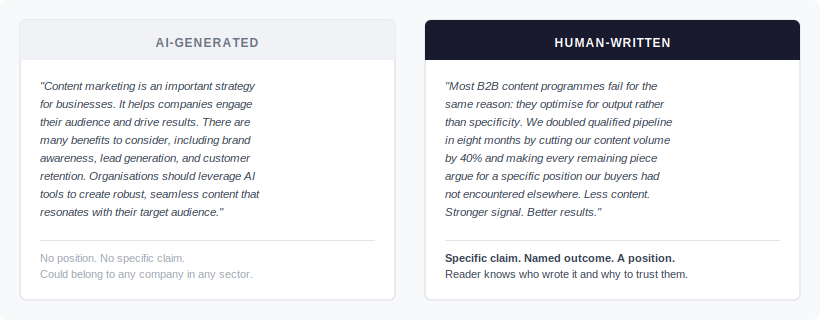
Treat AI generation as a research and structure tool, not a writing tool, until you can answer this question about any given brief: does this piece need to carry a brand perspective, or does it simply need to answer a query accurately? That distinction is where the deployment decision actually lives.
Infrastructure Content vs. Authority Content
Most teams make AI deployment decisions ad hoc. They use it for social captions because it feels low-stakes. They avoid it for case studies because it feels wrong. They make no consistent call on blog posts, email sequences, or landing pages. Every brief is a guess.
Ad hoc deployment has a predictable outcome. The content types where AI actively degrades quality get the same treatment as the content types where AI works fine. The result is a content operation where AI is quietly eroding the most valuable assets while marginally accelerating the least important ones. The weekly report looks good. The brand is getting flatter.
Working across content operations for KoinX, GrowthMentor, and Fledge, the pattern was consistent enough to become a working classification. AI generation performed well on informational, technical, and definitional content where the job was accurate query-answering. It performed poorly on anything that needed to carry a point of view, demonstrate lived expertise, or differentiate from a crowded competitive space. Those pieces required near-complete rewrites. The AI scaffold was structurally useful. The actual content had to be written.
That pattern has a name now.
Infrastructure Content is content where the primary job is answering a specific query accurately and completely. The reader is not choosing you because of how you said it. They needed an answer, you had one, and the quality threshold is accuracy. FAQ pages, technical how-to guides, glossary entries, product feature explainers, category-level descriptions, metadata. AI generation is appropriate here. The editorial layer is a fact-check and a light copy-edit.
Authority Content is content where the primary job is demonstrating expertise, establishing a position, and building the kind of trust that makes a reader choose you over a competitor who answered the same query. Brand voice is not a parameter here. It is the product. Thought leadership, opinion essays, original research, competitive takes, case studies, anything in YMYL (Your Money, Your Life) categories. AI generation is a liability here. The output will reflect the internet’s average position on the topic. That is precisely the opposite of what Authority Content needs to do.
The classification question for any brief: is the value in the answer, or is the value in who is giving it and how?
For brand-dependent work like ad headlines and campaign copy, AI copywriting sits firmly in the Authority category. The decisions there deserve their own treatment, but the classification logic is the same.
The short answer to which content types should not be AI-generated: anything that qualifies as Authority Content.
The real problem with most AI content generation is not the AI. It is that teams are applying it to Authority Content, the content that carries their brand’s actual value, while calling the generic output a time-saving win.
Human Oversight Is a Production Stage, Not an Afterthought
Every guide on AI content generation says “apply human oversight.” None of them say what that means in practice. So teams interpret it the way it sounds: have someone read it before publishing. Catch the obvious errors. Fix the worst phrasing. Move on.
That is a safety check. It is not oversight.
A safety check does not ask whether the content is achieving anything beyond basic accuracy. It does not ask whether the piece carries a brand perspective, makes an argument, or gives a reader a reason to trust the author over the eleven other articles on the same query. If the AI produced a bland but technically correct draft, and the editor fixed two typos and approved it, no oversight happened. The content is still the statistical average of the internet on that topic, with two fewer typos.
Consumer data confirms the gap between what teams are producing and what audiences are experiencing. A Bynder study of 2,000 UK and US consumers found that 50% can correctly identify AI-generated copy, and 52% say they would disengage if they suspected a brand’s content was AI-generated. The safety check is not catching the actual problem because the actual problem is not errors. It is the absence of a perspective.
Real editorial oversight for AI content requires three specific interventions. Most teams are doing none of them.
The brand voice test: read the paragraph out loud. Does it sound like us, or does it sound like every marketing blog that covered this topic this week? If the answer is unclear, the paragraph is not ready. This test is not about tone of voice guidelines. It is about whether a distinct human voice is present at all.
The position test: does this section make an argument? Or does it describe both sides and leave the reader to decide? LLMs default to both-sides summaries because the training data contains far more of them than decisive positions. Authority Content requires a position. If the section ends without one, the editorial layer missed its job.
The proof test: is the claim in this paragraph backed by something the author actually knows, or is it backed by “studies show”? AI defaults to the second. Readers are increasingly able to distinguish lived expertise from aggregated generalities. So are search engines.
I arrived at this three-test framework from a specific failure. At GrowthMentor, the content engine I helped build for three years depended on genuine depth: personal testing, real observations, the kind of specificity that makes people bookmark a page rather than close it. When I started incorporating AI drafts into the production workflow, pieces began passing internal review but underperforming on the metrics that mattered. Organic growth slowed on categories where I had introduced AI-drafted content. The safety check was fast. It did not catch the problem because it was not looking for perspectives. It was looking for errors. The three tests are what made the distinction between “this is publishable” and “this is ready” operationally clear, rather than instinctive.
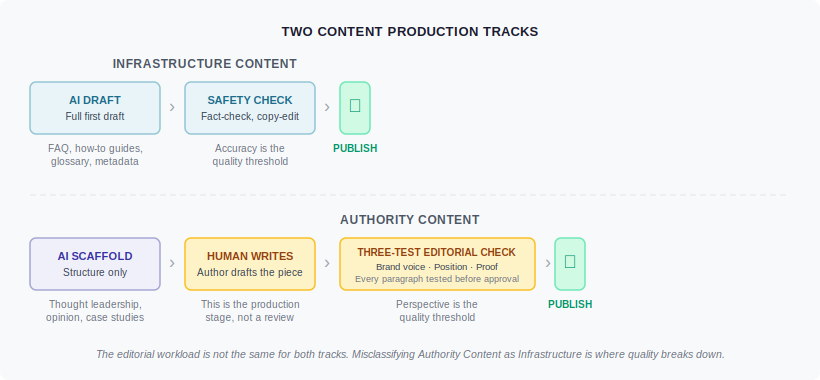
For Infrastructure Content, a safety check is the right level of oversight. For Authority Content, the editorial layer is not a review stage. The writer is not reviewing AI output. The writer is using AI output as a structural scaffold and writing the actual piece. That is what AI-assisted content means, and it is different from AI-generated content with a copy-edit on top.
What Consumer Sentiment Is Already Telling You
Most guides on AI content generation lead with the adoption numbers. How many teams are using AI. How much time it saves. How fast the market is growing. The picture they paint is one of universal acceleration with minor friction to manage.
There is another set of numbers most of those guides skip.
A Bynder study of 2,000 consumers found that 50% can correctly identify AI-generated copy, and 52% would disengage from content they suspected was AI-generated. Separately, a Gartner survey of 1,539 US consumers conducted in October 2025 found that 50% say they would prefer to do business with brands that do not use generative AI in their consumer-facing messages, advertising, and content. A further 68% say they frequently wonder whether the content they see online is real.
Those numbers look alarming until you map them to the framework. Nobody is rejecting an AI-generated FAQ page because it feels inauthentic. The rejection is concentrated in the Authority Content categories. Thought leadership. Brand perspective essays. Content where the reader showed up specifically because they wanted to know what the author thinks, not what the statistical average of the internet thinks.
The broader picture of how this is playing out across the industry is tracked in the AI content marketing statistics for 2026. The adoption side is there. So is the trust erosion. Both are real. The teams that are managing both are the ones who have segmented their content operation to serve both signals simultaneously.
The efficiency gains on Infrastructure Content will not offset the brand trust loss on Authority Content if you have misclassified either.
Before scaling AI content generation, run this diagnostic: which pieces in your content operation does your audience read to learn your brand’s position on something? Those are Authority Content by definition. It does not matter how you have been producing them. If AI is generating them, that is the highest-priority correction in your content operation.
Where to Start on Monday
You do not need to rebuild your content operation overnight. Five actions will make the Infrastructure vs. Authority classification real in your workflow.
- List your top 20 published pieces by organic traffic. For each one, ask the classification question: is the value in the answer, or in who is giving it and how? Mark each as Infrastructure or Authority. This is your baseline.
- For every piece you classified as Authority Content, check how it was produced. If AI drafted the full piece and a human copy-edited it, you have a brand signal problem that may already be visible in your engagement and ranking data.
- Set a written rule for new content briefs. Infrastructure Content briefs go to AI-first production with a safety-check editorial layer. Authority Content briefs go to human-first production with AI used for research and structural scaffolding only. Write it down. Ambiguity here is expensive.
- Run the three-test editorial check on your next five AI-drafted pieces before they publish. Brand voice test. Position test. Proof test. Count how many paragraphs fail at least one. That number tells you whether your current editorial layer is overseeing or just approving.
- Audit your thought leadership specifically. Anything published under your brand as a named perspective on an industry question is Authority Content. If AI is generating it, that is the reclassification to make first.
Read next: scaling content production with AI, for the operational decisions that follow once you have the classification framework in place.