
You have added half a dozen AI tools to your marketing stack this year. The contracts are signed. The privacy policy is updated. You are reasonably sure you are covered. You are probably not. The compliance problem in AI marketing is not that marketers ignore the rules. It is that they outsource accountability to vendors who cannot legally accept it. I spent a decade in enterprise customer data strategy and now advise SaaS companies on growth. The liability gaps in this article are not hypothetical.
The Regulatory Map: Which Laws Actually Reach Your AI Marketing Stack
Most compliance content treats regulations like a geographic menu. GDPR if you have EU users. CCPA if you have California users. EU AI Act if you deploy AI systems. The implied logic is that you identify which one applies to your situation and focus there.
That logic is wrong, and it is expensive to learn the hard way.
The three major frameworks governing AI marketing right now do not replace each other. They govern different things, and they stack. GDPR governs the collection and processing of personal data: what you need to collect it lawfully, how long you can keep it, and what rights individuals have over it. The EU AI Act governs how AI systems must behave when they interact with consumers, what disclosures they require, and what obligations fall on the organizations deploying them. California’s ADMT regulations, approved by the California Office of Administrative Law in September 2025 and effective January 1, 2026, govern consumer rights to opt out of AI-driven decisions that affect them, with full ADMT consumer rights compliance required by January 2027.
The compliance obligation is not a menu. It is a stack.
If your marketing reaches EU visitors and California residents, which describes most SaaS products and e-commerce brands, all three frameworks apply at the same time. Each adds its own layer on top of the others. The EU AI Act’s transparency obligations for general-purpose AI models became effective in August 2025. If you are using GPT-4o, Gemini, or similar models to generate consumer-facing marketing content, you are a deployer under that regulation right now, whether your legal team has reviewed it or not.
Here is how the three frameworks divide their territory in a marketing context:
According to the IAB State of Data 2025, 58% of organizations cite legal governance and compliance as a top challenge for AI adoption. In my experience, the bottleneck is almost never a lack of awareness that regulations exist. It is the assumption that one framework covers everything, or that your geography puts you outside the relevant ones.
What the EU AI Act August 2025 Milestone Actually Changed for Marketers
The EU AI Act is not a future risk for most marketing teams. Parts of it are already in force and already relevant to decisions being made today.
The prohibition on high-risk AI practices took effect in February 2025. Transparency obligations for general-purpose AI models, including requirements to label AI-generated content so that it can be identified as such, became effective in August 2025. For marketing teams, the practical obligations from that milestone are:
- Interactive AI systems, including chatbots and virtual assistants, must disclose their AI nature at the start of any consumer interaction, without waiting for the consumer to ask
- AI-generated or substantially AI-altered visual content depicting real people requires explicit labeling
- Providers of general-purpose AI models must publish summaries of training data used, which affects how you assess the tools in your stack
The EU AI Act applies to organizations deploying AI systems that affect EU residents, not only to organizations based in the EU. A US-based SaaS company running an AI chatbot on its website or generating AI-written emails to EU customers falls within scope. Penalties for serious violations can reach €35 million or 7% of global annual turnover, whichever is higher.
For the broader question of what responsible AI marketing practice looks like beyond legal requirements, the AI marketing ethics framework covers the voluntary governance territory that sits adjacent to these legal obligations.
Knowing which regulations apply is the starting point. The harder question is what your actual obligation looks like once the vendor contracts are signed.
The DPA Misconception: Why Your Vendor Contract Does Not Cover What You Think It Does
Ask a marketing team if they are compliant and the most common answer is: “Yes, we have DPAs in place with all our vendors.” They say it with confidence. Legal reviewed it. It is in the contract folder.
This is the most common and most costly compliance mistake I see in AI marketing stacks.
A Data Processing Agreement documents one specific thing: it records that your vendor is acting as a data processor on your behalf, and it sets out the rules for how they handle the data you pass to them. What it does not do is transfer your data controller obligations to the vendor.
Here is the mechanism that matters. As the data controller, you are the entity that determines the purpose and means of processing personal data. The vendor, as your processor, executes on your instructions. GDPR places the primary compliance burden on the controller. If the processor makes a mistake, you are still accountable for having failed to exercise adequate oversight over them. The DPA is not a liability shield. It is documentation of the split in roles.
The CPPA’s May 2025 enforcement action against clothing retailer Todd Snyder made this explicit. Todd Snyder had deployed a third-party consent management platform and assumed the compliance obligation was handled. The platform was misconfigured and failed to process opt-out requests for 40 days. The CPPA fined the retailer $345,178. The head of the CPPA Enforcement Division stated directly that using a consent management platform does not get you off the hook for compliance, and that the buck stops with the businesses that use these tools. Todd Snyder remained the data controller. The data controller remained liable.
A signed DPA does not transfer your data controller liability. Enforcement cases prove it. The contract is documentation of the split, not a transfer of the obligation.
I have seen this play out in advisory work. I run marketing stack audits for SaaS clients as part of early engagement, and the pattern is consistent. While auditing one company’s AI marketing setup, I found a consent tool that was correctly enabled in the platform dashboard. The DPA was signed. The team was confident opt-outs were being honored. I ran an actual test: submitted a real opt-out request through the consent flow and then checked whether behavioral data was still being sent to downstream ad platforms.
It was. Two platforms were still receiving behavioral signals for opted-out users. The configuration was wrong. The tool was technically live but not functioning correctly. Nobody had tested it because the DPA felt like sufficient coverage. It was not.
This pattern goes back further than AI tools. At Hansa Cequity, where I worked on CRM and customer data strategy for brands like Westside, TataSky, and Fossil India at scale, the gap between “configured” and “functioning correctly” was a constant operational risk. The same problem appears in AI marketing stacks today, just with more tools, faster deployment cycles, and higher regulatory stakes.
The customer trust data is consistent on this point: a single documented compliance failure does not just generate a fine. It generates evidence of organizational negligence that is difficult to undo with customers and that regulators reference in subsequent encounters.
Three things need to happen after a DPA is signed. First, request and review the sub-processor list. Every vendor you sign a DPA with has their own chain of processors, and data can travel further than the original agreement covers. Second, test the privacy and consent features in your live environment, not in the vendor’s demo. Third, document that you conducted this review. The documentation is what separates demonstrable due diligence from assumption in an enforcement context.
Read next: AI marketing risks
The Pseudonymization Gap: Why “Anonymized” Behavioral Data Often Is Not
Here is a scenario I run into regularly. A marketer is evaluating an AI personalization or segmentation tool. The vendor documentation includes a line: “All customer data is anonymized before processing.” The marketer reads this and assumes GDPR does not apply to what the tool does with that data. They remove it from their consent flows. They do not run a Data Protection Impact Assessment. They treat it as out of scope.
The assumption is almost always wrong.
Anonymization under GDPR means the data cannot be re-identified by anyone, ever, under any reasonably likely circumstance. This is an extremely high legal bar. It requires that no additional information exists, held by anyone, that could be used to link the data back to a real individual. Data that genuinely meets this standard falls outside GDPR scope entirely.
What most AI marketing tools actually perform is pseudonymization. They transform data so that it cannot be directly linked to a named individual without additional information, but that additional information still exists somewhere. Hashed email addresses, tokenized user IDs, cookie identifiers, and device fingerprints are all pseudonymous, not anonymous. The additional information needed to re-identify the individuals is present, either in the vendor’s systems, in your CRM, or in both.
GDPR Article 4 is explicit: pseudonymized data remains personal data and all GDPR obligations continue to apply. Purpose limitation, data minimization, right to erasure, and consent or lawful basis requirements are all still live for pseudonymous data.
If your AI vendor cannot tell you whether user data is anonymous or pseudonymous under GDPR Article 4(1), assume it is pseudonymous and maintain full GDPR compliance posture for that processing activity.
I have not encountered a marketing AI tool that achieves true anonymization of behavioral data. The reason is architectural: if the data were truly anonymous, the tool could not do what it is built to do. AI personalization requires re-identification at the system level to serve the right content to the right user. Behavioral targeting requires persistent user identification across sessions. The anonymization claim in vendor documentation almost always describes a pseudonymization step. That is not a criticism of the vendor. It is a statement about what the product must do to function.
The practical fix is a single question, sent in writing to each AI marketing vendor: “Is the user-level data processed in your system truly anonymous under GDPR Article 4(1), or is it pseudonymous?” Document the response. If they cannot answer clearly, default to treating it as pseudonymous.
This affects three things: your consent flows (behavioral data processing likely requires explicit consent or a carefully documented legitimate interest assessment), your right-to-erasure obligations (users can request deletion of their pseudonymous behavioral profile), and your DPIA requirements (AI systems processing pseudonymous personal data at scale often require a formal assessment).
Fixing the pseudonymization gap requires one question per vendor. Fixing the broader accountability picture across your whole stack requires a more systematic approach.
The Controller Accountability Map: A Practical Framework for Your AI Stack
The typical response when legal asks whether the marketing stack is AI-compliant is to update the privacy policy, refresh the consent banner language, and send a note to the team reminding them to be careful with customer data. None of this is wrong. None of it answers the question.
Compliance exposure does not come from outdated policy language. It comes from a specific processing activity, performed by a specific tool, on specific data, without the correct legal basis, oversight, or disclosure in place. A privacy policy update addresses the visible surface. The Controller Accountability Map addresses the source.
The map works because it forces a tool-by-tool answer to a question most marketing teams have never explicitly asked: what is my legal role in each vendor relationship, and what does that role require of me?
Three roles matter under the frameworks governing AI marketing. As a data controller, you determine the purpose and means of processing and bear full accountability for outcomes. As a co-controller, you share accountability with the vendor for jointly determined processing purposes. As a deployer under the EU AI Act, you are responsible for ensuring an AI system is used appropriately even if you did not build it. The deployer role is new enough that most marketing teams have not classified themselves as such for any of their tools, even though most AI marketing tool users are deployers by definition.
Most marketing teams do not know which role they occupy for each tool in their stack. That is the gap the map closes.
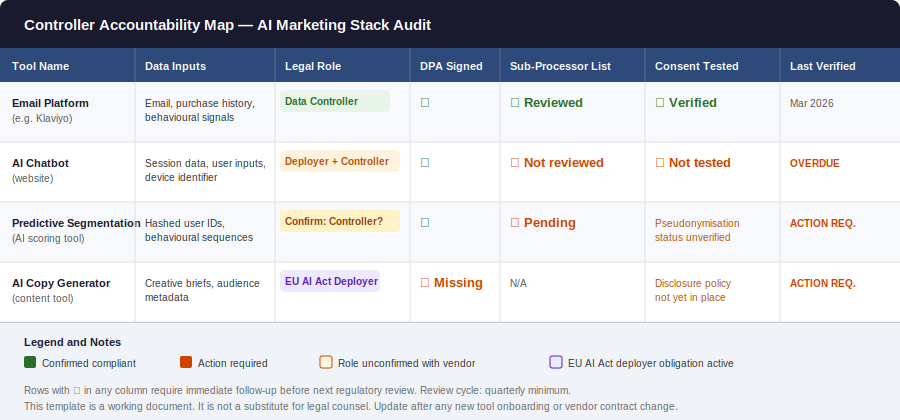
Controller Accountability Map: a tool-by-tool audit record that documents each AI marketing tool’s data inputs, the marketer’s legal role for that processing activity, the applicable lawful basis or disclosure obligation, and the last review date.
Here is what the map looks like in practice, with four common AI marketing tool categories as example rows:
I run this exercise with every advisory client as a first-pass audit. Take every AI tool in the marketing stack. Classify the role. Identify what that role requires. Flag tools that do not have a documented lawful basis, a verified sub-processor list, or a tested consent mechanism. The output is always the same: three or four tools that everyone assumed were covered and are not.
For AI marketing automation workflows specifically, the map applies to each automated flow individually. A single automation platform may have you operating as a controller for some activities and a deployer for others, depending on whether the platform’s AI is making decisions about processing or simply executing your instructions.
What the Disclosure Obligation Actually Requires for AI-Generated Marketing Content
The most common practical question I get after walking through the regulatory map is: do I need to disclose every time I use AI to write an email, a landing page, or a social post?
The short answer: not for all static AI-generated content, but more than most teams are currently doing.
The EU AI Act creates clear disclosure requirements in two scenarios. Interactive AI systems, including chatbots and virtual assistants, must disclose their AI nature at the start of any consumer interaction. This is not dependent on the consumer asking, and it is not satisfied by a buried footnote. Any AI-generated or substantially AI-altered visual content depicting real people also requires explicit identification.
For AI-generated text content such as email copy, ad headlines, or landing page body text, the EU AI Act does not currently require per-piece labeling for marketing content that is not presented as human-authored. The FTC standard applies here: under Section 5 of the FTC Act, if non-disclosure of AI use would influence a purchasing decision, the omission may constitute a deceptive practice.
The working standard I use with clients: generic footer or privacy policy disclosure for AI-assisted copy generation; explicit in-interaction disclosure for any chatbot or AI-driven conversation tool; and explicit labeling for any AI-generated creative that depicts real people or could reasonably be mistaken for authentic human-created media.
Here is where to start today, in order.
- List every AI tool your marketing team uses that touches customer data. This includes the obvious tools (CRM, email platform, ad networks) and the ones that get overlooked (AI copy generators, chatbots, predictive scoring tools, personalization engines). Write the list down before doing anything else.
- For each tool on the list, classify your legal role: data controller, co-controller, or deployer under the EU AI Act. If you are genuinely unsure, default to data controller until you can confirm otherwise with the vendor.
- Pull the signed DPA for each tool and locate the sub-processor list. If there is no sub-processor list, request one. If a vendor will not provide one, treat that data flow as unaudited and unverified.
- For each tool that processes behavioral data, ask the vendor in writing whether user-level data is truly anonymous under GDPR Article 4(1) or pseudonymous. Document the response.
- Test your consent and opt-out mechanisms end to end. Submit a real opt-out request and verify it is processed correctly through to every downstream platform. Do not assume it works because it was configured correctly several months ago.