
You set up the automation. Ran it for two weeks. Then it started breaking in ways you couldn’t predict, and fixing it took longer than just doing the task manually. The problem is not the tool you picked. The problem is that the underlying process was not clean enough to hand off in the first place. I’ll walk you through a framework for identifying which marketing tasks are actually ready to automate, built from a decade of marketing ops work for brands like Westside and TataSky and, more recently, from building my own AI-assisted content systems at Shnoco and KoinX.
Most AI Workflow Failures Are Process Failures, Not Tool Failures
When an automation misfires, the debugging instinct is to look at the tool. Wrong trigger. Broken integration. Drifted prompt. These are worth checking. They are almost never the real cause.
The real cause usually lives one step earlier: a process that was ambiguous before you handed it to the machine.
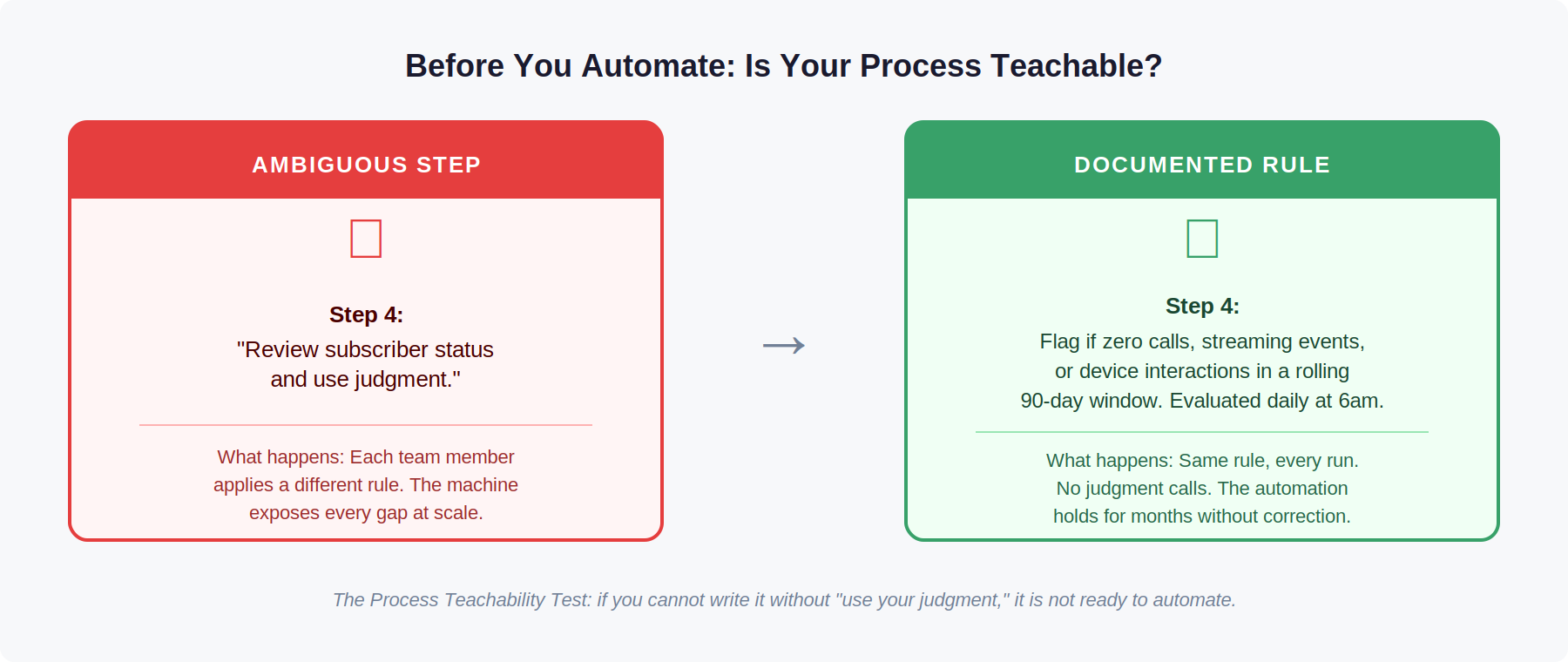
When I was at Hansa Cequity, working on CRM automation for TataSky’s subscriber base of 12 million customers, we set up a re-engagement trigger for subscribers who had gone inactive. The automation misfired from the first run. Subscribers who had interacted recently were still being flagged. Others who clearly qualified were not. We spent two days inside the platform looking for the bug. There was no bug. The problem was the word “inactive.” Everyone on the team was applying a slightly different definition. Nobody had ever written down the exact rule. The automation followed whichever version appeared in the brief, which turned out to be inconsistent in ways we had not noticed until the machine exposed every single gap at scale.
Once we replaced the ambiguous definition with a precise if-then condition (no call, no streaming activity, no device interaction in a rolling 90-day window, evaluated daily at 6 a.m.), the campaign ran cleanly for the next six months without a single manual correction.
AI amplifies whatever process you give it. A clean process becomes faster. An ambiguous process becomes consistently wrong, faster.
Most companies still pilot AI for individual tasks without achieving workflow-level scale, and the bottleneck in most cases is not technology access. It is documentation. The same research estimates that 10 to 15 times faster campaign execution is achievable for teams that rebuild their processes before adding the automation layer. The teams missing that result are not using worse tools. They are using good tools on undocumented processes.
The reason most AI marketing workflows fail within 60 days is not the tool choice. It is that the underlying process was never documented well enough to automate in the first place.
The fix starts before you open any automation tool. Write down every step of the process as if you are briefing a new hire who has never done it before. If you find yourself writing “use your judgment” or “it depends,” stop there. That step is the bottleneck. Fix the documentation. The tool comes after.
Workflow automation adoption and ROI data shows the productivity gap between teams with clean process foundations and those without is not marginal. It is the difference between a workflow that compounds for months and one that needs constant maintenance.
The question is not whether your process is automated. It is whether your process is teachable.
The Process Teachability Test
Repetitive is not the same as automatable. This is where most first workflow attempts break down, and it is more insidious than the tool selection problem because it looks solved right up until it isn’t.
A task can repeat every day and still contain invisible judgment calls. Content scheduling looks mechanical until you realize the person doing it is silently checking brand tone against recent news, timing the post relative to a competitor’s announcement, and deciding whether the piece still fits the current campaign phase. None of that is written anywhere. The moment automation takes over, all of it disappears. The system runs on schedule and produces the wrong thing, consistently, because the rules it was given were incomplete.
I ran the Shnoco content process manually for eight months before automating any part of it. Deliberately, not because I lacked tools or time. I needed to discover every edge case before handing anything to a system. Every article, every tool categorization, every use case decision was done by hand. By month eight I had 23 documented rules: what qualified a tool for a full review versus a mention, how to handle a tool that fit three categories simultaneously, how to frame a use case for a tool I had tested personally versus one I had researched but not built with. When I finally automated the brief compilation and categorization layers, they ran cleanly from the first week. Not because the tool was well-chosen. Because the process was clean enough to teach.
AI marketing automation benchmarks consistently show that teams with documented process foundations before automation see higher sustained productivity gains than those who automate first and document reactively. The gap shows up at month three and four, when the latter group starts spending maintenance time that the former group does not.
The Process Teachability Test: a workflow is automation-ready only when it can be explained to a new hire in one sitting, with no judgment calls left unresolved.
Three questions, applied before touching any tool:
- Can you write every step without using the words “depends” or “use your judgment”?
- If a new hire followed these steps on day one, would the output be correct nine times out of ten?
- Does the process produce the same output from the same input, every time?
If all three answers are yes, the task is a candidate for automation. If any answer is no, the process needs more documentation before the tool matters at all.
“Start small” is the advice everyone gives. The one piece of AI workflow advice that actually stuck across multiple Reddit communities lands the same way: pick one specific task, automate just that. The Process Teachability Test is what “one task” actually means. Not short. Not simple. Precisely defined, with no implicit decisions hiding inside it.
Your First Workflow Should Hurt the Most and Surprise You the Least
The first AI marketing workflow most people try to build is the most visible one. AI-generated content at scale. Multi-channel campaign orchestration. Personalized email sequences. These look the most impressive in demos. They also fail the hardest in production.
The reason is density. High-visibility workflows contain the highest concentration of implicit decisions. Content generation requires brand voice calls. Campaign orchestration requires audience judgment calls. Email personalization requires data quality calls at every step. Every one of those is a step the automation cannot resolve without explicit documentation. The automation runs, produces something wrong at scale, and the marketer concludes that AI content doesn’t work. The tool is not the variable. The starting point was.
When I started advising KoinX on their content system for a crypto tax SaaS serving 1.5 million users, the category was crowded and the temptation to automate content generation immediately was real. I resisted it. The first workflow we built was brief compilation: keyword list in, structured brief out. Pull the search intent pattern, note the competitor content structure, flag the relevant regulatory context for that keyword. Every step was explicit. The output was always a brief, never a final piece. No editorial judgment required anywhere in the chain. That workflow ran cleanly from the first week.
Content generation came six months later. By then we had briefed enough articles manually to document every edge case that mattered in that category: how to handle ambiguous regulatory language, how to write for an audience that ranged from first-time filers to tax professionals, which competitor angles to avoid and why. The AI generation layer worked because the brief layer was already clean.
The right first AI marketing workflow is not the most impressive one. It is the one that is most painful to do manually and most boring in its logic.
Use this to choose:
Start where the pain is high and the judgment calls are few.
The Three Tasks Worth Starting With
These three score consistently well across both dimensions for most marketing teams and none of them require coding.
Content repurposing. Take a published post and generate a set of social variations from it. Headline pulled from the article. Three key points extracted. One call to action matched to the platform. The input is fixed: the source article. The output format is fixed: three to five social posts. The source article carries the brand voice, so the automation is not making voice decisions. It is reformatting. AI content marketing adoption rates are highest in this category precisely because the task is genuinely teachable.
Performance report compilation. Pull weekly data from your analytics platform, format it against a standard template, flag any metric that has moved more than 10 percent above or below the prior week. The inputs are the data. The output is a formatted summary. No interpretation happens at the automation layer. Interpretation happens after the report exists, not during its creation.
Content brief generation from keyword research. Given a target keyword, your audience definition, and a competitor reference, produce a structured brief: primary search intent, key questions to address, competitor content gaps, one angle not yet covered in the top ten results. The output is always a brief. Never a draft. This was the KoinX starting point and it is the cleanest entry point I have found across every content team I have worked with.
All three can be built with the tools you already use. The tools are not the variable. The process documentation is.
Read next: the best AI marketing tools for each workflow layer
The Human Checkpoint That Makes Everything Else Work
Most AI content workflows put the human at the end. AI drafts the piece, human edits it, then publish. This feels efficient because the AI handles most of the work. It is not efficient. It is damage control.
The output is generic because the brief was generic. A human reviewing a vague AI draft and trying to make it specific at the revision stage is doing two jobs: the brief-writing job that should have happened first, and the editing job that is happening now. You have not saved time. You have moved time around and added friction.
At GrowthMentor, we ran both versions of this workflow directly. The first version: AI receives a loose prompt with a topic and target keyword, produces a draft, human edits heavily before publishing. Average revision rounds: five. Output quality: technically correct, generically phrased, indistinguishable from competitors covering the same topic.
The second version: human defines the specific angle before the AI sees the task. Which reader situation is this for? What is the one thing the piece must prove? What is the concrete experience or data point that makes this credible? AI receives that brief and executes. Average revision rounds: two. Output quality: readable and specific on first pass, because the thinking had already been done.
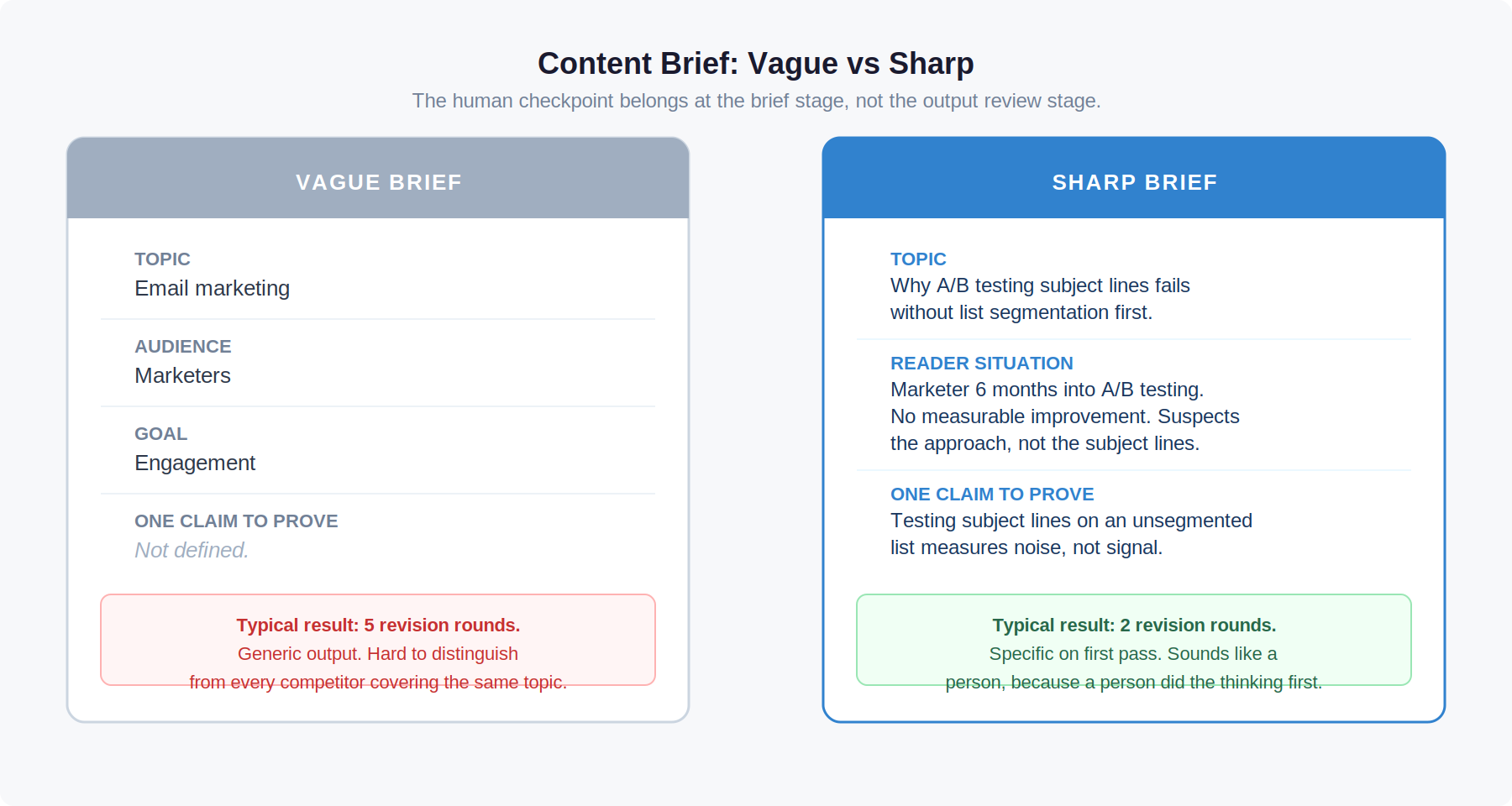
The human job in an AI marketing workflow is to define the angle, the audience moment, and the one thing the piece must prove. AI executes against that definition.
If you spend more than 20 minutes editing an AI-generated piece, the problem is not the AI. The problem is what you handed it. Move the human checkpoint to the front. The review at the end becomes minimal when the brief at the beginning was right.
Where to Start This Week
Five steps. Each is something you can do today.
- Pick one marketing task you do manually at least twice a week.
- Write every step of that task without using the words “depends” or “use your judgment.”
- Apply the Process Teachability Test: three questions, honest answers. If any question fails, spend one week running the task manually with explicit documentation before touching a tool.
- Score the task on two dimensions: how much it hurts to do manually, and how well it scores on teachability. If both are high, that is your first workflow.
- When you build the workflow, place the human checkpoint at the brief or input definition stage, not the output review stage.
That is the full framework. Process before tool. Teachability before automation. Human at the front, not the end.
Once a workflow runs cleanly for 60 days without manual correction, it is ready for the next level.
Read next: AI marketing agents
If you are building AI marketing workflows for a SaaS or content-led business and want a second opinion on the process design, reach out at shankar@shno.co.