
Your boss wants AI marketing. You have sat through the demos, clicked around your platform’s new AI tab, and you still cannot tell what is actually different from the automation you already have. The problem is not which technology you choose. It is whether your data is actually ready for AI to outperform the rules you have already written. I spent a decade running CRM and campaign strategy for retail, FMCG, and BFSI brands at a customer analytics firm. The thing that determined outcomes was never the tool. It was always the data underneath it.
The Comparison Every Article Makes Gets the Question Wrong
Most articles about marketing automation versus AI marketing open with a definition of each, build to a comparison table, and land on the conclusion that you should use both. If you have been researching this topic for more than ten minutes, you have probably read that article three times in slightly different fonts.
The definitions in those articles are accurate enough. Automation is deterministic: rule-based, predictable, and consistent. AI marketing is probabilistic: adaptive, pattern-driven, and capable of adjusting based on data rather than logic you write in advance. If you want a clear grounding in what AI marketing actually is at the technical level, that is a useful place to start. But making a technology decision from that distinction alone skips the step that actually determines whether AI marketing will outperform what you already have.
The standard framing treats automation and AI as equally accessible options sitting on a shelf beside each other, available to any team that picks one. They are not. Whether AI marketing can outperform your existing automation is not a question about technology preference. It is a question about whether your data can support what AI systems require to function better than the rules you already wrote. Most teams evaluating AI marketing are starting with the wrong question entirely.
Most companies calling their marketing AI-powered are running better-configured automation on slightly cleaner data, and the real decision is not which technology to choose but whether your data is ready for AI to beat the rules you already have.
The technology choice is downstream of the data reality.
In the CRM and campaign strategy work I ran at Hansa Cequity across retail, FMCG, and BFSI brands, the factor that consistently determined campaign outcomes was not the sophistication of the platform. It was the completeness, accuracy, and accessibility of the customer data. Every client. Every category. Better data in a simpler tool beat worse data in a more capable one, reliably. That gap between using AI and AI actually outperforming your existing setup is enormous for most teams: fewer than a third have scaled AI operations beyond isolated experiments to genuine cross-programme deployment.
Before evaluating any AI marketing tool, run a data audit. Establish what customer data you have, how complete it is, and whether it is unified enough for a system to act on in real time. That audit answers the question the vendor comparison will not.
Before we get to the diagnostic, though, we need to be honest about what the AI label on your current platform actually means.
Most “AI” Marketing Features Are Better-Configured Rules
When a platform adds an AI badge to its feature list, most marketing teams assume a machine learning model is now actively learning from their customer data. That is the story the vendor tells in the demo. The model reads engagement signals, adapts over time, and makes decisions that improve without anyone rewriting rules. It is a compelling story. It is also not what most platforms are doing.
Most of what platforms label as AI falls into one of three categories. The first is statistical optimisation: the system selects the best-performing variant from a fixed set of options you have already defined. Testing subject line A against subject line B is not machine learning. It is a coin flip with better memory. The second is rules with dynamic inputs: send time optimisation that adjusts scheduling within pre-defined windows based on historical open data, not a live per-customer behavioural model that updates with each new interaction. The third is generative assistance, typically an LLM suggesting subject line copy that a marketer approves before anything sends. None of these require the platform to maintain a model of your customer’s behaviour that improves across campaigns without you writing new rules.
If switching the feature off does not require retraining a model or losing patterns that were not there when you turned it on, what you had was not ML in any meaningful sense.
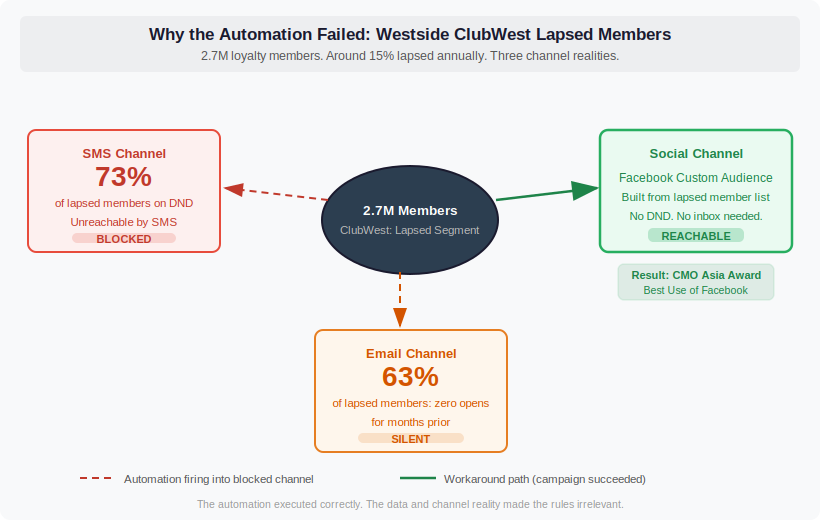
I saw this directly during the CRM strategy work I ran for Westside, the department store chain under Trent, around 2015 and 2016 as part of Hansa Cequity’s client practice. Westside’s loyalty programme, ClubWest, had 2.7 million members and drove the majority of the chain’s annual sales revenue. Solid programme by any standard. Good segmentation, multiple lifecycle triggers, SMS and email campaigns running on schedule.
Every year, around 15% of members lapsed. When we dug into the data on who was lapsing, we found something that clarified the automation picture immediately. Seventy-three percent of recent lapsers were registered on DND lists, completely unreachable by SMS. Sixty-three percent had not opened a single email in months. Our automation stack was executing perfectly: the right rules, at the right trigger points, firing into channels that had no path to the people we needed to retain.
No AI feature in the platform would have changed that. The issue was not that we needed smarter personalisation or a better model. We needed to find those customers where they were actually reachable. We built a Facebook Custom Audience from the lapsed member base and ran re-engagement directly in their social feed. No DND restrictions. No email open rate to depend on. The campaign worked and won a CMO Asia Award for Best Use of Facebook.
The lesson I took was not about the technology. The automation was doing exactly what we had designed it to do. The data and channel reality made the rules irrelevant. No amount of AI layered on top of a broken channel assumption would have closed that gap.
When evaluating whether a platform feature is genuine AI or optimised automation, three questions cut through the marketing:
- Does it maintain a per-customer model that updates with each new interaction, or does it optimise based on aggregate behaviour across the segment?
- Does it make decisions that differ between two contacts in the same segment based on their individual signals, or does it apply the same logic to everyone who matches the rule?
- Does its performance degrade if you stop feeding it fresh data, in the way a model degrades without retraining?
If the answer to all three is no, you are evaluating a better-configured automation tool. Reviewing marketing automation adoption rates across industries shows that 92% of marketers say marketing automation is key to staying competitive, per Taboola’s AI marketing trends research. The majority of those teams are running rule-based systems with AI labels on a handful of optimisation features. That is not a criticism. Well-configured automation is genuinely valuable. The issue arises when teams believe the AI label means something categorically different has happened, and build their next technology decision on that assumption.
The more useful question is what genuine AI marketing would actually require from your data.
What Genuine AI Marketing Actually Needs to Work
The vendor demo always shows AI marketing at its best. A unified customer profile populates in real time. The model identifies a contact whose behaviour signals churn risk, predicts the offer most likely to retain them, and triggers a personalised message before the customer has consciously decided to leave. It is a clear and compelling demonstration of what the technology can do.
What the demo does not show is the data infrastructure behind it. That model runs on clean, unified, high-volume customer data with real-time feeds from every touchpoint. It has at least twelve months of consistent behavioural interaction history per contact. It has a customer data platform or equivalent system piping structured first-party data into the model continuously. Most teams do not have this. Most teams have a CRM with several years of inconsistent records, a handful of tools syncing on overnight batch jobs, and behavioural data covering thirty to forty percent of the active contact base.
When AI runs on that, the personalisation is wrong. Lead scores are built on corrupted signals. Send time optimisation adjusts for patterns from contacts who last engaged during a completely different product era. The model makes decisions, but those decisions reflect the data it has access to, not your actual customers.
In these conditions, well-configured automation with a human reviewing the logic each week will outperform AI consistently. Not because automation is more capable. Because automation is transparent about its rules, and you can diagnose and fix a broken rule faster than you can diagnose a broken model.
I saw this play out in the BFSI client work I ran at Hansa Cequity between 2015 and 2017. The campaigns that performed were not on the most sophisticated platforms. They were built around a single, clearly defined lifecycle signal: salary credit received, first EMI completed, dormancy threshold crossed, transaction declined. The customer who had just received their first salary credit was a categorically different conversation from the customer whose payment had just failed. Same person, two entirely different moments, each with a specific action that produced measurable lift. The platform was basic by current standards. The data signal was sharp. The signal won every time. AI would have looked for patterns in a sea of noise. We built a direct trigger to fire on a specific event. The rule beat the model because the rule was asking the right question of the right data point.
Before AI consistently outperforms those rules, four conditions need to be true:
- You have unified customer profiles that combine behavioural, transactional, and engagement data in one place, not spread across three disconnected tools syncing on different schedules.
- Your data updates in real time or near-real-time, not in weekly batch exports that are already stale by the time the model reads them.
- Your contact database is clean: low duplicate rate, validated contact information, and active consent records that reflect current opt-in status.
- You have enough per-customer interaction history for a model to find real, non-obvious patterns, typically a minimum of 90 days of consistent behavioural data per active contact.
This is what I call the Data Floor: the minimum quality, completeness, and unification of customer data required for AI to consistently outperform the rules you already have. Below the Data Floor, AI tooling generates confident-looking decisions from incomplete information. That outcome is worse than simple rules applied to clean data, because confident wrong decisions are harder to catch than obviously broken rules.
The table below shows where the requirements diverge practically.
Reviewing AI adoption in marketing data shows a clear divide between teams using AI features and teams where AI is genuinely outperforming their prior approach. The teams on the right side of that gap are mostly teams who cleared the Data Floor first. When the four conditions above are met, the results are measurable: marketing teams running genuine AI automation report campaigns launching up to 75% faster with meaningful downstream lift in conversion metrics. Below the Data Floor, that upside does not materialise regardless of which platform you are using.
Read next: Predictive Analytics in Marketing: AI-Powered Forecasting
The Data Floor Also Applies to Small Teams
The most common version of this question from smaller teams is whether AI marketing is simply beyond their reach given their list size or budget. The honest answer is that the binding constraint is usually volume, not cost.
Small teams often have cleaner data than enterprises because a smaller CRM is easier to maintain. The problem is that the Data Floor applies in two dimensions: quality and volume. Machine learning requires enough interaction history to surface non-obvious patterns. Below roughly 10,000 active, consistently engaged contacts, there are often not enough signals for a model to find anything useful. A well-configured automation sequence built around the right lifecycle events will outperform an AI model that cannot find real patterns in a small population, reliably.
For teams at that scale, the right answer is to build the list, maintain the data quality, configure the automation well, and revisit AI tooling when the contact base and behavioural history can genuinely support it. That is not a concession. That is the correct sequencing.
A Decision Framework for Teams Who Need a Real Answer
Most teams make the automation versus AI decision the same way they make most technology decisions: based on what a competitor appears to be doing, what a vendor recommended after a compelling demo, or what the marketing press has been amplifying for the past year. One company publishes a case study on AI marketing results, and within six months everyone in the same sector wants to move in the same direction. None of those inputs reflect what a specific team’s data and operational reality can actually support.
The decision is diagnostic, not preferential. It has a right answer given your current situation, and that answer can be found before you spend any time evaluating platforms.
The framework I use comes directly from the approach we applied at Hansa Cequity when evaluating CRM and marketing programme architecture for clients across retail, BFSI, and FMCG. The same questions that determined programme recommendations for large enterprise brands determine whether a team is in automation territory or AI territory today.
If fewer than 60% of your contacts have a behavioural interaction in the last 90 days, you are in automation territory regardless of what any AI vendor promises.
Step one: count your unified profiles. A unified profile, for this diagnostic, has at minimum an identified contact record, at least one behavioural interaction in the last 90 days, and one transaction or engagement event in the last 180 days. Calculate what percentage of your total contact base meets that threshold. If it is below 60%, your Data Floor has not been cleared. The investment belongs in data hygiene, reactivation, and unification before any AI evaluation begins.
Step two: check your data update frequency. If your CRM syncs in batches of more than 24 hours, AI personalisation will operate on stale signals. That is a functional disqualifier for most AI use cases that produce meaningful lift. Real-time or near-real-time data pipelines are a prerequisite, not a premium feature.
Step three: audit your existing automation quality. Pull your top three automation flows and find the last 90-day conversion rate for each. If you cannot find those numbers in under ten minutes, your automation reporting is broken. That problem predates any AI evaluation, and adding a more complex system on top of it will not fix it. Measure first.
Step four: name one specific marketing decision you currently make manually each month that would benefit from being made with better accuracy at scale. Predictive lead scoring, churn probability modelling, next-best-offer logic: these are the use cases where genuine AI consistently outperforms rules when data conditions are met. If you cannot name a specific decision, the value of AI tooling for your team is unclear, regardless of what the platform can technically do.
On whether AI will eventually replace marketing automation: the honest answer is partially, and at different layers at different speeds. AI is already replacing rule-based logic at the decision layer in environments where data is sufficient and the decision involves complex, multi-signal prediction. Where the requirement is consistency, auditability, and compliance, automation remains the right tool. The execution layer stays with automation. The intelligence layer moves toward AI as data matures. These are not competing systems. They are different layers of the same architecture, and the sequencing matters more than the choice.
Read next: AI Marketing Automation: What It Is and How to Set It Up
Three things to do this week.
- Export your active contact list and calculate what percentage of records have at least one behavioural interaction in the last 90 days. That number tells you more about your AI readiness than any vendor demo will.
- Pull the conversion rate on your highest-traffic automation flow for the last 90 days. If you cannot find that number in under ten minutes, fix your measurement before you evaluate anything else.
- Write down one specific marketing decision you make manually each month that you wish could be made with better accuracy at scale. That use case is the only legitimate starting point for an AI marketing evaluation worth your time.
If you are working through this and want a second opinion on what your stack can actually support, I do advisory work for SaaS and e-commerce marketing teams at shankar@shno.co.