
There is a version of “AI marketing” that means a Fortune 500 brand running real-time propensity models across 10 million customer records. And there is a version that means you used ChatGPT to write a subject line last Tuesday. Both get called the same thing. That is the problem. I have spent years sitting inside customer data and campaign decisions for brands across retail, FMCG, and financial services. The question I got asked most often was not “should we use AI.” It was “what counts.” This is the answer I wish someone had written earlier.
The Definition That Vendor Content Keeps Getting Wrong
Pick any top-ranking article on AI marketing and you will find the same list: chatbots, email personalization, A/B testing, customer segmentation, content generation, programmatic advertising, predictive analytics, and a few others. All presented as equally valid members of the same category. All presented as things your team should be doing. None of them are distinguished by the one thing that actually matters.
The list is shaped by the people who benefit most from keeping the category as wide as possible. Tool vendors had every reason to position their existing products inside the AI marketing umbrella once the term became desirable. Rule-based email triggers, decision-tree chatbots, and basic behavioral segmentation have been running since the early 2010s. They are useful. But they are not AI. They do exactly what they are told. They do not learn. A triggered email that fires when a user hits a purchase threshold is not machine learning. It is a conditional statement with a send button.
I was working on CRM and loyalty strategy for major retail brands when the vocabulary shift happened. Tools that had been sold as “marketing automation” for years were relabeled “AI-powered” around 2015 and 2016, with no change in the underlying capability. The rules were static. The model did not update based on outcomes. The only thing that changed was what was written on the vendor’s homepage. The marketing automation statistics document the scale of rule-based automation spending that now sits inside AI marketing budgets. The category overlap is not an accident.
The Nielsen 2025 Annual Marketing Survey found that 47% of companies use AI for content creation and 44% for customer segmentation. Those figures are not wrong. They are just not useful for the question you are trying to answer, because they do not distinguish between tools that actually learn and tools that execute pre-written rules. Both get counted.
A usable definition of AI marketing needs one criterion: does the system update its behavior based on data outcomes without a human rewriting it?
If yes, it is AI. If no, it is automation. Both are useful. Only one is AI marketing.
Intelligence Gap: the measurable distance between what a marketing system is actually doing (following rules) and what it is claimed to be doing (learning from data). Every marketing team has one. Most have never measured it.
Most of what gets sold as AI marketing is automation that predates the current AI moment by a decade, and conflating the two is what makes the term useless for anyone trying to make a real decision about it.
Read next: AI marketing guide
The Four Components That Actually Require Machine Learning
The standard AI marketing component list has eight to ten items depending on who wrote it. Four of them require genuine machine learning. The rest are either pre-trained models that do not learn from your data, or rule-based automation that has been relabeled. Getting clear on which is which changes every purchasing and prioritization decision you will make.
The reason this distinction is collapsed in most content is the same reason the definition gets collapsed: it is inconvenient for the category. If you tell a marketer that the “AI personalization” in their email platform is actually a behavioral segmentation rule, they are less likely to upgrade to the enterprise tier.
Here is what actually requires machine learning, what the AI is doing in each case, and what breaks down if your data is not ready for it.
Predictive Analytics: What the Model Is Actually Doing
Predictive analytics is the component cited most often and understood least clearly. The image most marketers have is a dashboard showing a churn risk score or a next-purchase probability. The mechanism behind that score is where it gets real.
A genuine predictive model is trained on historical customer records. It learns which combinations of behavioral signals correlate with a future outcome. Then it scores new records against that learned pattern. The key word is “learned.” The model updates its weights as it sees more data. Its predictions improve over time without a human changing the logic.
I worked on churn and ARPU modelling for TataSky, which had 12 million customer records at the time. The propensity models at that data volume behaved in ways that smaller subsets simply could not replicate. When we tested simplified versions on lower-volume samples, the output was not meaningfully better than a rule: customers who had not transacted in 60 days were at risk. That is not a model. That is a filter. The model needed volume to find the signal patterns that were not obvious. The combinations of usage type, tenure, plan category, and call center contact history that, together, predicted churn better than any single variable. Below a certain data threshold, the model cannot find those combinations. It produces noise.
Dynamic Personalization, Ad Optimization, and NLG: The Other Three
Dynamic personalization at the genuine ML level means a system that updates its content or product recommendations for each user based on ongoing behavioral signals, not a static segment assignment. The model reassigns each user continuously as their behavior changes. A rule-based personalization engine assigns a user to “frequent buyer” and shows them one set of content. A genuine ML personalization engine updates that assignment every session, weighting recent signals more heavily than older ones.
AI-driven ad optimization means a bidding or creative selection system where the model learns which combinations of audience, creative, placement, and timing produce the best outcomes for your specific campaigns, and adjusts without manual intervention. Google’s Smart Bidding and Meta’s Advantage+ are genuine ML systems. They update in real time based on conversion signals. Most third-party “AI optimization” overlays on top of these platforms are rule sets applied after the fact.
Natural Language Generation at the AI level means a model producing text from data inputs: a product description written from attribute fields, a personalized email body generated from a customer’s behavioral record, a reporting summary written from a metrics dataset. This is categorically different from a content generation tool that gives you a starting draft based on a prompt. The draft tool uses a pre-trained model that does not learn from your data. The NLG component in a genuine AI marketing system does.
What AI Marketing Actually Looks Like at Different Scales
Every AI marketing article I have read uses Nike, Amazon, Netflix, and Spotify as examples. Sometimes Delta or a European bank appears. The examples are not wrong. They are just useless if you are running a mid-market SaaS, a regional e-commerce brand, or a content-led business with a fraction of the data those companies operate on.
The problem with enterprise examples is not just accessibility. It is that they create a false expectation about what AI marketing produces at smaller data volumes. A team with 8,000 monthly transactions reading about Netflix’s recommendation engine is not getting a model of what AI marketing looks like at their scale. They are getting a model of what AI marketing looks like with a nine-figure data engineering budget and 300 million users. The two are not on the same spectrum. They are different things.
This matters because the wrong example leads to the wrong tool purchase. A team that invests in a genuine ML personalization platform without the individual-level event data to train it will not get ML personalization. They will get a rules engine with a premium price tag.
When I was building Shnoco, which grew to 50,000+ active monthly readers using only content and search, the data available was clickstream and Search Console signals. No customer ID graph. No purchase history. No session-level behavioral depth. The “personalization” I could do at that scale was content categorization: surface more content similar to what someone had clicked before. That is a recommendation filter. It is useful. But it is not machine learning personalization, and I knew better than to pay for a tool that required data I did not have.
The honest thing to say about AI marketing at mid-market and smaller scale: some of the four genuine ML components are viable, and some are not, depending on your current data volume.
One component that does become accessible at mid-market scale is email send-time optimization. Klaviyo’s personalized send time feature requires a list of 12,000+ recipients and uses an ML model that continuously learns from engagement signals. In their beta testing, top-performing campaigns saw a 35% increase in click rates compared to control groups receiving the same campaign at a fixed time. That threshold, a real subscriber list with sufficient volume, is achievable for brands that have been building their email list for a year or more. The contrast with enterprise-scale personalization is deliberate: this is what a viable ML component looks like when you match the tool to the data you actually have.
Before evaluating any AI marketing component, answer: how many records does the model need to learn from, and do I have that volume today?
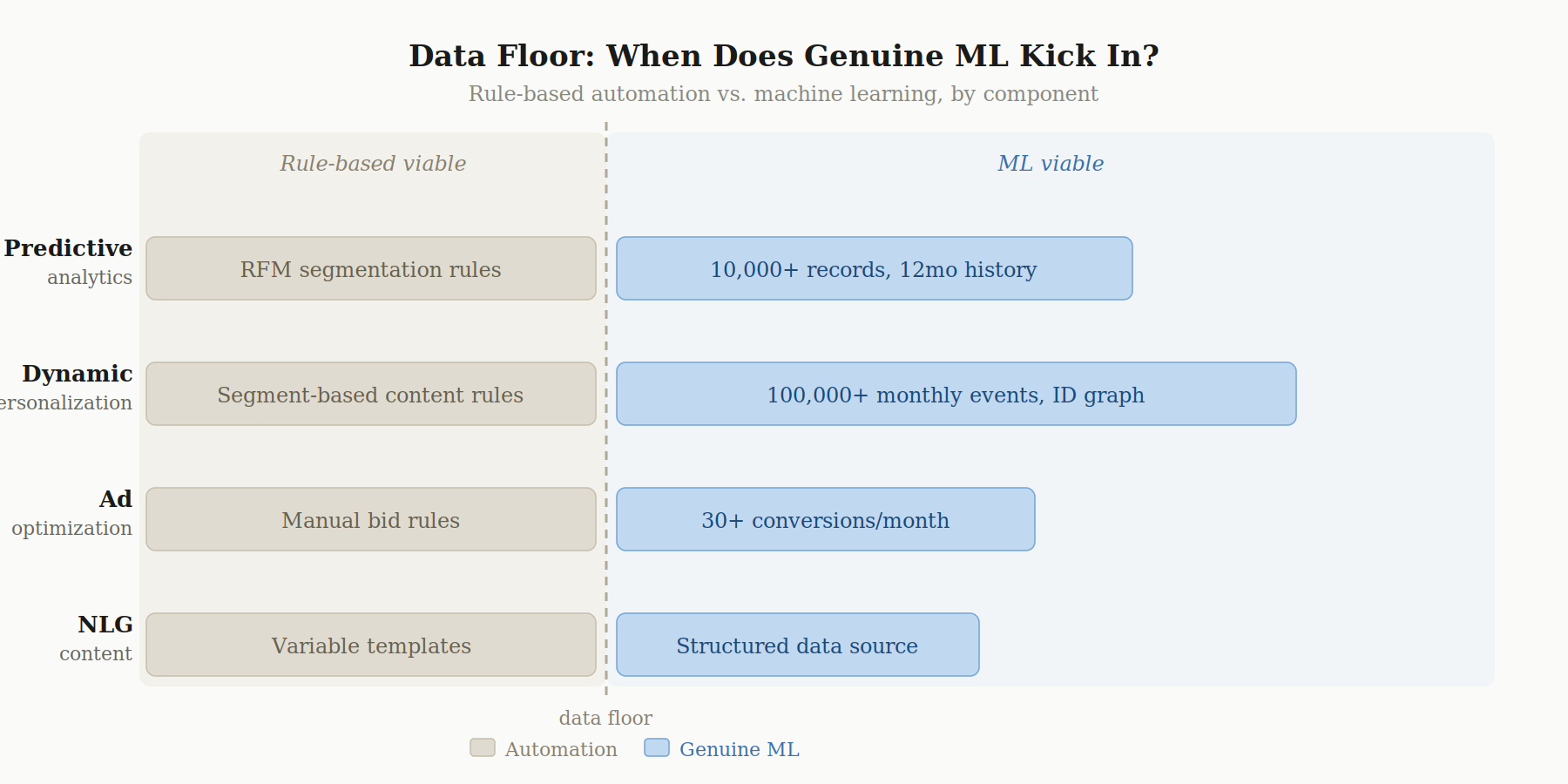
The Data Floor for Each Genuine ML Component
These are the practical thresholds below which each genuine ML component stops producing output that is meaningfully better than a well-built rule. These are not hard ceilings. They are the ranges where the model starts having enough signal to learn from.
Read next: AI marketing examples
How AI Marketing Actually Works as a System
Most teams build their AI marketing stack the way they build any software stack: one tool at a time. An AI content tool here. A predictive analytics layer there. A personalization engine added six months later. Each evaluated in isolation against its own claimed ROI. Each producing its own data. None of that data feeding the next tool.
This is the single most common reason AI marketing underdelivers. It is not the tools. It is the disconnection between them.
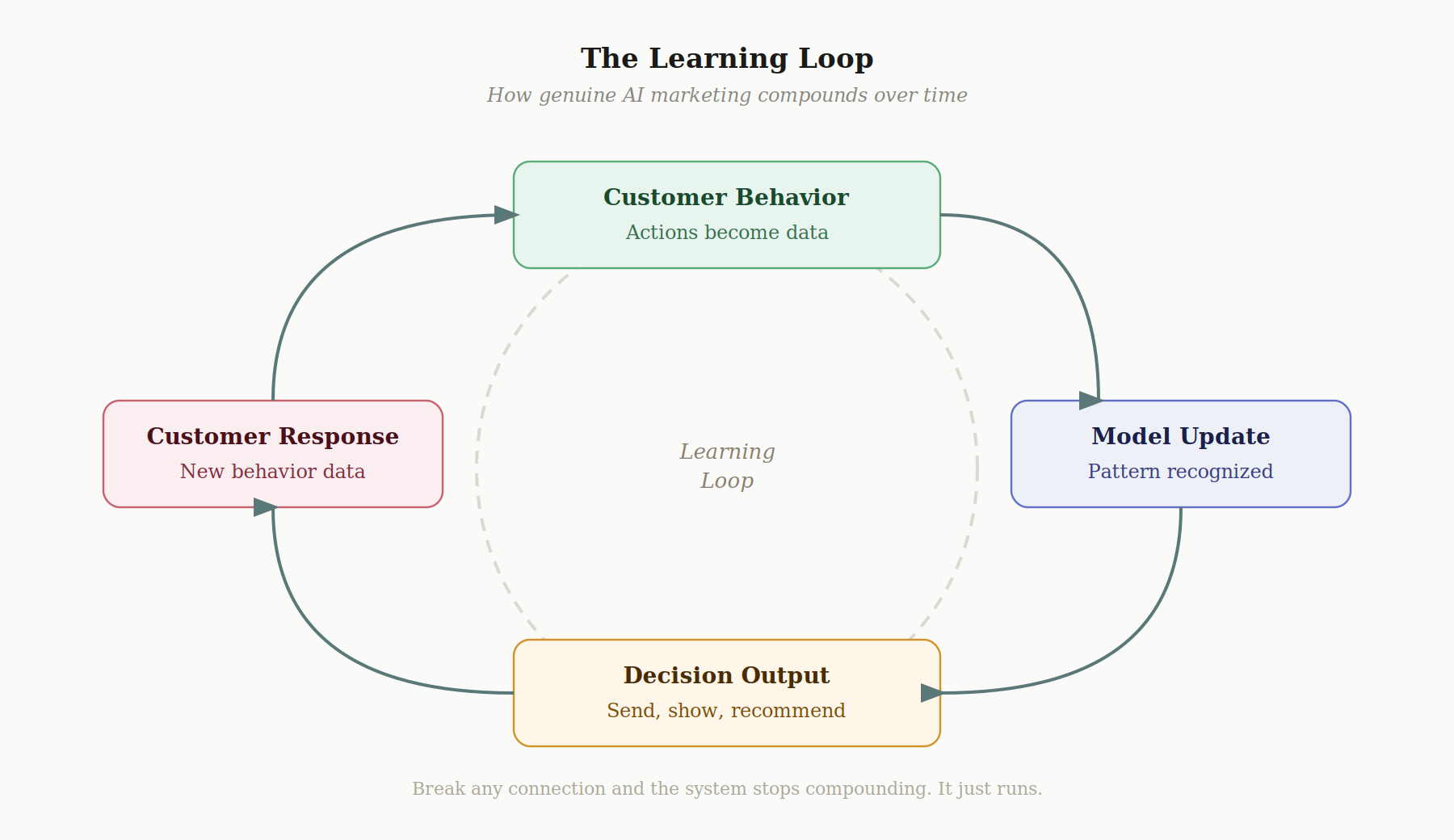
Here is what genuine AI marketing looks like when it works: a customer does something. That behavior becomes data. The model reads that data and updates its prediction. The updated prediction drives a decision about what to send, when to send it, what to show, what to recommend. That decision reaches the customer and produces a new behavior. That new behavior becomes data. The loop runs again.
Every step of that loop makes the next step more accurate. The model learns. The decisions improve. The interactions get more relevant. The customer generates more useful signals. That compounding is what separates genuine AI marketing from a collection of individual tools.
Break the data connection between any two steps and the loop stops compounding. It just runs. An AI personalization engine that cannot see your paid ad campaign data does not know what the customer was promised before they arrived on your site. A churn model that cannot see your email engagement data does not know whether the at-risk customer responded to your last outreach. A content recommendation engine that cannot see your CRM purchase history treats every return visitor like a new one.
I saw this clearly when I was at Hansa Cequity, working on the Fossil India account. The project we ran, internally called the Dolphin Project, was about building a unified customer datamart from seven or more disparate data sources: transaction records, call centre logs, warranty registrations, online behavior, and in-store data. The goal was a 360-degree customer view for the call centre agents who needed full context on every interaction.
What became obvious in that project was that the analytic value was not in any individual data source. It was entirely in the connections. Before the unified datamart, each system was making decisions with partial information. A call centre agent could see purchase history but not online browsing. A campaign system could see email engagement but not in-store transactions. Every system was operating on a slice of the customer. The datamart made the full picture available. Any model that then ran on top of that data was working with the actual signal, not a fragment of it.
That is exactly what an AI marketing system requires. Before you buy a tool, map what it needs as input and what it produces as output. If the output goes nowhere, you have bought a standalone tool. You have not built a system.
Learning Loop: the connected cycle of customer behavior, model update, decision output, and new customer response that allows genuine AI marketing to compound over time. The intelligence is in the connections, not the components.
Map the data connections before buying tools.
Where to Start From Here
The five steps below apply the framework in this article to your current stack. Each one takes less than an hour and gives you a clearer picture of where you actually stand than any vendor presentation will.
- List every tool or tactic your team currently calls “AI marketing.” For each one, answer one question: does it update its model based on outcome data without a human rewriting the rules? Sort your list into two columns: genuine ML and automation. Do not be discouraged if the automation column is longer. Most teams’ lists look that way. That is the honest starting point.
- For every item in the genuine ML column, identify the data it needs as input. Write down the current volume of that data you have today. Compare it against the data floor table in the section above. If your volume is below the floor, the tool is not producing genuine ML output at your current scale.
- For every tool where your data is below the floor, write down the rule-based equivalent. Decide whether to run the rule-based version now and revisit the ML version when your volume allows, or to deprioritize the component entirely. The rule-based version is not a failure. At low data volume, it often outperforms the model because it does not need to learn. It just executes.
- Map the data connections between your genuine ML components. For each one: what data does it take as input, and where does the data it produces go next? If the output data goes nowhere, sitting in a dashboard that no other system reads from, you are running an isolated tool. That is the disconnection to fix before adding more tools.
- Write one sentence describing what AI marketing means for your team right now, at your current data volume and stack. Not what you want it to mean in three years. What it means today, given what you found in steps one through four. That sentence is your actual strategy.
If you want to go deeper on any of these components, the AI marketing strategy guide walks through how to build a connected system from your current starting point.
Also available: the AI adoption in marketing statistics page compiles the adoption rate data referenced in this article, with full source attribution.