
Your AI-powered forecasts are working fine. Churn probability. Purchase likelihood. Predictive lead scores. Every number your platform promised is there. The part that is not working is everything that happens after. Knowing a customer has a 72% churn probability does not tell you which email to send, at what threshold, or whether sales should call instead. I ran customer analytics for brands with millions of loyalty members. In that work, the question that killed more projects than bad data or bad algorithms was always the same: what do we do differently based on this score?
Predictive Models Do Not Fail at the Algorithm Level. They Fail at the Decision Level.
Most marketing teams approach predictive analytics as a data science problem. They focus on model selection, data pipeline setup, and accuracy metrics. The project gets handed to a data science team or a vendor. The model runs. Scores populate a field in the CRM. The data team marks the project complete.
What the data team has actually delivered is a ranked list of people by probability. That list tells a marketer who is at risk. It says nothing about what intervention to run, at what score threshold the campaign triggers, which channel reaches this customer, what the message needs to accomplish, or who is accountable for approving the action. The marketing team gets a number they were never taught how to use. When they cannot act on it, they stop checking it. Within a quarter or two, the scores sit in a field nobody opens. The initiative dies quietly. The failure looks like a data quality problem, or a tool problem, or an adoption problem. It is none of those.
The model is almost never the reason predictive analytics fails in marketing. The reason is that nobody asked what marketing action the prediction was supposed to trigger before building it.
I saw this pattern consistently in CRM and loyalty analytics work across enterprise retail clients. The models that produced zero campaign change were never the ones with the worst accuracy. They were the ones where the business brief going in was “who is likely to churn?” rather than “what do we do differently for a customer who is likely to churn?” The first brief produces a score. The second produces a campaign brief. The gap between them is the entire gap between a model that gets used and a model that gets abandoned.
According to Marrina Decisions, a January 2026 analysis of predictive analytics implementations found that programmes succeeding were “scoped narrowly, grounded in stable signals, and positioned as decision support rather than automation authority.” The ones that failed were expected to compensate for structural gaps in process and planning. The model was not the variable. The surrounding decision architecture was.
Before building or activating any predictive model, answer three questions in writing. First: what specific marketing action changes when a score crosses a threshold? Second: what is that threshold? Third: who owns the decision to trigger the campaign? If any of those three answers are missing, the model is not ready to deploy.
Before those three questions can be answered, a more fundamental check is needed. The decisions a predictive model supports are only as trustworthy as the data used to train it. And most teams are asking the wrong question about that data.
The Data Question Most Teams Are Getting Backwards
When teams hear that predictive analytics requires good data, they translate it into one of two responses. The first is paralysis: fix everything before starting, which usually means never starting. The second is optimism: proceed with current data and let the model sort it out. Both responses come from asking the wrong question. The typical question is: do we have enough data? The right question is: can we trust the decisions this data will produce?
Volume is not the primary data problem.
The primary problem is signal quality. The most common signal quality failure in marketing datasets is not missing records. It is misattributed records. Transactions credited to the wrong customer ID. Email engagement tracked against a hashed address that does not match the CRM record. Purchase history from a physical store location that never made it into the database. When a model trains on misattributed data, it does not know the data is wrong. It finds patterns in the misattributions and predicts on them with full statistical confidence. The result is a model that is accurate on its training set and operationally useless in the field.
In retail loyalty programme analytics work, the most common data failure was fragmented customer identity. A customer with two loyalty cards, two email addresses, and one legacy in-store account was counted as three separate individuals in the segmentation model. The churn prediction model identified the dormant second and third records as churning customers and triggered win-back campaigns to people who had never left. The campaign spend was real. The “recovered” customers were already active under a different record. The model ran cleanly. The output was wrong.
Teams that resolve identity and attribution issues before model deployment consistently outperform those that do not, and the performance gap is documented in data-driven marketing benchmarks that show where the measurable lift actually comes from.
Up to 80 percent of a data scientist’s time goes to finding, cleaning, and reorganizing data rather than building models, according to IBM. The teams that treat preparation as overhead get this proportion exactly backwards relative to where project value is actually produced.
Run a data trust audit on three specific questions before touching a model. First: does a unique customer ID exist and is it consistently applied across every source system you plan to train on? Second: is the behavioral signal you plan to use as a predictor (purchase, email open, login, support ticket) accurately attributed to the right customer record? Third: when was the training data generated? If it predates a major product change, pricing change, or external disruption by more than 12 months, the model may be training on behavior patterns that no longer describe your current customers.
With a clean data foundation, the next decision is which use case to build first. This is where the second-most-common failure happens.
Four Use Cases That Actually Move Marketing Metrics, and the One to Start With
Most teams choose a predictive analytics use case based on what a vendor demo featured, what a competitor appeared to be doing, or what sounded most impressive in the briefing. Occasionally, a team attempts all four simultaneously. The result in almost every case is the same: a model that runs, generates scores, and produces no campaign change, for reasons unrelated to the model’s quality.
Churn prediction, CLV forecasting, predictive lead scoring, and propensity modeling each require different data inputs, different minimum record volumes, and different organizational prerequisites before anyone can act on what they produce. A propensity model trained on a 12,000-customer database is noise, not signal. There is not enough purchase history to separate genuine behavioral patterns from random variation. A CLV forecasting model deployed to a team without a tiered campaign structure produces segments that nobody has a campaign ready for. Predictive lead scoring deployed without sales team alignment produces a prioritization queue the sales team ignores. The use case mismatch is the failure. The model accuracy is a separate conversation.
Across retail, BFSI, and loyalty analytics engagements with clients at different data maturity stages, teams with fewer than approximately 50,000 clean behavioral records consistently produced more actionable outputs from RFM segmentation than from machine learning propensity models. The ML model was more sophisticated. The RFM model produced a segment list the marketing team could actually run a campaign against within a week.
The sophistication of the model does not determine the value of the output.
Choose the use case where the data already exists, the team already has a defined downstream action, and the campaign that gets triggered is one someone can approve and send this quarter. For most mid-market teams, that is churn prediction using 12 or more months of email engagement or login behavior, with a defined win-back sequence as the output.
Before choosing churn prediction as your starting use case, calibrate against customer churn benchmarks by industry to set realistic intervention targets. CLV prediction is most useful when you already have a working sense of CLV benchmarks across business models and need to identify which customer tier to prioritize in your campaign differentiation.
The table below maps each use case to its minimum viable data requirement, the organizational prerequisite to act on the output, what a score actually triggers, and where it already lives inside common marketing tools.
The Predictive Features Already in Your Stack That Most Teams Ignore
Most teams I work with have not activated the predictive scoring already running in platforms they currently pay for. The models are computing. The scores exist. They are just not connected to anything.
Three worth checking this week:
- GA4 predictive metrics compute purchase probability, churn probability, and predicted revenue for qualifying users automatically, once the account has 1,000 or more returning purchasers and 1,000 or more non-purchasers in the relevant 28-day window. If those thresholds are met, the metrics are available now in your Audiences panel.
- HubSpot predictive lead scoring uses machine learning to determine the probability that a contact will close as a customer within 90 days, drawing on CRM activity, website behavior, email engagement, and form data. It is available on Professional and Enterprise plans.
- Klaviyo predictive CLV estimates expected revenue from each customer over the next 365 days, updated with every purchase event. It is available on most paid Klaviyo plans and is accessible as a profile property for segmentation immediately, without any configuration required.
Activate what you already have before buying anything new.
Read next: AI customer segmentation covers how to build audience structures from these predictive signals without a data science team.
Knowing which use case fits your situation is necessary. It is not sufficient. The gap that ends most predictive programmes is not before the score is generated. It is after.
Prediction Activation: What Happens Between the Score and the Campaign
Most teams treat the model output as the end of the project. They build the model, generate scores, schedule updates, and wait for someone to use them. Sometimes the scores appear in a CRM custom field. Sometimes they surface in a report reviewed in a monthly analytics meeting. The model is technically running. No campaign changes because of it.
A score is a recommendation waiting for a decision.
Without a decision framework, it is just a number. The number might be accurate. But an accurate number with no defined action attached to it cannot change a campaign, redirect a budget, or trigger a retention sequence. The model’s value is entirely downstream of a human decision. That decision needs four things: a threshold (at what score does an action trigger?), a channel (how do you reach this customer?), a brief (what does the message need to accomplish and why is this the right moment?), and an owner (who approves the campaign and is accountable for the outcome?). Without all four, the score sits in a dashboard. The programme fails quietly, and it looks like an adoption problem.
I learned this on a loyalty re-engagement project for one of India’s largest department store retail chains. The brand had 2.7 million loyalty programme members. Around 15% lapsed every year. A churn prediction model was running. Scores were being computed and updated. No re-engagement campaign had meaningfully changed because of them.
When we dug into why, the answer was not the model. The model was identifying the right people. The problem was that 73% of the recently lapsed members were on DND, unreachable by SMS. Another 63% had not opened a single marketing email in months. The CRM stack was running campaigns against a score it could generate but could not act on through its own channels. The model told us who was at risk. Nobody had asked what we would do when we found them.
Once we asked the question, the answer became clear. Stop trying to reach them through channels they had opted out of. Build a Facebook Custom Audience from the lapsed member list instead. No DND restriction. No promotions tab they never open. We reached them where they actually were. The campaign ran. It worked. It won a CMO Asia Award for Best Use of Facebook.
The model did not change. The decision framework did.
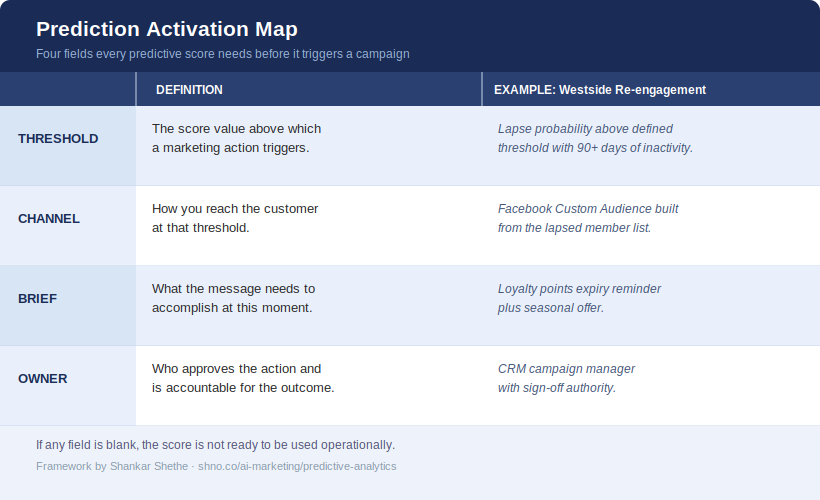
Prediction Activation Map: a four-field decision record that every predictive score needs before it is connected to a campaign. The four fields are threshold (the score value above which the action triggers), channel (the channel used to reach the customer at that threshold), brief (what the message accomplishes and why it is the right message at this moment), and owner (who approves the action and is accountable for the outcome). If any field is blank, the score is not ready to be used operationally.
Build the Prediction Activation Map before the model runs, not after. If you cannot fill in all four fields for a given use case, you have not finished defining the business problem the model is supposed to solve. A score without an activation map is not a deployed programme. It is a completed data science exercise.
Here is where to start. Five steps, each specific enough to act on this week.
- Name the one decision. Write one sentence that completes this prompt: “When a customer’s [score type] reaches [threshold], we will [specific action].” If you cannot complete that sentence today, you are not ready to build or activate a model. That sentence is the entire project definition. Resolve it first.
- Audit identity resolution in your CRM. Pull a sample of 500 customer records and check whether a unique customer ID exists and matches across your email platform, purchase history, and support data. The percentage of records that do not match is your effective data reliability rate. A rate below 90% is a data trust problem, not a model problem.
- Activate what you already have. Log into GA4, HubSpot, or your email platform and check whether predictive scores are already being computed. Most teams have churn probability or purchase propensity scores sitting unused in tools they already pay for. Use those before buying or building anything new.
- Build a Prediction Activation Map for one use case. Choose the simplest qualifying use case based on the table above. Fill in all four fields: threshold, channel, brief, owner. Do not connect a score to a campaign until all four are complete. If you cannot fill in the owner field, escalate that conversation before proceeding to the model.
- Set a 60-day model validity check. Schedule a recurring review to compare your model’s predicted outcomes against actual outcomes every 60 days. Customer behavior shifts. A model trained six months ago may be confidently predicting on patterns that no longer describe your customers. Catching that drift early costs one meeting. Missing it costs a quarter of misdirected campaign spend.
If you are working through a predictive analytics programme and the decision framework is where things are breaking down, that is the kind of problem I work on directly.
Read next: AI marketing analytics covers how to build the measurement layer that runs alongside your predictive programme and turns historical performance into ongoing reporting.