
You bought the tools. You ran the kickoff. Three months later, half the team is still working the old way and the other half is using AI in ways you cannot track. The problem is not the tools. It is that everyone treated this like a software rollout instead of a change. That is also what most implementation guides told you to do, which is why you are here. I spent 14 years inside enterprise marketing operations and personally tested hundreds of tools. Here is what actually makes AI adoption stick.
The Framework That Looks Right and Does Nothing
The default playbook goes like this. Define your marketing goals. Audit your data and tech stack. Select the right AI tools. Build a strategy. Run a pilot. Scale what works. Every guide on implementing AI in marketing follows this structure. IBM, HubSpot, Braze, and a dozen marketing platforms have all published versions of it. The steps are not wrong. They are a description of what successful adoption looks like from the outside, not instructions for how to get there.
The problem is what the framework assumes. Clean, structured data. A team that is ready for the change. Leadership and frontline staff aligned on what “using AI” even means. An organization with the training infrastructure to support a behavioral shift. Strip those assumptions away and the five-step framework becomes a map that leaves out all the terrain. It tells you where you are going. It says nothing about what you will run into on the way.
That is why the gap between adoption pressure and actual embedded usage is not small. The AI adoption in marketing statistics tell you what it actually looks like: according to the Supermetrics 2026 Marketing Data Report, only 6% have fully embedded it into their daily workflows, while 80% feel active pressure to do so. The organizations in that 94% gap did not skip the steps. Most of them followed every one. The framework was not the problem. The framework failed to account for the one variable it cannot model: how people actually change how they work.
There is a name for this mistake. The Rollout Illusion is the belief that purchasing and deploying AI tools constitutes implementation. It does not. Implementation requires the organizational behavior change that most teams never reach, because nobody designed for it. You can find the wider picture in the AI marketing statistics from the last two reporting cycles. Tools are being bought at pace. Workflows are not changing at anything close to the same rate.
AI marketing implementation fails at the team level, not the tool level, and most implementation guides are making this worse by treating the symptom instead of the cause.
Before selecting any tool, answer three questions. Who on your team has mentioned AI in conversation without being asked? What task does that person do more than three times per week? What would a visible success look like in two weeks, not six months? Implementation does not start with goals. It starts with a person, a task, and a timeline short enough that failure costs nothing.
The Only First Step That Actually Builds Momentum
Most organizations start AI implementation with a meeting. Usually several. A goal-setting session. A vendor evaluation. A data audit. Stakeholders are aligned. A rollout plan is documented. Six weeks later, the team has a clear strategy and zero new AI habits. The documentation cycle is how organizations signal intent without creating change. It is also nearly universal, and it reliably produces the same result.
The reason it fails is mechanical, not motivational. Adoption in any organization is driven by early visible wins, not by strategic alignment. The team member who watches a colleague turn a campaign brief from three hours of work into 20 minutes will try the tool. The team member who attended the kickoff meeting will not, unless something tangible connects to their actual job on an actual day. That first visible win is not a nice-to-have in AI implementation. It is the mechanism by which one curious adopter becomes two, then five. When it is absent, the Rollout Illusion settles in. The tools are deployed, the sessions have been run, nothing has changed.
According to McKinsey’s 2025 State of AI, AI high performers are three times more likely than their peers to have senior leaders actively demonstrating AI use rather than only mandating it. The mechanism is modeling, not mandate. That same principle runs at the team level. One visible, specific win from someone the team knows and respects converts more reliably than any vendor case study, because it is from a job they recognize.
In advisory work with content and marketing teams at early-stage SaaS companies, the pattern holds consistently. The teams that built real AI workflows started from one person solving one specific, recurring problem. The teams that planned broadly and piloted across the whole team simultaneously were still “exploring AI” five or six months later. The breadth of the plan was inversely correlated with how fast anything actually changed.
The Two-Week Proof is a contained adoption pilot built around one person, one task, one tool, producing a specific measurable comparison the team can see. Find the person already curious. Give them one tool. Assign one task they do at least three times per week: a content brief, a competitive summary, a weekly report, an email sequence draft. Run it for two weeks alongside their existing method. Measure the time difference. Write it up in one paragraph. Share it with the team. That paragraph is worth more than any vendor deck, because it is from someone they know, doing a job they understand.
That first proof point is what building AI marketing workflows that scale across a team actually looks like in its earliest form. Not a platform rollout. One story from one person with a before-and-after time stamp.
The Three Failure Modes That Kill AI Adoption After Launch
When AI implementation stalls after the initial rollout, the default diagnosis is wrong tool selection or insufficient resources. The response is a new budget request, a vendor evaluation, or another training session. These responses misidentify the cause every time. The stalls are not random. They happen at three predictable, named moments, each with a different fix.
Failure Mode 1: Tool Sprawl. Most marketing teams subscribed to multiple AI tools in the 2023 to 2025 window. The martech stack utilization data shows a consistent pattern across company sizes: teams buy broadly and use narrowly. When a team has four AI tools with no defined use case map, every team member makes independent decisions about which tool to use for which task. There is no shared workflow to observe, document, or improve. The tools underperform because nobody is building on each other’s usage. Nobody knows if any of them are working.
Failure Mode 2: The Training Vacuum. Salesforce’s Generative AI Snapshot research found that 70% of marketers say their employer does not provide gen AI training. A separate finding from the same research series: 43% of marketers say they do not know how to get the most value from gen AI. The access is there. The practical knowledge of how to use these tools well, for specific jobs, with specific prompts, is not. Without documented examples, usage stays individual, inconsistent, and invisible to the rest of the team.
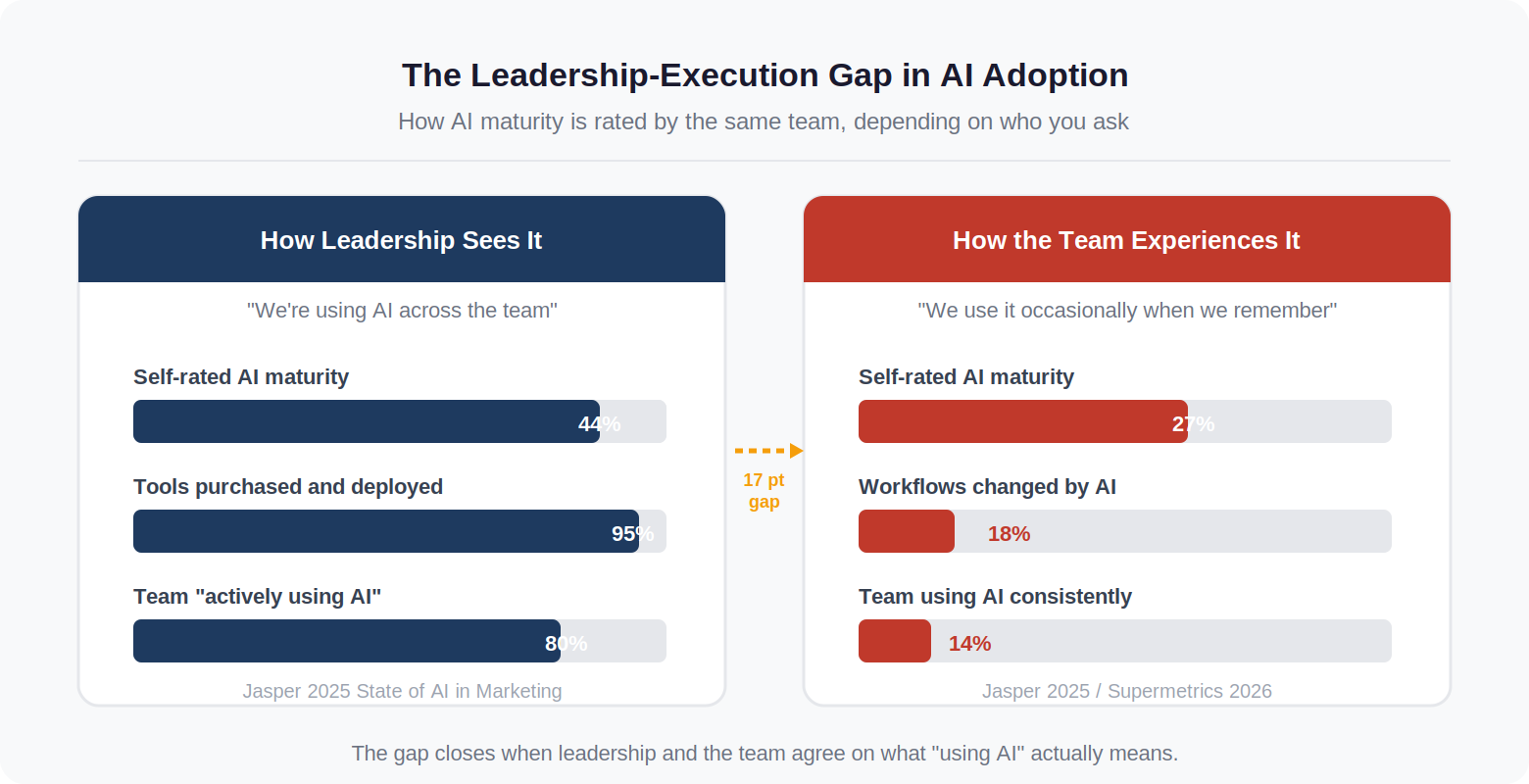
Failure Mode 3: The Leadership-Execution Gap. This one is the most damaging because it goes undiagnosed. Jasper’s 2025 State of AI in Marketing documented it with specific numbers: CMOs rate their team’s AI maturity as “advanced” or “very advanced” at 44%, while the managers doing the daily work rate the same teams at 27%. That 17-point gap is not noise. It means leadership is reporting an implementation that has not fully happened, and nobody on the ground is correcting the record.
I saw this gap clearly during advisory work with a content-led SaaS team. The founder had purchased three AI tools, mentioned them in investor updates, and believed the marketing function was running with AI assistance. When I spent a day with the two people doing the actual content work, their process had not changed. They were writing briefs in Google Docs the same way they always had. They used AI occasionally to clean up a sentence or two. The tools were subscribed. No shared process had been built. Nobody had shown them what good AI usage looked like in their specific context. The founder was not being dishonest. He had no visibility into how the work was actually done, so he was measuring inputs (subscriptions, logins) instead of behavior (changed workflows). That is the gap.
When Leadership and the Team Are Describing Different Companies
The fix for the leadership-execution gap is a single agreed-on maturity definition before anyone reports upward. Not “are we using AI” but “what does using AI mean in this function, at this stage?”
A team with one documented prompt shared between two people and one use case with a measured time saving is at a fundamentally different maturity level than a team running automated content workflows with AI quality checks built in. Both teams could describe themselves as “using AI.” Neither description is useful without specificity.
Before your next AI update to leadership, agree internally on three things: the specific tasks where AI is now part of the process, the specific workflow each task follows, and the specific metric that proves it is working. Then report that. It is a shorter update. It is also an honest one.
Once the three failure modes are addressed, AI marketing automation becomes the natural next layer. There is now an actual documented workflow to automate. Before that point, automation compounds nothing.
How to Measure Progress Without Lying to Leadership
The most common measurement mistake in AI implementation is reaching for campaign metrics too early. Leads generated. Click-through rates. Revenue attributed. These are the right metrics for a mature, embedded AI operation. They are the wrong metrics for the first 60 to 90 days of an implementation that is still in the behavioral change phase.
The reason is structural. In the early phase of implementation, the thing changing is how work gets done, not what it produces at the campaign level. A team that has cut campaign brief production time from four hours to 90 minutes has changed something real and compounding. If the only dashboard metric is “leads generated this quarter,” that change is invisible. Invisible progress gets cut.
According to Jasper’s 2025 State of AI in Marketing, 51% of marketing teams cannot measure the ROI of their AI investments. This gets framed as a measurement capability failure. It is actually a sequencing failure. These teams are attempting to measure phase-three outcomes from a phase-one or phase-two implementation. The answer comes back as zero not because AI is not working, but because the compound effect has not had time to run yet.
I saw this dynamic directly at Hansa Cequity, where loyalty programme investments for large retail clients regularly looked flat in quarterly reviews. The 30-day campaign reporting cycle showed nothing. The 90-day and 180-day retention data told a completely different story: the programme was working, but working slowly, in the way that long-cycle behavior change always does. The measurement window was wrong, not the programme. AI implementation has the same structure. If you measure it on a campaign cycle before the behavioral change has had time to compound, you will consistently conclude it is not working when the real problem is that you stopped too early.
Phase 1, weeks 1 to 4: task-level time savings only. Measure how long specific recurring tasks took before and after AI involvement. No campaign metrics yet. Not because they do not matter, but because they cannot reflect phase-one change.
Phase 2, weeks 4 to 8: output quality comparisons. Apply human-reviewed quality scores to AI-assisted versus non-AI-assisted outputs on the same task type. Is the work getting better, staying the same, or declining?
Phase 3, weeks 8 and beyond: campaign and pipeline metrics. This is when it is fair to ask whether AI is affecting business outcomes.
Report to leadership by phase, not by aggregate. An update that says “we are in phase one and brief production time dropped from three hours to 45 minutes across two recurring asset types” is more honest and ultimately more persuasive than a phase-three dashboard showing nothing because you are in week six. The full mechanics of measuring AI marketing ROI once you are past the behavioral change phase are covered separately, including the attribution frameworks that hold up when leadership asks harder questions.
Start Here, This Week
The Rollout Illusion is fixable. It does not require a new tool, a larger budget, or a consultant. It requires a different sequence.
- Name one person on your team who has mentioned AI in the last 30 days without being prompted. That is your first adopter. All of this starts with them, not with a committee.
- List three tasks that person does more than three times per week. Pick the one most likely to benefit from a text, research, or summarization tool. That is your Two-Week Proof task.
- Clear 30 minutes this week. Set up one tool with them, not for them. Build one specific prompt for that one task together. Context makes the difference between a tool that gets used and one that gets abandoned after two sessions.
- After two weeks, write up the time difference in one paragraph. Share it with the rest of the team. That paragraph is your proof of concept. It will do more work than any kickoff deck.
- After the first Two-Week Proof succeeds, add one more person and one more task. Do not buy a second tool yet. Compound the workflow before you expand the stack.
If you want help mapping which tools fit which tasks for your specific team setup, the AI Marketing Tech Stack: How to Build and Manage It covers the tool selection layer in detail, once the adoption foundation is in place.
Read next: AI Marketing Tech Stack: How to Build and Manage It