
You turned on the AI insights. You built the dashboards. The weekly review still runs on whoever argued most confidently. The problem is not your data. It is that your organization has never built a process for what happens after AI surfaces a finding. I ran analytics programs for brands like Westside, TataSky, and Titan Eye+ at Hansa Cequity. The issue was never bad data. It was always the absence of a decision process. Here is what building one actually looks like.
AI Analytics Adds Output. What It Cannot Add Is the Process for Acting on That Output.
Most marketing teams treat AI analytics as an insight problem. They activate every available AI feature, connect more data sources, add another reporting layer, and stack more dashboards. The logic is straightforward: if we surface more patterns, generate more automated summaries, and flag more anomalies, the team will naturally start making better decisions. More input means better output.
This is where the investment breaks down. The bottleneck was never informational. The bottleneck has always been organizational: who acts on a finding, when, and based on what criteria. When you add AI analytics to a team without a decision process, you are not improving decision-making. You are increasing the volume of unactioned findings. Every AI summary that lands in an inbox and gets skimmed counts against you, not for you. It trains the team that insights are something to be read, not acted on. The AI adoption in marketing statistics track rapid tool uptake across company sizes. But adoption metrics measure implementation, not whether decisions actually changed.
Here is the pattern I saw consistently across FMCG, retail, and financial services analytics programs at Hansa Cequity. The teams that got the most from their analytics were not the teams with the most sophisticated tools. They were the teams with the clearest question. Working across data programs for brands in beverages, health, and personal care, the most valuable thing I did repeatedly was not build a model. It was decide which question was actually worth answering. You can spend six months building a segmentation nobody uses, or two weeks building something crude that actually changes how a sales team targets its top 20% of outlets. The data does not make that call. The process does.
Adverity’s CEO coined a useful term for the gap AI analytics was supposed to close: the curiosity bottleneck. The idea was that marketers avoided asking data questions because insights were too slow or costly to retrieve. AI removes that friction. But removing the curiosity bottleneck creates a different one: a decision bottleneck. That one is not solved by any platform. The data-driven marketing statistics over the last two years show the same gap in numbers: organizations calling themselves data-driven are increasing, but the share of decisions actually changing because of data is not moving at the same rate.
Before you activate another AI analytics feature, answer one question: what is the specific decision this output is supposed to inform? If you cannot answer that in one sentence, the feature will produce findings that nobody acts on. Name the decision first. Then work backward to what signal would inform it.
Most organizations do not have an AI analytics problem. They have a decision infrastructure problem that more AI analytics output will make worse, not better.
The question then is what a decision process actually looks like, and why most analytics stacks are missing it entirely.
Decision Infrastructure: The Layer Your Analytics Stack Is Missing
Most teams assume that a good analytics platform is the decision process. The platform finds the patterns. The platform flags the anomalies. The platform generates the recommendations. Acting on those outputs is a natural next step.
It is not. An analytics platform surfaces findings. It does not tell you which findings are worth acting on, who is responsible for acting on them, what acting on them looks like in practice, or how quickly that needs to happen. Without those four things defined, findings surface and die. Practitioners in analytics communities have a term for this: insight orphan. It is an accurate finding with no owner and no action pathway. The platform did its job. The organization had no mechanism for doing anything with what the platform produced.
The gap is not in the analytics layer. The gap is in what sits between the analytics output and the actual decisions.
Decision Infrastructure: the organizational process layer that converts AI analytics findings into actual marketing decisions.
It is not a platform. It is not a dashboard. It is not a BI team. It is the set of organizational agreements that determine which findings trigger action, who owns each finding category, what a sufficient signal looks like, and what happens next when that signal appears.
The clearest illustration I have of this gap comes from a store analytics project at Hansa Cequity. The client was a large optical retail chain. The brief was clean: some stores are underperforming. Figure out why.
The real problem appeared immediately. Nobody in the business had defined what underperforming meant. The same revenue number looked completely different depending on a store’s footfall, its catchment area, its competitive environment, and its staffing. Everyone had a theory about why certain stores were struggling. Nobody had a framework that could hold all those theories to the same standard.
We built the framework. It layered footfall-to-invoice conversion rates against year-on-year sales growth. On top of that went catchment data: population density, income distribution, competition presence, and a fashion index by area. What came out was a Potential-Performance Index, ranking every store not by how it was doing, but by the gap between what it was doing and what it should be doing given its location.
The data had always been there. The analysis was not revolutionary. What changed was this: for the first time, there was a single interpretable number that made accountability concrete. Store managers knew which stores were underperforming relative to their actual potential, not just in absolute terms. And the business could assign specific people to specific responses.
The framework did not just diagnose the problem. It changed how the business thought about who was responsible for what, and what doing something about it would mean. That is Decision Infrastructure. The analytics surfaced the finding. The framework made acting on it possible.
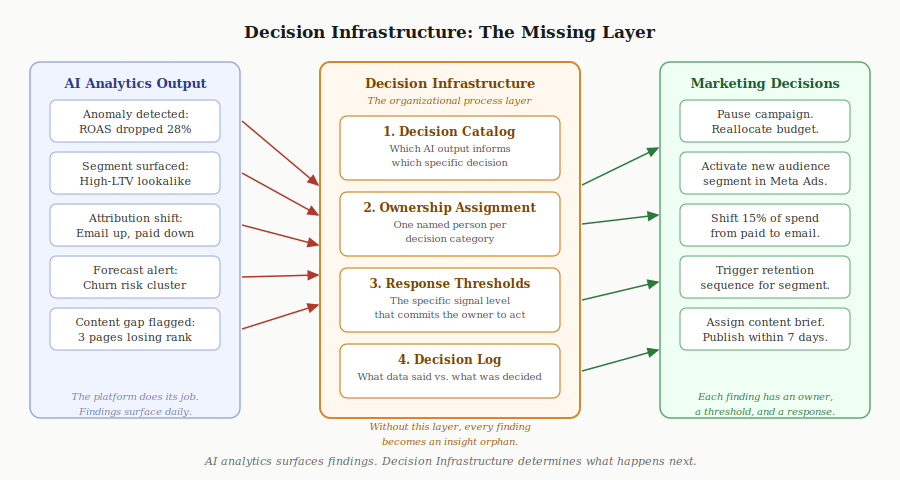
Decision Infrastructure has four components. Every team needs all four.
- Decision Catalog: A written list of every marketing decision your team makes in a given quarter (budget reallocation, campaign pause, audience targeting shift, content pivot, channel mix change), with one sentence per entry defining the specific AI analytics signal that should inform it.
- Ownership Assignment: Every entry in the Decision Catalog has one named person responsible for the call. Not a team. One person. If the answer is “it depends,” the entry needs to be broken into clearer sub-decisions until each has an unambiguous owner.
- Response Thresholds: For each decision, the specific number or pattern that commits the owner to action. “ROAS drops below 1.8 for five consecutive days triggers a campaign review with budget reallocation authority.” That level of specificity. Vague thresholds produce vague action.
- Decision Log: A running record of every significant marketing decision over the next 90 days. What AI analytics signal was available. What it said. What was decided. Review at 30, 60, and 90 days. The gap between what the data said and what you decided is your calibration data.
What Decision Infrastructure Is Not
Decision Infrastructure is not a new analytics platform. It is not a BI tool, a data governance policy, or a data team. It is not a dashboard.
These confusions are expensive, because each one leads a team to spend money rather than build a process. A new platform adds more findings to the pile. A BI tool makes those findings prettier. A governance policy determines who can access the data. A data team produces reports. None of these create the organizational agreement about what happens when a significant finding appears.
Decision Infrastructure is built in a meeting, not in a vendor portal. It is a set of written agreements between the people who generate insights and the people who act on them. You likely already have the tools you need. What is missing is the document that tells your team what to do when the platform flags something significant.
Read next: predictive analytics in marketing, which covers the forecasting and prediction layer in full.
Knowing what Decision Infrastructure is narrows the build. But before you build it, you need to know which specific version of the problem your team has. There are three. They are structurally different. The fix for one does not work for the other two.
The Three Ways the Insight-to-Decision Pipeline Breaks
Teams that are not acting on their AI analytics typically diagnose the problem in one of two ways: they need better tools, or they need to be “more data-driven.” Both diagnoses lead to the same intervention: more training, more dashboards, more pressure to use the data. The intervention changes nothing. The team concludes the problem is culture. That conclusion is both accurate and useless.
Applying the wrong fix to the wrong failure mode is why most “be more data-driven” interventions fail without changing anything.
There are three structurally different failure modes in the insight-to-decision pipeline. Each has a different root cause and a different first step. These labels come from practitioner communities, not from vendor white papers. Marketing and analytics practitioners have been naming these patterns for years in language that formal content has not caught up with.
Working across analytics programs at Hansa Cequity, I saw the distribution clearly. Enterprise retail and financial services organizations almost always had Insight Orphan as their primary failure mode: analytics teams producing accurate outputs that had no clear owner in the commercial or marketing function. The findings would surface in a quarterly review and disappear. In smaller SaaS and digital product teams I have worked with in an advisory capacity, the So What Gap dominated: the team could see the signal but had no framework for deciding whether it was significant enough to act on.
Zenloop found that 35% of CX professionals spend excessive time navigating dashboards filled with too much information. That is the behavioral signature of Insight Theater: the team is engaged with the data, but the data is not changing what they do.
On attribution: according to the IAB State of Data 2024, 73% of advertising and data decision-makers believe their ability to attribute campaigns, track performance, and measure ROI will be reduced as privacy regulations and signal loss continue. Teams already dealing with degraded attribution accuracy are acutely vulnerable to the So What Gap. When you cannot fully trust what the data is telling you about channel performance, the default is gut feel. No amount of AI analytics tooling reverses that default without a decision process in place.
Use this table to identify which failure mode you have before deciding on an intervention.
Insight Orphan: The Finding With No Owner
Insight Orphan is the most common failure mode in mid-to-large organizations. It is also the most invisible, because the analytics team is producing findings. The meetings happen. The reports go out. The organization can honestly say it does analytics. What it cannot say is that those analytics are changing anything.
The diagnostic question is specific: can you name the one person responsible for acting on your top AI analytics output right now? Not a committee. One person. Write the name down.
If you cannot, you have Insight Orphan. The fix starts with the Decision Catalog. List the decisions. Assign one owner per entry. Make the ownership explicit in writing before the next reporting cycle.
AI customer segmentation is one of the most common places Insight Orphan surfaces. The model generates a new audience segment. Nobody owns the decision about whether to activate it, test it, or discard it. The segment sits unused in the platform, and the next model run generates a slightly different segment that nobody acts on either. AI customer segmentation done right requires both the analytics layer and a clear ownership structure for what happens when a new segment appears.
The So What Gap: When the Data Is Right and the Decision Is Still Wrong
The So What Gap is the failure mode most directly linked to missing Decision Infrastructure. The data is accurate. The finding is real. The team can see it. Nobody knows what to do with it.
This is not a skills gap in the traditional sense. The team can read the dashboard. What they lack is the answer to the question that follows: ROAS on this campaign dropped 22% last week. Is that enough to pause it, change the creative, or wait another week? The analytics surface the number. Decision Infrastructure is what specifies what that number means and who makes the call.
The So What Gap closes when response thresholds exist. Not “low ROAS triggers a review” but “ROAS below 1.8 for five consecutive days, with no confounding factor in spend or targeting, triggers a pause decision by [owner] within 24 hours.” The specificity is the point. Vague thresholds produce the same outcome as no threshold: the finding surfaces, the team debates, nobody commits.
Insight Theater, the third failure mode, is different in kind. It is a symptom of the other two existing long enough that the organization has built workarounds. Teams perform data-driven behavior without any of it changing decisions. The intervention is a Decision Log audit: document what the data said versus what was decided for the last ten decisions. What you find will tell you whether you have an Insight Orphan problem, a So What Gap problem, or both.
Once you know which failure mode you have, building the fix is more straightforward than most teams expect.
How to Build Decision Infrastructure Without Rebuilding Your Stack
Teams hear “build a decision process” and assume it requires a new platform, a data team hire, or a six-month internal project. So they file it under “when we have more resources” and continue producing reports nobody acts on.
Decision Infrastructure is a process, not a technology. It requires a few hours of focused work, a shared document, and agreement from the people in the room. No new platform. The analytics tools you already have will work the same before and after. The difference is that you will have a written record of what decisions those tools are supposed to inform, who owns each one, and what signal triggers action.
The causal sequence is what most teams get backwards. They invest in tools first and expect process to follow. It does not. Process clarity first, then tool capability compounds. Most teams invert this.
The FMCG brands that got the most from their analytics at Hansa Cequity were not the ones with the best data infrastructure. They were the ones who arrived at the analysis with a specific question already formed. The question determined what was worth building. Without a question, you build models that change nothing and dashboards nobody checks.
The same pattern appeared in my advisory work with KoinX, a crypto tax SaaS with over 1.5 million users. AI-assisted SEO analytics generates keyword pattern data every week. Before we built a decision framework, those patterns accumulated without changing the content strategy. After building it, defining which pattern types triggered a content brief, which triggered an immediate page update, and which were logged for quarterly review, content velocity and decision speed both improved within 60 days. No new tools were added. One document changed how the team used the tools it already had.
Robert Half research on marketing analytics teams confirms this pattern more broadly: the gap in marketing analytics capability is decisional, not technical. Teams can read dashboards. What they lack is the organizational process for knowing what to do when the dashboard shows something significant.
Build Decision Infrastructure in four steps. This is a process project. Allocate two to four hours. Start this week.
- Build your Decision Catalog. List every marketing decision your team makes in a quarter: budget reallocation, campaign pause, audience targeting change, content pivot, channel mix shift. For each entry, write one sentence defining the AI analytics signal that should inform it. Keep it to one page. If you cannot get it to one page, you are covering too many decisions at once.
- Assign ownership. Every entry gets one named person. Write the name down. If the answer is “the team” or “it depends,” split the entry into sub-decisions until each has an unambiguous owner. A decision without an owner is not a decision. It is a recurring agenda item.
- Set response thresholds. For each decision, write the specific number or pattern that triggers action. “Conversion rate drops below 2.1% for three consecutive weeks triggers a landing page audit assigned to [owner].” Run each threshold for 30 days. Adjust based on what you observe. A threshold that never triggers is not calibrated. A threshold that triggers every week is noise.
- Start the Decision Log. For every significant marketing decision over the next 90 days, record what AI analytics signal was available, what it said, and what was decided. Review at 30, 60, and 90 days. The gap between what the data indicated and what was decided is your calibration data. That gap, tracked over time, is also the closest thing to a real ROI measurement for your analytics investment that actually means something.
You do not need a new analytics tool to start. You need to know where your pipeline is breaking and what the first repair looks like.
Run this diagnostic now.
- Pull your last five significant marketing decisions and trace each one back to the specific AI analytics signal that informed it. Write that signal down. If you cannot name it, you have Insight Orphan or So What Gap.
- Name the one person responsible for acting on your highest-priority AI analytics output right now. Not a team. One person. If you cannot name them, start with Ownership Assignment in your Decision Catalog.
- Write three marketing decisions that your AI analytics should be informing but currently is not. Those three entries are the beginning of your Decision Catalog.
- Pick one metric your AI analytics tracks and write the specific number that would trigger a decision from you. Run it for 30 days. Adjust the threshold based on what you observe.
- Record the next three significant marketing decisions you make: what data was available, what it said, and what was decided. That is your Decision Log. Review it in 30 days.
Read next: best AI marketing analytics tools. Once your Decision Infrastructure is in place and you know which decisions you need AI analytics to inform, this guide will help you evaluate which platform fits your specific Decision Catalog.
If you want help mapping your team’s Decision Infrastructure or identifying which failure mode is breaking your insight-to-decision pipeline, reach out at shankar@shno.co.