
Every vendor in your inbox is selling the same vision: AI that plans, launches, and optimizes campaigns without you touching it. On the demo, it looks like that. Then you connect it to your actual data. That is where the paradigm ends. The bottleneck in agentic AI marketing is not the AI. It is the fragmented data, broken attribution, and siloed signals most teams are running on. I have spent over a decade inside customer analytics for large retail, FMCG, and financial services brands. I can tell you exactly what breaks when autonomous systems hit a foundation not built to support them.
Agentic AI Means Goal-Directed, Not Just Automated: Here Is the Actual Distinction
Most vendors use “agentic” to describe anything that runs without manual input. If a workflow triggers automatically, they call it agentic. If a subject line gets tested without someone clicking a button, they call it agentic. The label is being stretched over any feature that reduces visible human effort. Most marketing teams are accepting that definition without questioning it. That is a mistake with real operational consequences.
An agentic system pursues a goal and decides how to reach it. A rule-following system executes what someone already specified.
Most of what teams are currently calling agentic AI falls within the definition of marketing automation. These are rule-based systems with better interfaces. Traditional automation is instruction-following: if X happens, do Y. Agentic AI is goal-seeking: given objective Z, figure out what to do and do it. That difference sounds philosophical. It is not. A rule-following system needs a human to specify every conditional path in advance. A goal-seeking system needs a human to specify the end state. Then the system must have the data to make each decision reliably on the way there. When that data is wrong, the decisions are wrong. And because no human is reviewing each step, nobody catches the error until the downstream damage is already done.
I have seen this play out at the scale that makes it legible. When I was part of the Hansa Cequity team working on the Fossil India brief, the project required pulling seven separate data sources into a single customer record. The goal was to give the call centre a complete view of each customer. Even with dedicated resources and human review at every step of the merge, we found duplicate records, conflicting preference signals, and customer identities that existed in completely different forms across different data entry points. The previous system had simply skipped the records it could not resolve. It did not make a bad decision about those customers. It made no decision. An agentic system cannot skip. It acts on whatever it gets. The quality of the action is a direct function of the quality of the input.
This is what I call the Goal Gap: the distance between what a vendor calls agentic and what the system actually does when given a goal the underlying data cannot support.
For a cleaner grounding in the difference between marketing automation and AI marketing before adding the agentic layer, that distinction is worth establishing first. The goal-seeking versus rule-following difference is where the agentic definition either holds or collapses.
The Three-Question Test for Any “Agentic” Claim
Before evaluating any product that calls itself agentic, apply this test.
First: does the system pursue a defined objective autonomously, or does it execute a predefined sequence someone already mapped? If the vendor demo shows a flowchart with conditional branches, that is automation. If the demo shows the system adapting its path based on live data to reach an outcome, that is closer to agentic.
Second: what data does the system require to make each decision, and where does that data come from? A system that requires clean identity data, accurate attribution, and real-time behavioral signals to function as advertised is telling you something important about your readiness, not just its capability.
Third: what happens when that data is missing, stale, or contradictory? This is the question most vendors do not want to answer. Push for it anyway. The answer tells you more about the product than any feature list.
If a vendor cannot answer question three clearly, the product is automation with better marketing copy. That may still be useful. But calling it agentic creates the wrong expectations about what will happen when it meets your real data environment.
The definition question is the starting point. The harder question is structural: what changes about how a marketing organization works when the decision layer moves from human to machine?
The Paradigm Shift Is Structural: What Actually Changes When Agents Run Campaigns
The most common framing of the agentic AI shift is a productivity story. AI handles the execution. Marketers get time back for strategy. The creative work stays human. The repetitive work gets automated. Nobody loses anything, everyone gains bandwidth.
The problem is that this framing misrepresents what the shift actually demands. When a human marketer makes a campaign decision, that decision sits inside an accountability structure. Someone can be asked why they made it. If it was wrong, there is somewhere to look. When an agent makes a campaign decision, accountability shifts to three things: the objectives the agent was given, the data it was trained on, and the governance structure the organization built around it. That is not a question of “who approved this email.” It is an organizational design problem, and most marketing teams are not thinking about it yet.
McKinsey surveyed senior marketing executives at Fortune 250 companies on their primary concerns about agentic AI adoption. Their top concern was not whether the technology worked. It was brand and legal governance. The executives who have looked at this most seriously had already moved past the capability question.
The governance question was what remained unanswered.
The AI adoption in marketing data shows a consistent pattern: 82% of marketers name reducing repetitive tasks as their primary AI goal, but fewer than a third have a concrete plan for how AI-generated decisions will be reviewed, overridden, or audited when they go wrong. The intent is there. The governance scaffolding is not.
The right response is not to slow down. It is to split the adoption question into two separate evaluations. First: is the AI capable of the task? Second: is your organization capable of governing it? Most teams are running only the first evaluation and treating it as sufficient. The second is where the real work is.
What the Marketing Org Chart Looks Like When Agents Handle Execution
IDC predicts that by 2028, 1 in 5 marketing roles or functions will be held by an AI worker, shifting human expertise toward strategy, creativity, and managing a blended human-and-AI workforce.
What does the other 80% look like? The functions that do not hand over to agents are the ones that require judgment that cannot be operationalized in advance. Before agents: a marketer set up the campaign, chose the audience, picked the channel, monitored performance, and adjusted spend. After agents: a marketer defines the objective, sets the guardrails, reviews anomalies, and applies brand judgment to what the agent produces.
This shift is not a reduction in value. It is a change in what creates value. In practice, agentic AI currently shows up in four functional categories: audience segmentation adjusted in real time based on behavioral signals, campaign spend reallocation across channels without manual intervention, personalization decisions made at the individual level without a human building the rule, and content variation selection based on live performance data. These are the categories worth probing in any demo. The question is always how much decision logic the system genuinely owns, versus how much a human pre-specified.
The governance and organizational questions are real. But there is a precondition underneath both of them that almost nobody in vendor-facing content is naming directly.
The Real Failure Point Is the Data Foundation, Not the AI
Most of the industry frames agentic AI adoption as a question of budget, organizational will, and tool selection. Analyst reports ask whether you are ready to commit to the investment. Vendors ask which package fits your use case. Both questions assume that if you have the intent and the resources, the deployment will work.
The reason most marketing teams will fail at agentic AI is not the AI: it is the data foundation they are trying to run it on.
The analyst evidence supports this directly. Gartner predicts that over 40% of agentic AI projects will be canceled by the end of 2027, due to escalating costs, unclear business value, and inadequate risk controls. Forrester puts the full realization of agentic AI benefits at two to five years out for most organizations. The gap is not AI capability. The AI is improving fast. The gap is what the AI is being asked to run on.
There are three specific data preconditions that almost no vendor conversation acknowledges. Each one is a place where the Goal Gap widens from a theoretical problem into an operational failure.
The Three Data Preconditions Before Any Agentic System Can Work
Identity resolution. An agentic system that treats the same customer as two separate profiles makes two separate decisions about that customer. At scale, this is not an edge case. It is a systematic error that compounds every time the system acts.
I spent two years at Hansa Cequity building CRM and analytics strategy for large enterprise brands. The Fossil India project required unifying seven separate data sources into a single customer record for the call centre team. Even with dedicated resources and human review at each merge step, the reconciliation work was significant. Customer identities existed in different forms across different system entry points. Some profiles were clear duplicates. Others were ambiguous matches that required resolution rules to handle. The previous system had skipped the ambiguous cases entirely. It never made a bad decision about them. An agentic system cannot skip. It decides. And if the identity is wrong, every downstream decision is wrong too.
If you run a loyalty programme, an e-commerce platform, or any CRM with more than a few years of history, assume you have identity duplication at a scale that will matter. Audit it before you hand decision-making to an autonomous system.
Attribution accuracy. An agent that optimizes based on an overclaiming attribution model shifts budget toward the channels claiming the last touch, and bleeds spend away from the channels that actually drove the decision.
The agent is not wrong. It is correctly optimizing against a flawed objective function.
The Westside ClubWest loyalty programme I worked on at Hansa Cequity had 2.7 million members. When we dug into the lapsed member base, we found that 73% of recent lapsers were on DND, unreachable by SMS, and 63% had not opened a single email in months. If an autonomous system had been scoring re-engagement propensity from email engagement signals, it would have written off most of those customers. The signal said: disengaged. The reality was: wrong channel. We ran re-engagement through Facebook Custom Audiences instead. It worked well enough to win a CMO Asia Award for Best Use of Facebook.
An agentic system acting on the email signal alone would never have found that path. It would have correctly identified low email engagement and correctly optimized away from those customers. The flaw was upstream of the AI, in the attribution picture it was given.
Unified behavioral context. An agent making personalization decisions needs a complete picture of what a customer has done across all touchpoints. If session data lives in one platform, transaction history in another, and support interactions in a third, and none of them communicate in anything close to real time, the agent is personalizing against an incomplete picture. The more autonomous the system, the more consequential that incomplete picture becomes.
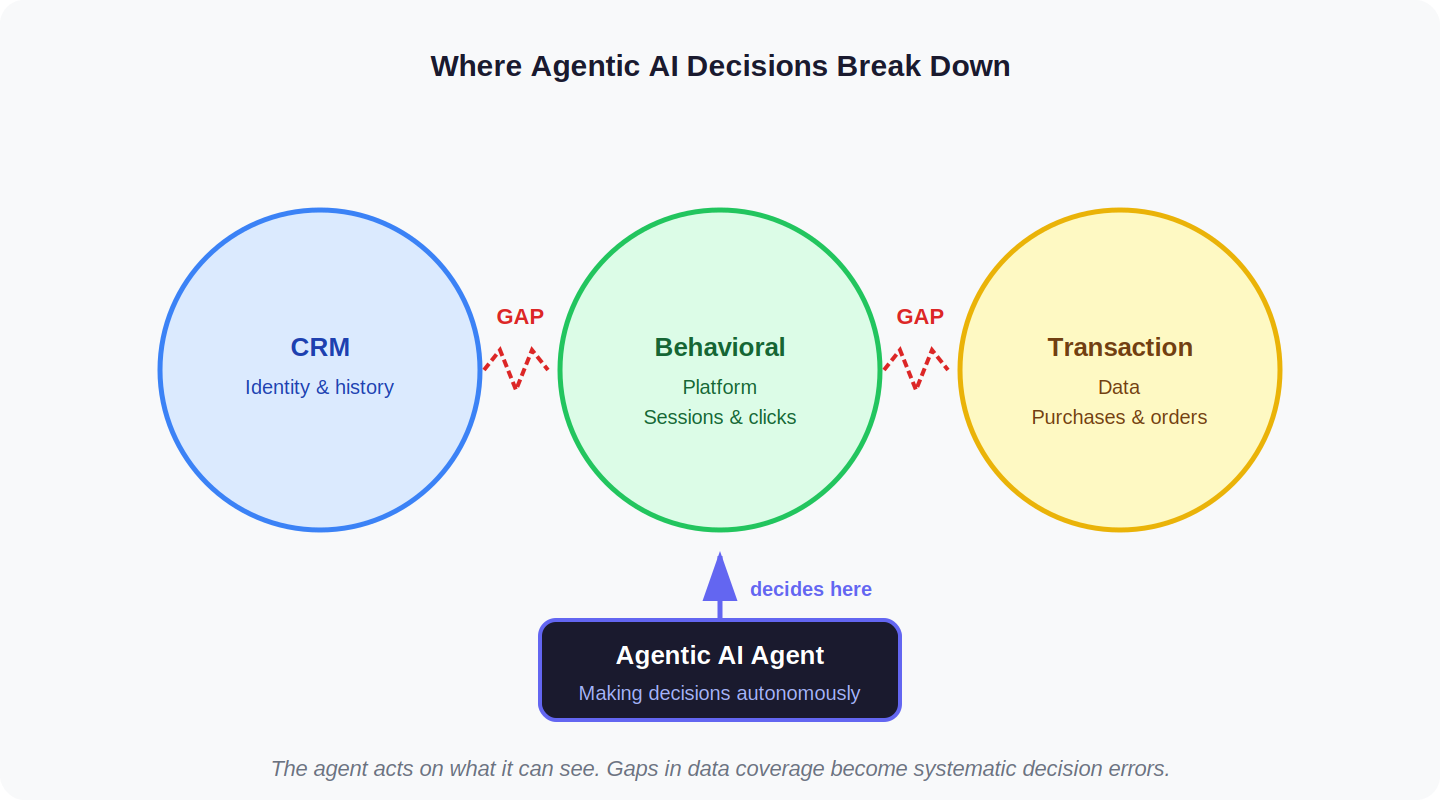
The teams winning at data-driven marketing today are the ones whose data foundation is clean enough to trust. That same foundation is the prerequisite for agentic AI working at all.
Before committing to an agentic AI investment, audit your data foundation against these three questions. Can you resolve a single customer identity across all your data sources? Does your attribution model credit touchpoints based on actual influence, or on which came last? Do your behavioral signals from different platforms communicate in anything close to real time? A no on any of these means the agentic AI problem is downstream of the problem you need to solve first.
The data foundation is the precondition for everything else. Once it is in place, the next question is not about the tools at all.
The New Work of Marketing Is Judgment, Not Execution
The standard reassurance when agentic AI and job displacement come up in the same conversation is this: AI takes the repetitive work, humans focus on strategy. That is not wrong. But it is stated at too high an altitude to be useful. “Focus on strategy” is not a job description. It does not tell a marketing manager what their Monday looks like when an agent has handled their campaign queue.
The more specific answer is that when agents handle execution, three capabilities determine who compounds value and who does not. Objective-setting: the ability to define what success means for a specific customer segment in a specific competitive context, stated precisely enough for an autonomous system to act on without systematic distortion. Governance: the ability to design review structures that catch edge cases and brand failures before they reach customers. Brand judgment: the ability to evaluate AI-generated output for tonal, contextual, and cultural fit that no metric captures.
These are skills, not attitudes.
In advisory work with growth-stage SaaS companies, the marketing problems that do not resolve with AI tools belong to a consistent category. The team cannot agree on what “good” looks like for a new segment. The content the AI produces is technically correct but tonally wrong for the brand. The metrics the team is optimizing against are measuring the wrong thing, and nobody noticed until the AI started producing results that surprised everyone. These were judgment problems before AI existed. They remain judgment problems after it. The difference is that the cost of poor judgment is higher when an autonomous system is acting on it at scale.
Build explicitly for the three functions agents cannot perform. Objective-setting: decide what you are optimizing for and why, before the system runs, not while it is running. Governance: define what a failure looks like in writing, with specific thresholds, before deployment. Brand judgment: build a review protocol for AI-generated output that goes beyond accuracy checks and assesses what only someone who knows the brand deeply can evaluate. These are not bureaucratic additions to the workflow. They are the workflow that makes everything else safe to hand over.
The teams that build these capabilities now will compound their advantage as the tools improve. The teams that wait will spend their time firefighting agent errors rather than directing agent outcomes.
Here is what to do before you commit to any agentic AI deployment.
- Run an identity audit. Pull a sample of 1,000 customer records and check how many individuals appear as multiple profiles across your CRM, email platform, and behavioral data tools. A duplication rate above 5% means your identity layer is not ready for autonomous decision-making.
- Challenge your attribution model. Run one month of campaign performance through both last-click and data-driven attribution. Map where the biggest discrepancies are by channel. The channels where these models most disagree are the channels where an autonomous agent will make the worst decisions.
- Map your data communication gaps. List every platform that holds behavioral data about your customers. For each one, note how often it syncs with your central customer record and what it does not capture. Anywhere the sync gap exceeds 24 hours, or a data type never makes it into the central record, is a place where your agentic system will operate blind.
- Define your governance minimum before anything goes live. Write down, in one document, what an autonomous campaign failure looks like. A specific brand violation. A compliance breach. A budget misallocation threshold. If you cannot define failure before deployment, you cannot build a system that catches it.
- Start with a closed-loop pilot. Pick one workflow where the inputs and outputs are fully within your controlled data environment. Run the agent on that workflow for 60 days before expanding scope. The goal is not to prove the AI works under optimal conditions. It is to find every edge case your data foundation produces before it causes damage at scale.
If you are ready to look at the specific tools and deployment models for agentic AI in marketing, the next piece covers exactly that.