
.jpg)
You asked AI to build your content calendar. It handed you thirty topics that looked plausible, and three months later the content feels generic, disconnected, and is not building anything. It is not AI that is the problem. It is the order in which you are using it. I have built content programmes from scratch for brands like Westside and TataSky and grown Shnoco to 50,000 monthly readers using nothing but content and search. Here is how to plan a content calendar with AI that actually compounds: set the strategic direction first, then deploy AI to execute against it.
Most AI Content Calendars Fail at the Same Step
Most teams approach AI content planning the same way. They open ChatGPT, describe their industry and target audience, and ask for a content calendar or a topic list to plan around. The AI returns something that looks reasonable. It covers the category, mentions the right keywords, sounds like something a content strategist would say. So they populate the calendar and start publishing.
Three months later, nothing is working. The content is getting indexed. It is not ranking. What traffic arrives bounces. The whole calendar feels like it belongs to a brand that is not quite theirs.
AI generates statistically likely topics for a category, not strategically correct topics for a specific brand position.
This is the core problem. AI pattern-matches against what already exists and is already indexed. When you describe your industry and ask for content ideas, what you get back is the average content programme for your niche. The topics are high-volume, widely covered, and occupied by brands that have been publishing in that space for years. You are not getting a tailored strategy. You are getting a statistical summary of what everyone else is already doing.
The problem is not that teams are slow to adopt: AI adoption in marketing has grown sharply across every function in the last two years. And if you look at the broader data, AI content marketing statistics show that adoption rates are high, but the gap between using AI and producing differentiated output that actually performs is wide. Most people are using it. Most are not getting the results they expected. The tool is not the issue. The order of operations is.
I run SEO and content strategy for KoinX, a crypto tax SaaS with over 1.5 million users. Every time I ran an AI-generated topic list against the competitive landscape, the overlap with what existing players were publishing was significant. High volume, low differentiation. The content that actually drove traffic, earned citations, and brought in users ready to pay was identified through a different process entirely: specific audience questions that were not being answered well anywhere, informed by a real understanding of where users were stuck in a fast-changing regulatory environment. AI could not have surfaced those topics from a standing start. It could only confirm them after the human identified the gap.
Most AI-assisted content planning fails not because the AI is bad at generating topics, but because generating topics was never the hard part. The hard part is knowing which topics your brand has any right to own, and AI cannot tell you that.
Before you can use AI to plan a content calendar that compounds, you need what I call the Direction Layer. It is a defined set of decisions about your position, your audience’s actual problems, and your competitive angle. Without it, every AI-assisted planning session produces the same undifferentiated output. The next section defines exactly what it contains.
The Direction Layer: What Must Be Set Before AI Touches Anything
Here is the most common version of this mistake. A team or founder describes their business to an AI tool, asks it to define their content pillars, accepts what comes back, and builds the entire editorial calendar on top of those AI-generated pillars. The output sounds right. It usually covers product, audience, industry, and thought leadership. These are the correct content pillar categories for most businesses in most categories, which is precisely the problem.
AI returns the most commonly used pillars for a category. They are correct in the sense that they are genuinely relevant. They are wrong in the sense that your competitors are using the exact same ones. Content pillars built from AI prompts reflect what the category discusses, not what your brand specifically knows, has experienced, or is positioned to say differently. The content produced against those pillars looks relevant on a spreadsheet. It never differentiates.
The Direction Layer is the set of strategic decisions about your brand’s position, editorial point of view, and competitive context that must be made before AI can plan content that is worth executing.
The experience that taught me this most clearly was building Shnoco, a no-code and builder community that grew to 50,000 active monthly readers using nothing but content and search. When I started, every other resource covering no-code tools was doing the same thing: publishing top-ten tool lists, roundups of Webflow alternatives, comparisons of automation platforms. The category was full of that content and it all looked the same because it was all produced the same way.
The decision that changed everything was made before the first piece was published. I decided Shnoco would only cover tools I had personally built with and tested under real conditions, with specific observations about where they broke, what they could not do, and who they were actually suited for. Not curation. Not aggregation. Specifically what I found when I built things and where the tools failed me. That editorial position was set by me, informed by the work, before AI tools were part of the workflow at all. No AI prompt could have generated that position. It was earned and it could only be decided by the person who had done the actual work.
That is what the Direction Layer is. Here is what it contains.
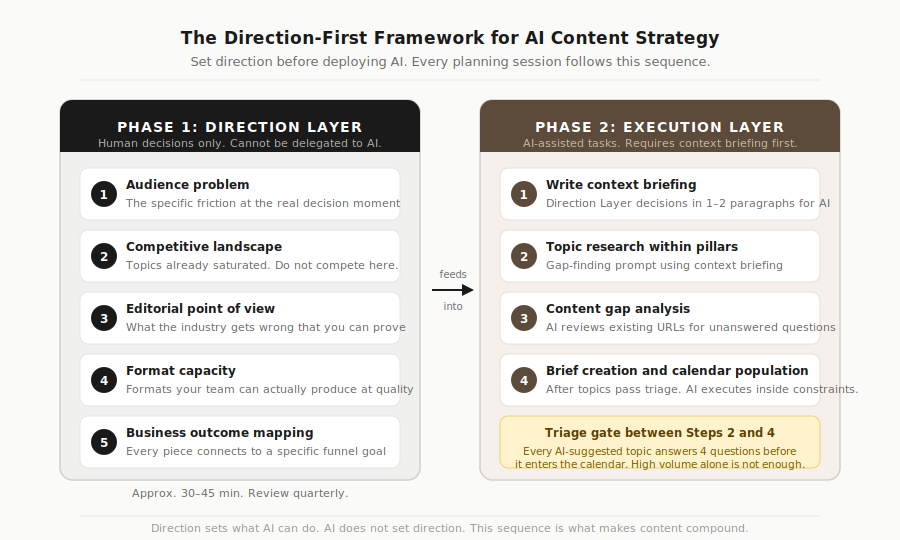
The five Direction Layer decisions:
- What specific audience problem are you uniquely positioned to address? Not what the category is broadly about. What you specifically know about the moment in your audience’s experience where they are stuck, confused, or making a decision badly. This is the problem you are writing to solve.
- What content has your competition already saturated? These are the topics AI will always suggest because they are high-volume and commonly published. Knowing them is not optional. You need this list before you ask AI for anything, so you can exclude it from the brief.
- What is your editorial point of view? The specific thing the industry overstates, gets wrong, or ignores entirely. Your content will argue it, prove it, or demonstrate it through specific evidence. If you cannot state your editorial POV in one sentence, you do not have one yet.
- What formats can you actually produce at quality? AI will suggest whatever format is most common in your category. You can only execute in formats your team has real capacity for, and the best content is produced by teams building in the formats they know, not the formats that sound most impressive in a strategy document.
- What business outcome does each content type serve? Every piece needs a reason to exist beyond “it is relevant to our industry.” Organic ranking. Audience trust-building. Lead capture. Customer retention. Without this mapping, the calendar fills with content that serves nothing specific, and nothing specific is what you get in return.
The Direction Layer work takes roughly 30 to 45 minutes the first time. After that it lives as a one-page document you update quarterly. It is what you hand AI every single time you ask it to do anything involving content planning.
Read next: content-led growth benchmarks show what compounding content programmes look like in practice and what separates the ones that compound from the ones that plateau.
The Execution Layer: Where AI Earns Its Place in Content Planning
After seeing the Direction Layer fail in practice, some people conclude AI is not useful for content planning. They go back to manual research, keyword spreadsheets, and editorial calendars built entirely by hand. That is one kind of mistake.
The other kind is worse. Someone builds their Direction Layer, does the positioning work, documents the decisions, and then opens ChatGPT and asks for content ideas in exactly the same way they always have. Without feeding the Direction Layer into the AI as structured context first. The output is identical to what they were getting before, and they cannot figure out why the strategy work did not change anything.
Feeding AI a general business description and expecting it to produce a differentiated calendar is the equivalent of hiring a new contractor, giving them no brief, and asking them to design a product.
The brief is the Direction Layer. AI without it produces category averages. AI with it produces gap-identified, position-consistent content ideas that your team can actually execute and defend.
At GrowthMentor, I spent roughly three years on the marketing team building the content engine that drove organic discovery and signups for the platform. Once the content pillar decisions were in place, which growth problems the platform’s mentors were specifically expert in, which keyword territory competitors already owned, what the editorial voice required, AI-assisted topic research and brief creation cut the time between a keyword being identified and a publish-ready brief reaching the writer by approximately 60%. The quality held because the positioning was already defined. AI was executing tasks inside a direction someone had already set. It was not being asked to be the strategist.
The Execution Layer is the set of content planning tasks AI can perform reliably when given Direction Layer decisions as structured context. It has four steps.
The Execution Layer workflow:
- Write a context briefing before every AI planning session. This is one to two paragraphs, not a novel. Feed it your Direction Layer: your specific audience problem, your editorial point of view, the competitor topics you are not going to try to displace, and the format you are planning for. Every planning session starts with this document. AI gets nothing without it.
- Use AI for topic research within your defined pillars. The prompt changes completely when you have a context briefing. Not “give me content ideas for [industry].” Instead: “I cover [specific problem] for [specific audience]. My editorial position is [POV]. Here are the topics my competitors already own: [list]. What questions within my pillar are not well-answered by existing content?” The difference between that prompt and a generic one is the difference between a topic list that mirrors the category and one that identifies actual gaps your brand is positioned to fill.
- Use AI for content gap analysis against your existing content. Feed it your published URLs alongside your context briefing. Ask it specifically what questions your audience is likely still asking that your existing content does not address. This is a genuine AI strength that most editorial teams significantly underuse. The compounding effect of gap-identified content is well-documented in content SEO statistics, and it remains the most underused application of AI in most editorial planning workflows.
- Use AI for brief creation and calendar population within constraints. Once topics have passed triage (covered in the next section), AI can build structured briefs with consistent format, populate a calendar with sequencing logic and seasonal considerations, and suggest format variation across a quarter of content. At this stage it is operating inside a defined direction. That is where it adds genuine value.
The four steps run in sequence. You do not skip to brief creation without completing triage. You do not run gap analysis without the context briefing in place. The efficiency gains come from operating inside a defined system, not from using AI as a shortcut around it.
How to Triage When AI Gives You Fifty Topics and All of Them Look Fine
Even with a context briefing and Direction Layer in place, a well-prompted AI planning session will return more topics than you can execute. Some will be genuinely strong. Some will look relevant but carry no real differentiation. The instinct most teams act on is to sort by estimated search volume and work from the top. That instinct produces the wrong result almost every time.
Volume and differentiation are often inversely related.
High-volume topics exist because many people search for them. Which also means many publishers have already covered them, and the brands with the strongest domain authority in your category have probably published definitive versions. AI will always surface these topics first because it is pattern-matching against what already exists and is heavily indexed. Executing against them first is optimising for the content your brand is least equipped to win with.
I saw this pattern clearly at KoinX. The AI-suggested topic list for the crypto tax category consistently foregrounded the highest-volume terms. “How to calculate crypto tax.” “Best crypto tax software.” “Crypto tax guide for beginners.” Technically correct priorities by volume. Completely wrong priorities for a brand trying to build differentiated authority in a category already occupied by well-resourced competitors publishing the exact same content.
The topics that drove qualified traffic, earned citations, and brought in users with genuine purchase intent were found through a different lens: specific regulatory edge cases that were causing real confusion, questions nobody was answering clearly because the answers required understanding both the tax code and how specific DeFi transactions are structured. Not AI’s first suggestions. Found through understanding the actual friction in the audience’s experience. AI could be used to research and brief those topics once identified. It could not have surfaced them independently.
Triage is not about finding mistakes in the AI’s output. It is about finding the gap between what the category already covers adequately and what your brand specifically is positioned to add.
Four questions to ask about every AI-suggested topic before committing to it:
- Does this reflect something we know specifically that a well-resourced competitor does not? If a brand with stronger domain authority and a larger content team could write this piece with equal quality, your version starts at a disadvantage by default.
- Is this already well-covered by a competitor who will be hard to displace in search? If yes, the question is whether you have a specific angle that changes the competitive calculation. High volume without a genuine angle is a slow content investment with low probability of return.
- Does publishing this move the business toward a specific outcome from the Direction Layer? If a topic cannot be connected to a goal you defined in the Direction Layer, it does not belong in the calendar regardless of how relevant it seems.
- Can you write this with a point of view that makes it different from what ranks today? Not different in structure or length. Different in position. Different in what it argues, proves, or demonstrates from direct experience.
Topics that pass all four go into the calendar. Topics that pass two or three are candidates for a future cycle or need a stronger angle before they are committed to. Topics that pass one or fewer are cut, regardless of search volume. The calendar that comes out of this process will be shorter than the AI’s original list. It will also perform better.
Evergreen content data consistently shows that a disproportionate share of organic traffic across any site concentrates in a small number of high-performing pieces. That is exactly why this triage framework favours fewer, more differentiated topics over a full calendar of adequately relevant ones. Ten pieces you have a genuine right to own will outperform forty pieces the category already covers.
Here is the complete workflow, applied from the start. The Direction Layer decisions take 30 to 45 minutes to document. The review cycle is quarterly. The triage questions run every time new topics are added to the consideration set.
Five steps to put this into practice today:
- Write your Direction Layer before your next planning session. Answer the five questions in the section above. Document the decisions in one page. Do not open any AI tool until this page exists.
- Build a context briefing from your Direction Layer answers. One to two paragraphs. Audience problem. Editorial POV. Competitor topics you are not chasing. Format constraints. This is the input AI gets before every planning session from now on.
- Run your last AI-generated topic list through the four triage questions. Cut any topic that does not pass at least three of the four. The shorter list you are left with is more valuable than the original.
- Use AI for gap analysis within your defined pillars. Feed it your existing content URLs and your context briefing. Ask what questions your audience is likely still asking that your published content has not addressed. This is your next batch of candidate topics.
- Build the calendar from the output of steps 3 and 4, not from a fresh AI prompt. Populate it with topics that passed triage and gaps identified by the analysis. Leave 20 to 30 percent of the calendar open for reactive and topical content that cannot be planned in advance.
If you want help applying this framework to a real content programme, reach out at shankar@shno.co.