
You’ve read six comparison articles on the best AI marketing automation platforms. You still don’t know which one to buy. That is not a research problem. The articles skip a prior test that makes every comparison useless without it: the readiness test, the four things that have to be in place before any platform’s AI features deliver real lift. I spent nearly a decade running customer marketing for brands with millions of members across retail, banking, and consumer goods, then the last several years advising SaaS founders on their growth stack. I’ll show you the test first. Then the platforms.
Your Data, Not Your Platform, Determines Whether AI Automation Works
Most buyers start by booking demos. They pick two or three platforms from a comparison article, sit through walkthroughs of the same dashboards, and make a decision based on which interface feels cleaner or which sales rep showed up more prepared. The data situation, the team capacity, and the CRM architecture never come up. They sign a 12-month contract before anyone checks whether the preconditions for AI automation to actually work are in place.
This is the error. AI features in marketing automation platforms are conditional. They do not perform on command. Predictive lead scoring requires a sufficient volume of historical behavioral data before the model produces reliable predictions. Send-time optimization needs months of engagement data per contact before the timing recommendations outperform a sensible human default. Generative content tools produce generic output without brand context, audience understanding, and editorial judgment from someone who knows what the reader actually cares about. None of these conditions are created by buying the platform. They have to exist before you buy it.
I’ve seen this play out directly. At Hansa Cequity, I worked on a loyalty programme with 2.7 million members for one of the largest department store chains in the country. The automation was running. The workflows were configured. The platform was fine. Re-engagement campaigns were producing almost nothing.
When we dug into why, the problem was the data, not the platform. Seventy-three percent of the lapsed members we were targeting were on Do Not Disturb (DND) registers, unreachable by SMS regardless of what the platform sent. Sixty-three percent had not opened a single email in months. The CRM stack was essentially talking to itself. The automation was running on a contact base that could not receive the messages. No platform upgrade would have fixed that. The data state made the automation irrelevant.
What would have fixed it is a readiness check before the campaign was built.
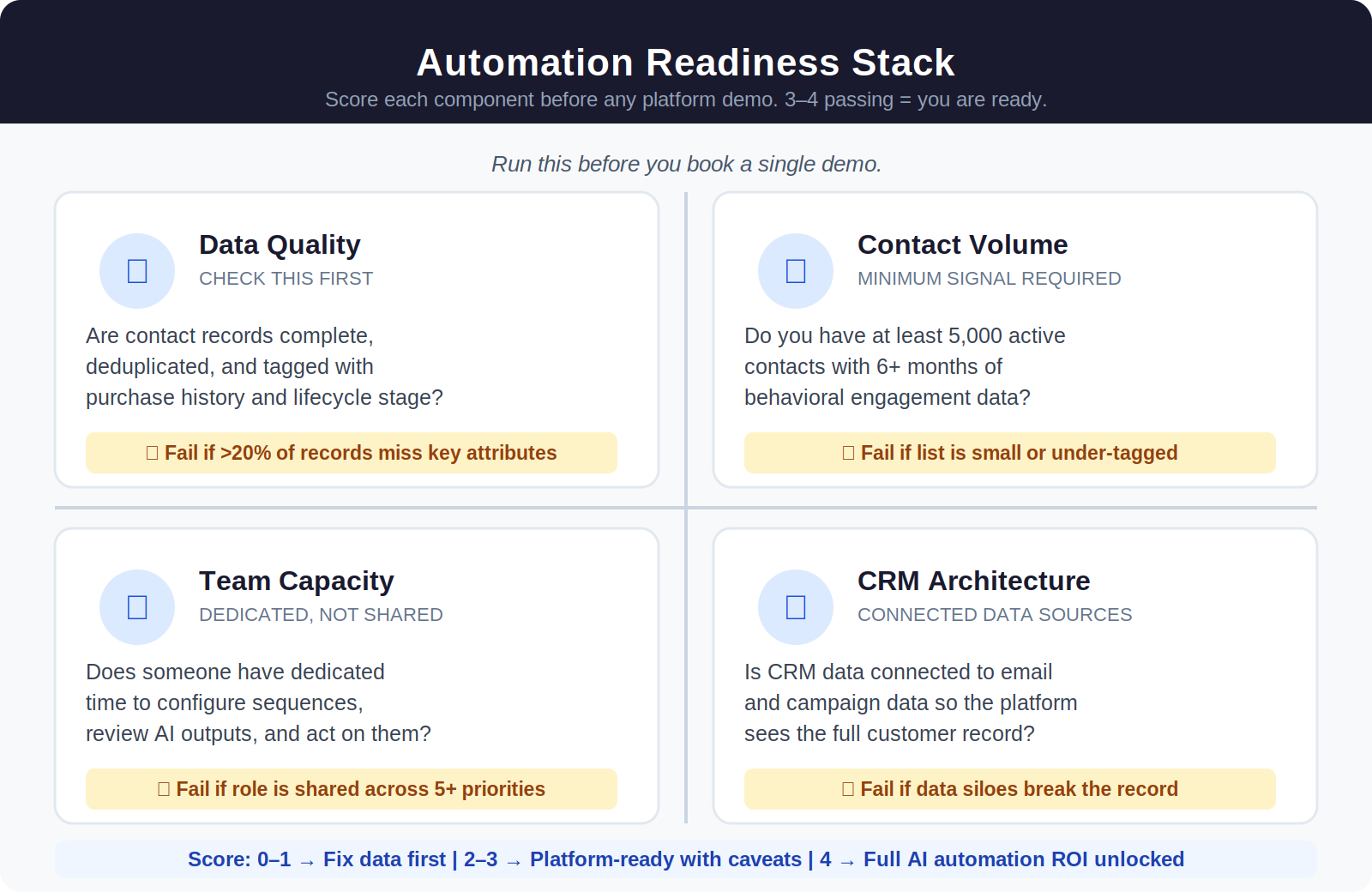
The Automation Readiness Stack is a four-component check that determines whether a platform’s AI features will deliver measurable lift or deliver invoices. Score yourself honestly on each before you open a single platform demo.
1. Data quality. Are your contact records complete, deduplicated, and tagged with behavioral data: purchase history, engagement level, lifecycle stage? If more than 20% of your records are missing key attributes, your AI features will train on noise and produce outputs that reflect it. The Westside situation was a data quality failure before it was anything else. The platform was fine.
2. Contact volume. Do you have at least 5,000 active contacts with six months of behavioral data? Below this threshold, most predictive models produce unreliable outputs. The model needs signal. A small, undertagged list is not signal.
3. Team capacity. Does someone on your team have dedicated time to configure automation sequences, review AI outputs, and act on the insights the platform surfaces? Not shared time. Dedicated time. A platform without human oversight is a workflow waiting to break. The AI suggests. A person still has to decide and act.
4. CRM architecture. Is your CRM data connected to your email and campaign data in a way that allows the platform to see the full customer record? Disconnected data siloes are the most common reason AI automation underperforms expectations. If your contacts are not segmented by lifecycle stage, purchase behavior, or engagement tier, the platform has no meaningful signal to work from. This is the foundational problem that AI customer segmentation addresses before automation can run on top of it.
The marketing automation with AI statistics show adoption accelerating across company sizes. Platform adoption and implementation readiness are not the same thing. The number of companies buying these platforms is growing fast. The number that have done the readiness work is a different, smaller number.
Score yourself on these four components before any demo. A score of 1 or 2 does not mean you should delay indefinitely. It means you know what to fix before the platform can do its job.
The AI label on a marketing automation platform tells you almost nothing about whether it will improve your marketing results; what determines ROI is whether your data, team, and workflows were ready before you bought in.
Knowing that readiness is the prerequisite changes how you read platform feature lists. The next question is what “AI features” actually means inside these platforms. Not what the marketing page says. What the platform actually does under that label.
Most AI Features in Marketing Automation Platforms Are Relabeled Rule-Based Automation
Buyers compare platforms by AI feature checklists. If both HubSpot and ActiveCampaign list “AI-powered segmentation,” “predictive send time,” and “AI content assistant,” most buyers assume those capabilities are equivalent and make the decision on price or interface feel. The feature names are identical. The underlying architecture and the conditions under which each actually works are not.
Two architecturally different things are sold under the same label. A predictive model trained on years of behavioral data is not the same as a rule-based workflow with a natural-language interface for building it. Both get called “AI features.” One is a prediction model built on years of behavioral data. The other is a generative text tool. Treating them as equivalent in a comparison is like treating a cardiologist and a first-aid kit as equivalent because both relate to health. The distinction matters for your budget and for what you can actually expect.
Here is how to sort the genuine from the relabeled.
Genuine AI capabilities: the ones worth paying a tier upgrade for.
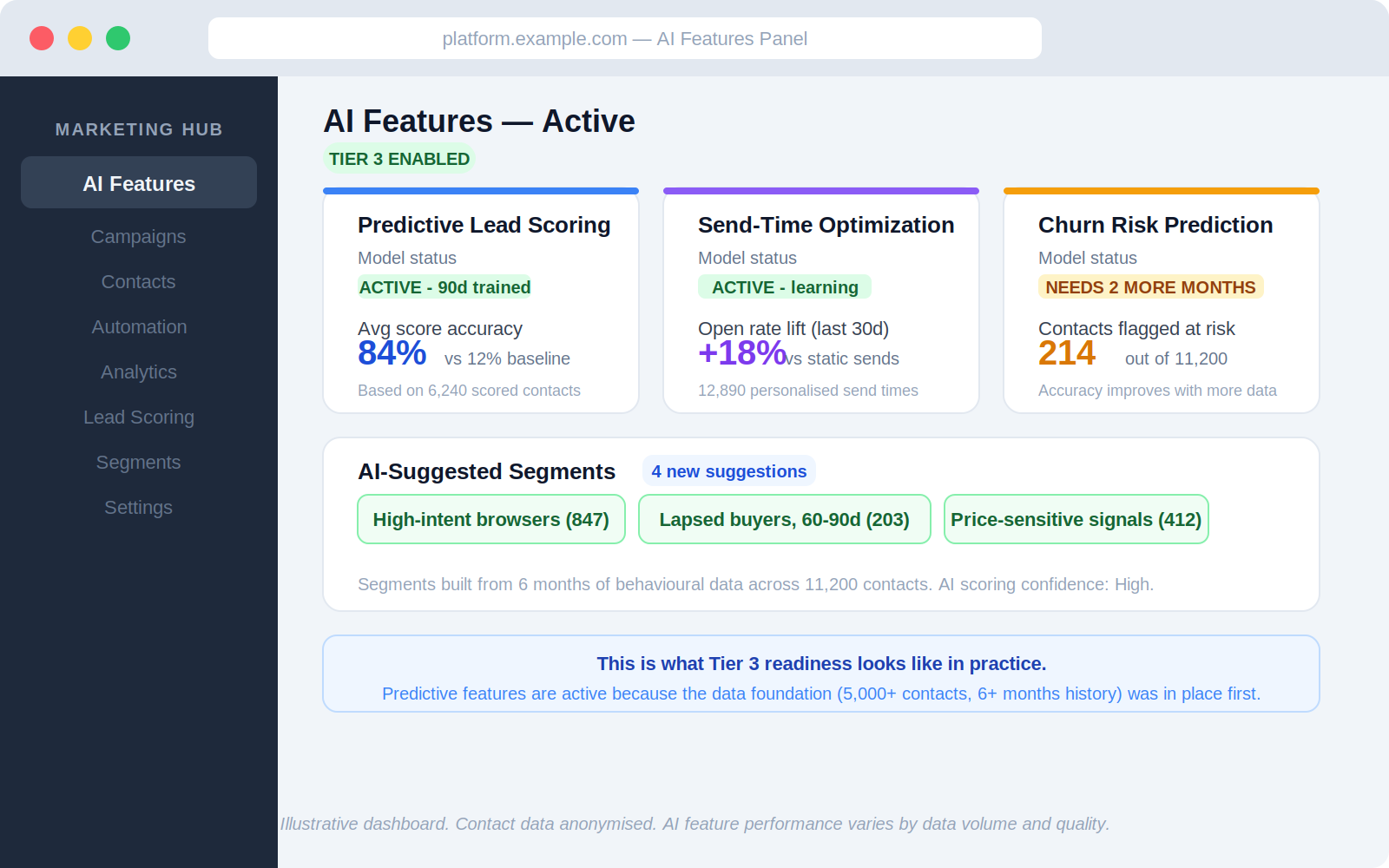
- Predictive send-time optimization. A statistical model trained on individual contact engagement history. It outperforms generic send times after approximately 90 days of engagement data per contact. The more behavioral history the model has, the more reliable the prediction. This is real. It requires data and time to become useful.
- Purchase propensity scoring. A behavioral model that ranks contacts by likelihood to convert based on observed actions: pages visited, products viewed, purchase history, recency. Requires transaction data. Klaviyo’s implementation for e-commerce brands is among the strongest in the category, trained on broad behavioral data across its customer base. HubSpot and Marketo offer versions at higher tiers using CRM data as the behavioral signal.
- Churn prediction. Available in enterprise-tier platforms including Salesforce Marketing Cloud and Marketo Engage. Requires 12 or more months of behavioral data across the full customer lifecycle before the model’s outputs are reliable. Not useful for companies without that history loaded and clean in the platform.
Relabeled automation with AI branding: valid tools, but not what most buyers mean by AI.
- AI-powered segmentation (in most implementations). Most versions are rule-based audience filters with a natural-language interface for building them. You describe your segment in plain language instead of setting dropdown conditions. The underlying audience logic is still if-then. The AI is in the input method, not the segmentation intelligence.
- AI automation builder. Natural-language prompts that generate workflow rules. It produces the same if-then logic as the visual workflow builder, only faster. More convenient. Not more intelligent in execution.
- AI content assistant. Generative text for subject lines, email copy, and CTAs. Useful as a starting point for a draft. Requires significant editing to match brand voice and audience context. It is a blank-page remover, not a content strategy.
This does not mean the second category is worthless. The AI automation builder saves real time. The content assistant reduces friction. But neither category justifies a tier upgrade on its own. The genuine AI capabilities do, under the right readiness conditions.
I ran into this distinction directly while advising a SaaS company on their email automation setup. They had just upgraded to a tier that included predictive send-time optimization and were expecting immediate lift. Six weeks in, their open rates had not moved. When I looked at the data, the problem was obvious: they had around 3,000 contacts and the platform had roughly eight weeks of engagement history to work from. The model was producing predictions, but they were barely distinguishable from a sensible default. We let another four months pass, cleaned the list down to active contacts, and added behavioral tagging from product events. Their open rates improved by 14 percentage points in the following 60 days. Same platform. Same feature. Different data foundation. That is the only variable that changed.
Ask three questions at every platform demo before accepting any AI feature claim.
- How long does this model train on my data before it produces reliable predictions? If the answer is “it works immediately,” it is not a predictive model.
- What minimum contact volume produces accurate results? If there is no stated minimum, it is rules-based, not model-based.
- What happens if my input data has gaps or duplicates? If the answer is “just clean your data first,” that is the honest answer. Be suspicious if they say the model handles messy data automatically.
Once you can separate the genuine AI features from the labels, the pricing question becomes unavoidable. This is where most comparison articles fail the reader most completely.
The Tier Where AI Works Costs Three to Ten Times the Advertised Starting Price
Comparison articles list starting prices. HubSpot: from $9 per month. ActiveCampaign: from $9 per month. Marketo: contact for pricing. These numbers create a completely false picture of what a marketing team actually pays once they need the features that justify choosing any of these platforms over a basic email tool.
Every major AI marketing automation platform gates its genuine AI capabilities behind tiers that cost significantly more than the advertised entry point. The starting price buys access to the platform and basic automation. It does not buy predictive features. It does not buy AI-assisted audience building, advanced lead scoring, or meaningful personalization at scale. According to Grand View Research, the global marketing automation market was valued at $6.65 billion in 2024 and is projected to grow to $15.58 billion by 2030. The full marketing automation statistics page covers those adoption figures in detail. What those reports do not cover is what the investment actually buys at each tier.
The platform that looks cheapest at month 1 is often not the platform that looks cheapest at month 12.
Here is what the major platforms actually cost at the tier where AI features activate, with a three-person team and 10,000 contacts.
Pricing accurate as of Q1 2026. Contact-volume scaling adds cost at every platform beyond these base figures.
A note on the two most commonly evaluated platforms: HubSpot Marketing Hub Professional is priced at $890 per month and includes 3 core seats. A team of 4 hits approximately $940 per month before contact-volume scaling. At 50,000 contacts, add roughly $300 per month more. ActiveCampaign Professional starts at $129 per month for 500 contacts and scales steeply with list size.
On Marketo: Adobe does not publish list prices. Based on Vendr’s analysis of over 117 Marketo contracts, the average annual contract runs $112,544. Most mid-market and enterprise teams land between $1,500 and $6,000 per month once database volume, email send limits, and required add-ons are included.
Klaviyo is the outlier in the table in a meaningful way. Its predictive AI features are available across its paid tiers, not gated to a premium level. The trade-off is that model quality scales with data volume. A Shopify store with three months of transaction history will get less from Klaviyo’s propensity model than a store with three years. The platform is not hiding capability behind a paywall. It is giving you the capability and letting the data determine how well it works. That is the honest version of what every platform should tell you.
The fix is a 12-month cost model built before any platform evaluation. Three inputs: your contact count today, your projected contact count in month 12 based on the last six months of growth, and the specific AI features identified from the list in Section 2 that you actually need. Price each platform at the tier that activates those features, at your month-12 volume. That is the number that belongs in your budget conversation. Not the starting price.
Read next: measuring AI marketing ROI once you have committed to a platform and a tier.
The cost table tells you what each platform charges at the tier where AI works. What it does not tell you is which of those tiers matches where you actually sit on the Automation Readiness Stack.
Picking a Platform Above Your Readiness Tier Is the Fastest Way to Waste an Automation Budget
Teams look at Tier 3 and Tier 4 platforms because they want to grow into the capability. They choose HubSpot Professional or Marketo not because they are ready for it today but because they intend to become ready. The platform becomes aspirational infrastructure for a team and data situation that does not yet exist. The features go unused. The invoice arrives every month anyway.
A team with messy CRM data, no dedicated marketing ops resource, and 2,000 contacts on a mixed-quality list will not extract AI lift from HubSpot Marketing Hub Professional at $940 per month. The same team, with a clean 2,000-contact list, three well-structured lifecycle sequences, and a marketer who reviews campaign performance once a week, will extract meaningful lift from ActiveCampaign Plus at $49 per month. The gap between what a platform promises and what it delivers is a function of readiness, not price.
I saw this clearly when advising an early-stage SaaS founder who came to me with a shortlist of two platforms: HubSpot Professional or Marketo. Budget was set. They were ready to sign. Contact list: 1,800 people, sourced from three different tools, no consistent lifecycle tagging, significant duplication. I ran the Automation Readiness Stack. They scored 1 out of 4. Data quality failed. CRM architecture failed. I recommended ActiveCampaign Plus at $49 per month and a six-week data cleanup project before any automation sequence was built. Six months later, their email engagement rate had more than doubled, their three lifecycle sequences were running cleanly, and they had the data foundation that made a platform upgrade worth evaluating for real. The platform ambition was not the problem. The readiness was.
Here is how to match platform to readiness tier.
Tier 1: Data not ready. Team under 0.5 FTE dedicated to automation. Automation Readiness Stack score: fewer than 2 of 4 components passing. Recommended platforms: Brevo Business (approximately $65 per month) or ActiveCampaign Lite ($9-19 per month). What to do first: Fix data quality and build three lifecycle sequences before touching a platform upgrade. The AI features at higher tiers will not function meaningfully on an unready database. These platforms handle the basics well. Use them for that purpose and build toward Tier 2 deliberately. Spending $890 per month on a platform whose AI features your data cannot support is not a growth investment.
Tier 2: Data reasonably clean. One dedicated marketer. Budget constrained. List under 10,000 contacts. Automation Readiness Stack score: 2-3 of 4 components passing. Recommended platforms: ActiveCampaign Plus ($49-99 per month) or Klaviyo Core for e-commerce brands (approximately $150-200 per month at this volume). Why this works: ActiveCampaign’s AI features at Plus level, including predictive sending and AI-suggested segments, are genuine and accessible at this price. Klaviyo’s predictive models for e-commerce are among the best in the category for brands with transaction data. Both platforms have AI that actually functions at Tier 2 readiness. Neither requires a marketing ops specialist to configure.
Tier 3: Data mature. Team ready. Growth-stage SaaS or e-commerce with 10,000 to 50,000 contacts. Automation Readiness Stack score: 3-4 of 4 components passing. Recommended platforms: HubSpot Marketing Hub Professional (if CRM is HubSpot-native or if CRM integration is the priority) or Klaviyo (for e-commerce brands where Shopify or WooCommerce transactional data is the primary behavioral signal). Why this works: At this readiness level, HubSpot’s Breeze AI suite and Klaviyo’s predictive analytics both perform as advertised. The data volume supports the models. The team has capacity to act on what the platform surfaces. This is the tier where the ROI case is most straightforwardly made.
Tier 4: Enterprise. Complex multi-channel lifecycle. Dedicated marketing ops team. List above 50,000 contacts. Automation Readiness Stack score: 4 of 4 components passing, with a dedicated ops resource. Recommended platforms: Marketo Engage (B2B with a Salesforce-first sales team) or Salesforce Marketing Cloud Account Engagement (teams already in the Salesforce ecosystem where data integration is the primary concern). Why this works: These platforms’ AI features require the data infrastructure and team capacity that only Tier 4 organisations typically have in place. Deploying them at Tier 2 or Tier 3 readiness is expensive and underperforming. At Tier 4, the complexity overhead justifies the return.
Here is the Automation Readiness Stack test, run as a five-step diagnostic you can complete today.
1. Open your CRM or email platform and assess four things: contact record completeness, data duplication rate, months of behavioral data available, and whether your CRM and email platform share the same contact record. Score each component pass or fail. If you score fewer than 2 passes, the right investment is data work, not a platform upgrade.
2. Identify the two or three AI features you actually need. Not the full checklist. The specific capabilities from the genuine AI list in Section 2, the ones that would change what your team does each week. Predictive scoring. Send-time optimization. Churn prediction. Be specific. “AI features” is not a specific requirement.
3. Price the tier that activates those features at each platform you are evaluating. Use the table in Section 3. Price it at your month-12 projected contact volume, not today’s count. That is the number that belongs in the decision.
4. Match your readiness score to the tier framework in Section 4. If you are Tier 1 or Tier 2, the platforms priced for Tier 3 and Tier 4 are not the right investment yet. Start at your tier. Build toward the next one with a clear milestone: when 3 of 4 readiness components pass, that is when you re-evaluate.
5. Run simultaneous trials on two platforms within your tier. Give each 30 days. Measure against the same three metrics: email engagement rate, automation completion rate, and the quality of the AI outputs the platform produces with your actual data. Then decide. The platform that performs better with your data, at your readiness level, is the right platform.
Read next: building AI marketing workflows once the platform is in place and the data foundation is ready to support it.