Brand management used to operate within a relatively stable system. Teams monitored media coverage, search rankings, backlinks, reviews, and social conversations. That framework is now expanding rapidly and irreversibly.
Today, users increasingly rely on AI systems to:
- compare vendors
- evaluate products
- understand categories
- summarize decisions
This shift is forcing enterprise teams to rethink visibility. It is no longer just about ranking on search engines. It is about being cited inside AI-generated answers.
That is exactly why more organizations are starting to compare AI citation tracking software for enterprise brand management with a new level of urgency. The question is no longer:
“Are we visible online?”
But rather:
“Are we the source AI systems trust enough to cite?”
The Rise of AI Citation as a Core Brand Signal
When users interact with AI search systems, they often receive a single, synthesized answer. That answer may:
- prominently feature one brand
- briefly reference another
- completely ignore several others
For enterprise companies, this has direct implications for:
- category leadership
- perceived authority
- buyer trust
- conversion outcomes
Unlike traditional search, where multiple results compete for attention, AI answers compress visibility into a small set of cited sources.
This makes citation not just a metric, but a gatekeeper of brand relevance.
Why Enterprises Are Actively Trying to Compare AI Citation Tracking Software for Enterprise Brand Management
As this shift accelerates, enterprise teams evaluating tools in this space are no longer satisfied with surface-level analytics.
When they compare AI citation tracking software for enterprise brand management, they are trying to answer deeper questions:
- Why are competitors consistently cited instead of us?
- Which sources influence AI-generated answers the most?
- Where does our content fail to be extracted or trusted?
- How do we systematically improve citation authority?
This is where most tools fall short.
The Gap Between Visibility Tracking and Real GEO Optimization
Most solutions today fall into two limited categories:
Basic tracking tools
They provide:
- mention counts
- prompt-level visibility
- citation frequency
But they lack:
- root cause analysis
- actionable insights
Partial analysis platforms
They may offer:
- source-level attribution
- competitor comparisons
But still rely on:
- manual execution
- disconnected workflows
What Enterprises Actually Need: A GEO Agent, Not Just a Tool
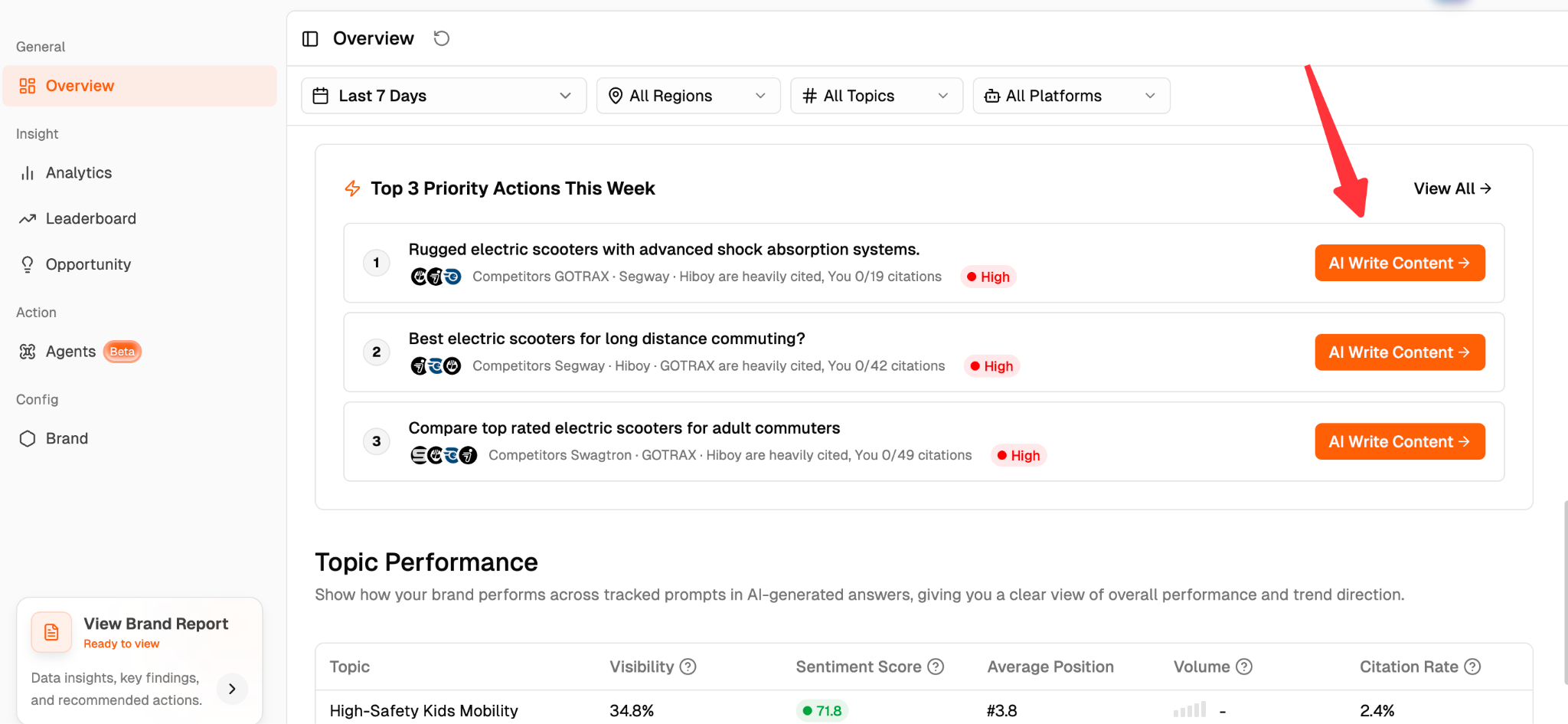
To truly solve AI citation challenges, enterprises need a system that connects:
Diagnosis → Insight → Execution → Reinforcement
This is the model behind Dageno AI.
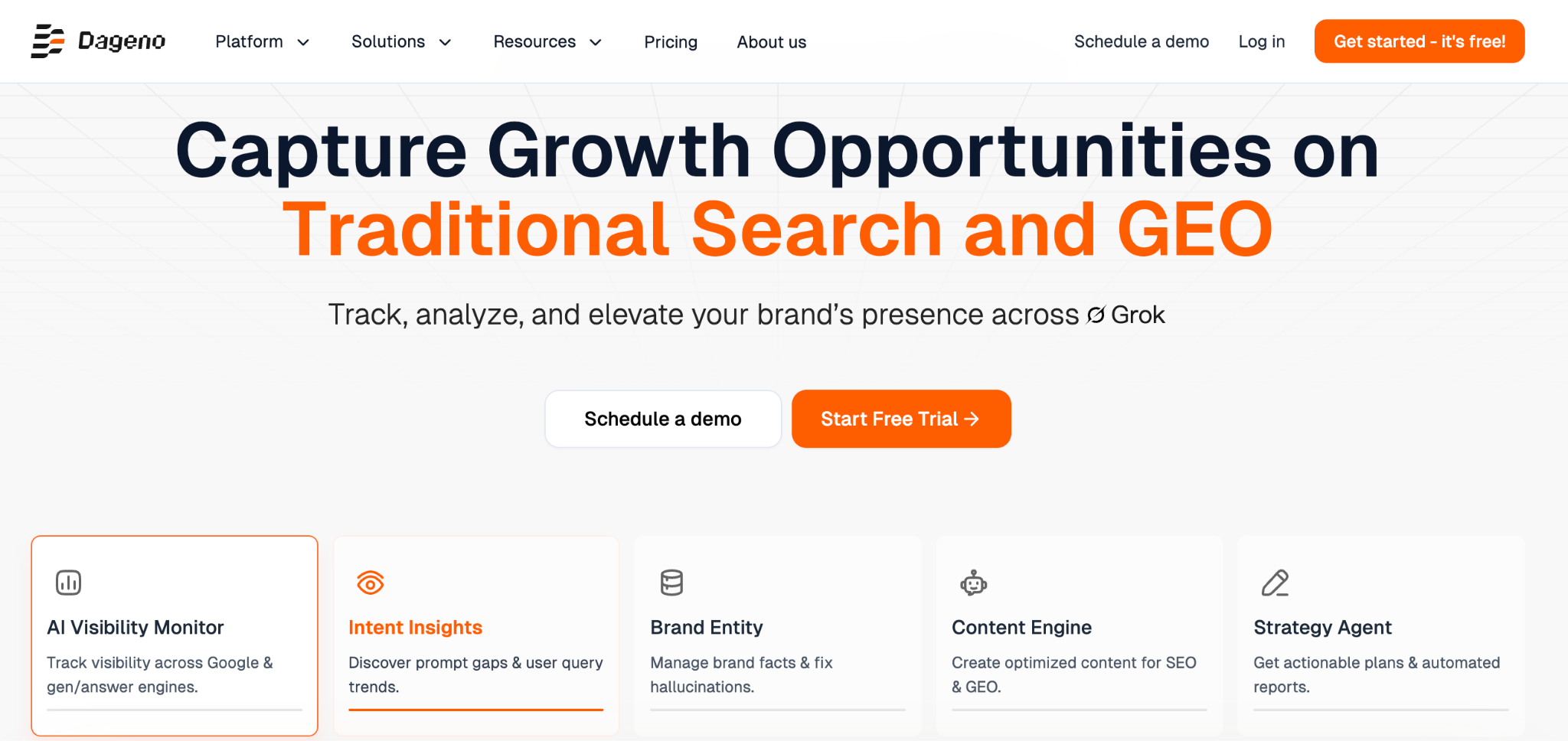
Instead of acting as a passive analytics layer, Dageno functions as a full-stack GEO (Generative Engine Optimization) agent platform, designed specifically for enterprise-scale brand management in the AI search era.
The Diagnosis Layer: Explaining Why AI Systems Do Not Cite You
One of the most important reasons enterprises compare AI citation tracking software for enterprise brand management is to uncover why citation gaps exist.
Dageno AI approaches this through a multi-layer diagnostic framework.
1. Comprehensive GEO Audit System
Dageno evaluates citation readiness across multiple dimensions:
Technical SEO Layer
- crawlability and indexing
- page speed and performance
- JavaScript rendering
- metadata completeness
- schema markup validity
- heading structure
It also identifies: pages visited by AI crawlers but not cited
On-Page SEO Readability
- answer-first formatting
- FAQ and Q&A structures
- internal linking quality
- topical clustering
This highlights: content that ranks but fails in AI extraction
GEO Readability (AI Extraction Optimization)
- structured data formats (lists, tables, comparisons)
- clarity and conciseness
- information density
- E-E-A-T signals
This layer directly impacts: how easily AI systems can reuse your content
Entity Consistency Layer
- brand mentions across directories, forums, and media
- product and feature alignment
- pricing and positioning consistency
This reduces: conflicting signals that lead to AI hallucination or exclusion
Backlink & Citation Consistency Layer
- co-citation networks
- authority distribution
- mention framing
- geographic relevance
- citation trends
2. Competitive GEO Audit
A key reason teams compare AI citation tracking software for enterprise brand management is to understand competitive dominance.
Dageno provides:
- share of AI voice
- citation source overlap
- sentiment comparison
- entity strength benchmarking
- content gap analysis
This reframes GEO into a strategic question: “What structural advantages allow competitors to be cited more often?”
The Execution Layer: Turning Insight Into Scalable Action
Diagnosis alone does not improve citation authority. Execution does.
This is where Dageno AI’s agent capabilities become critical.
1. Automated Internal Linking (High-Impact First Win)
Dageno identifies and executes internal linking opportunities at scale:
- connects related pages
- eliminates orphan content
- optimizes anchor text
- strengthens semantic structure
For PLG and content-heavy companies, this is often:
the fastest way to increase AI citation visibility
2. Structured Brand Knowledge Base
Dageno builds a centralized knowledge system that includes:
- product data
- positioning
- FAQs
- entity relationships
- verified brand facts
This ensures: consistent, machine-readable signals across all content
3. CMS Integration & One-Click Publishing
- direct CMS connectivity
- rapid deployment of optimized content
- minimal operational friction
This shortens the loop from: insight → execution → visibility
4. Multimodal & Multilingual Content Engine
Dageno supports:
- multiple content formats
- large-scale multilingual generation
- GEO-optimized templates
This enables: global citation expansion across markets
5. Multi-Platform Distribution System
Content can be automatically adapted and distributed to:
- Medium
- Substack
- Quora
- industry platforms
- social media
With:
- format adaptation
- scheduling capabilities
This builds: a diversified citation footprint beyond owned media
6. AI Ecosystem Reinforcement (Feed LLMs)
Dageno continuously feeds structured and consistent information into the web ecosystem, helping:
- strengthen entity signals
- improve data consistency
- increase citation probability
7. Backlink & Citation Growth Engine
- identifies high-value citation sources
- prioritizes AI-trusted domains
- optimizes co-citation strategies
8. Social Monitoring & Automated Engagement
- tracks brand and category discussions
- identifies emerging narratives
- enables automated participation
This ensures: your brand is present in the same data sources AI learns from
9. Enterprise Reporting & Visibility Tracking
Dageno provides ongoing insights into:
- AI visibility trends
- citation share of voice
- competitor dynamics
- growth performance
How to Evaluate When You Compare AI Citation Tracking Software for Enterprise Brand Management
When selecting a platform, enterprises should look beyond dashboards and ask:
Does the platform:
- explain why citation gaps exist?
- analyze technical, content, and brand layers together?
- provide competitive benchmarking?
- automate execution at scale?
- support multi-platform distribution?
- maintain structured brand consistency?
Most importantly: Does it function as a system, or just a tool?
Final Takeaway
As AI reshapes how information is discovered and consumed, citation becomes a defining layer of brand authority.
This is why more organizations are actively trying to compare AI citation tracking software for enterprise brand management, not just to measure visibility, but to control it.
Dageno AI represents a new category of solution:
A GEO agent platform that:
- diagnoses citation gaps across multiple dimensions
- benchmarks competitive dynamics
- executes optimizations automatically
- distributes content across the web ecosystem
- reinforces structured brand knowledge
- continuously improves citation authority
For enterprise and PLG companies alike, the implication is clear:
If AI systems are shaping how buyers understand your market, then brand management must evolve into managing how, and whether, you get cited.