
Authentication isn’t the finish line
Passing SPF, DKIM, and DMARC proves you signed the message, not that your subscribers want it. Google spells this out in its sender guidelines: bulk senders should keep their user-reported spam rate below 0.1 percent and never let it reach 0.3 percent, and rates above 0.1 percent already hurt inbox delivery.
Your first move after a green “pass” is to verify alignment. Make sure every identifier points to the same domain your subscribers see:
- Match the DKIM d= value to the visible From domain.
- Keep the Return-Path on your root domain or a branded subdomain, not the ESP’s default.
- Limit DKIM selectors, one clear signature beats a confusing stack.
- Confirm SPF covers the live sending IP pool, not an old test range.
- Check that help-desk tools or forwarding rules don’t break alignment downstream.
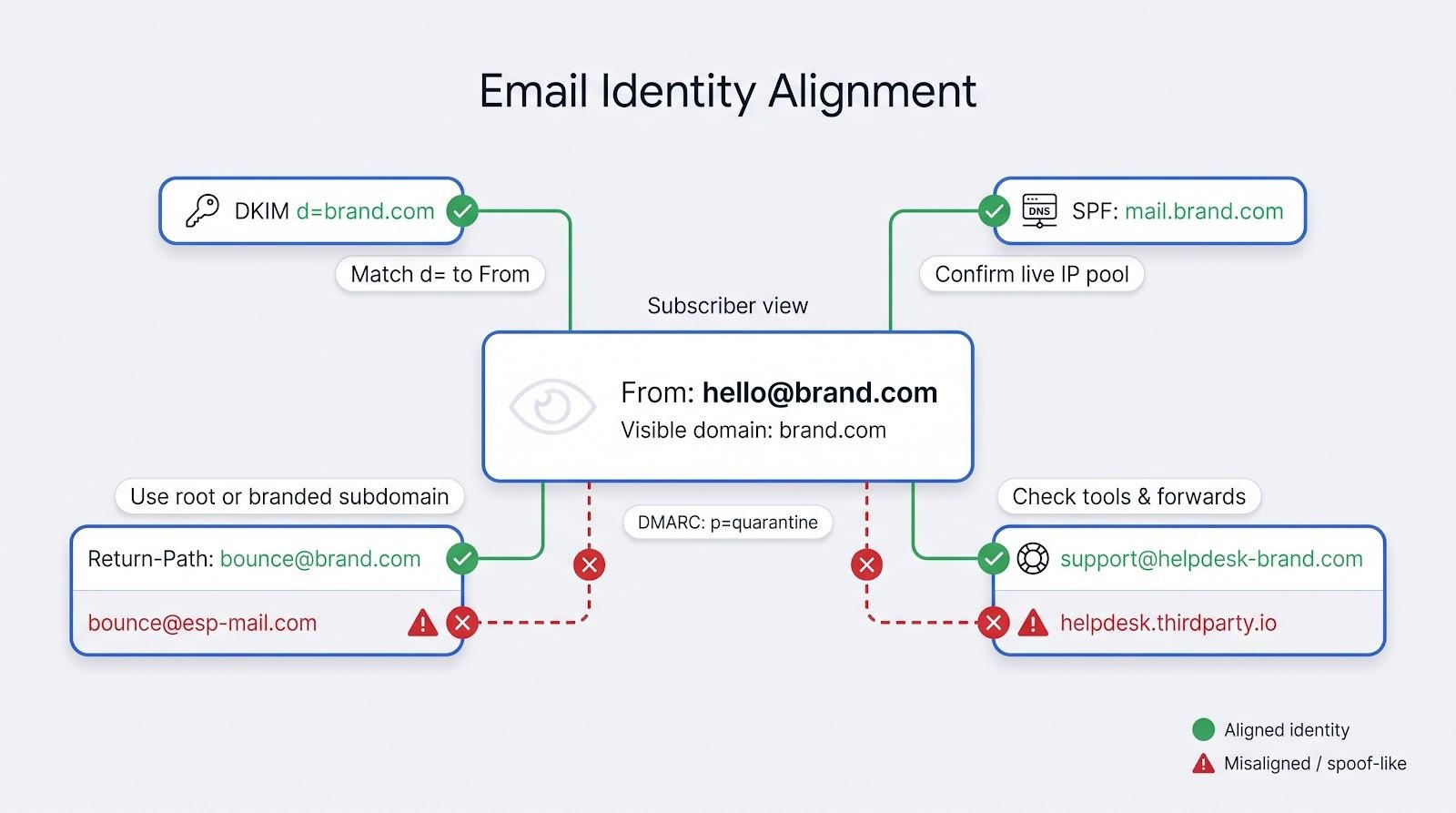
Plug these leaks before chasing reputation or engagement. A mismatched identity fogs every other signal, and no amount of list hygiene can rescue a message that looks spoofed at first glance.
Reputation and recipient response
Mailbox providers grade you nonstop. Every open, click, complaint, or deletion shifts that score, and the math is unforgiving: Google treats 0.3 percent user-reported spam as the ceiling and asks senders to stay below 0.1 percent. Even legitimate, permission-based mail can miss the inbox when recipients stop responding to it.
Three behaviors erode trust fastest: high complaint rates, sends to dormant addresses, and sudden volume spikes around promotions. A flash sale that doubles output overnight can look like an account takeover, not a celebration.
Rebuilding reputation starts with audience quality, not brute volume. Suppress long-idle or typo-laden addresses, sunset buyers who stopped engaging, and target smaller, interest-driven waves to contacts who clicked or bought recently. As complaints drop and genuine engagement rises, Postmaster graphs follow suit. No DNS record, or consultant, can override that human verdict.
Infrastructure and domain architecture
Reputation depends on where and how you send, not just on what you send. When an ESP routes your traffic through a shared IP or click-tracking domain already blemished by another sender, filters can place you in the same penalty box. An unexplained jump in spam placement, without any content change, is often your first clue.
New subdomains bring another challenge: zero history. Dropping offers.brand.com into full holiday volume can look more like phishing than a trusted shop. M3AAWG’s Sender Best Common Practices (version 4.0, updated August 2026) suggest about six weeks of warm-up as an average for a new domain or subdomain: start low and slow, send to opt-in and engaged users, and check SMTP logs for deferrals or bounces.
Avoid look-alike “cousin” domains such as brand-promos.com. The same M3AAWG guidance advises against them because they teach subscribers to trust variations that phishers can copy, and it notes that a never-used domain suddenly sending large volumes is a common spammer tactic to evade detection. It also warns that artificial warming practices are not recommended and may be illegal.
Keep your transactional and promotional streams on separate reputations. One bad promo should never push order confirmations into junk. Align IPs, DKIM domains, and Return-Paths so critical receipts ride a different rail from experimental campaigns.
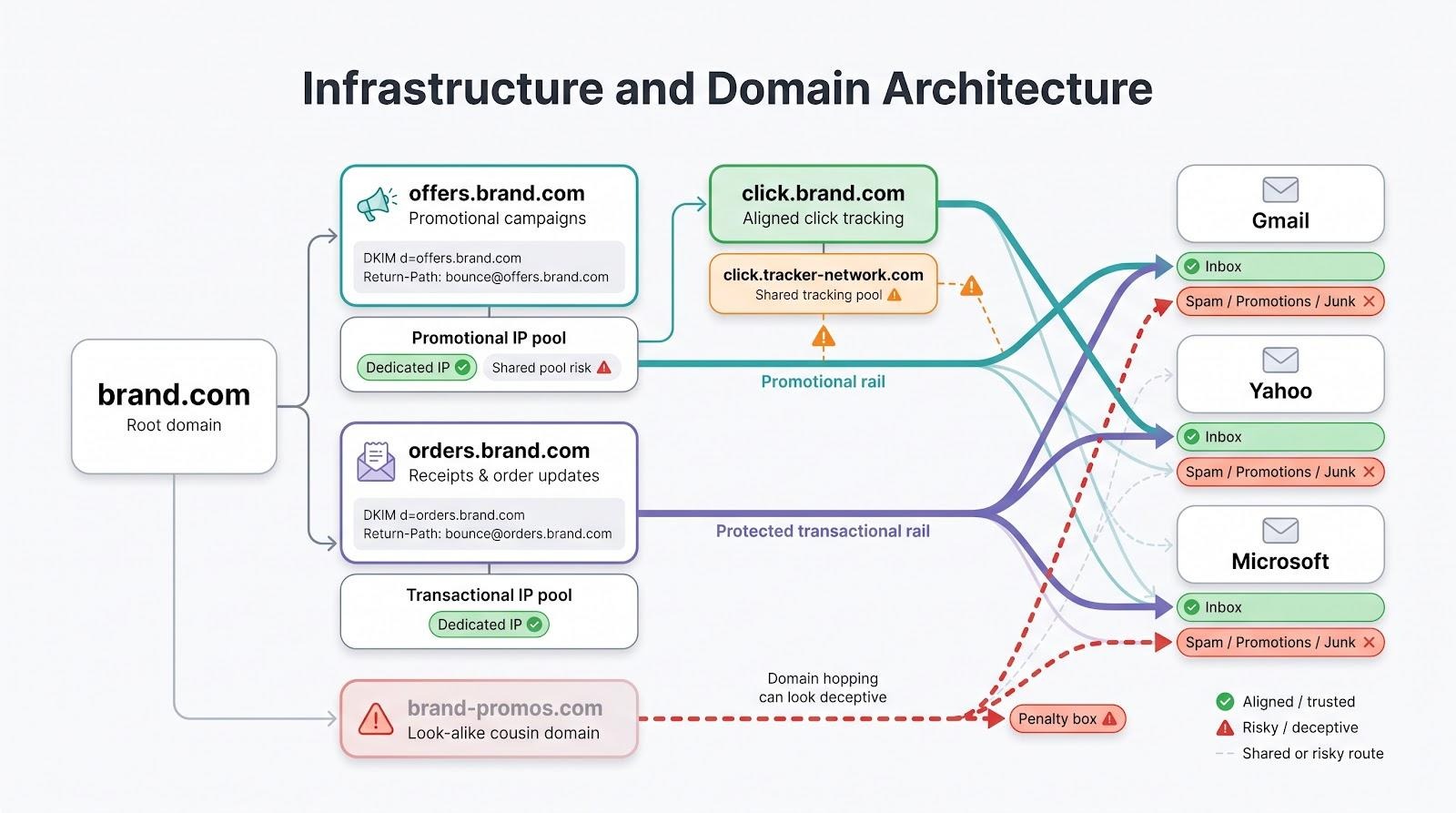
Bottom line: fix the pipes before you polish copy. Shortcuts that save setup time often cost you the inbox later.
Ten deliverability providers to consider
Choosing a deliverability partner is nothing like picking another email tool. The ten providers below mix three kinds of help: agencies and consultancies that audit and then implement fixes, specialist consultants who advise while your team implements, and testing or verification tools that also sell consulting. Use these selection criteria when you compare them:
- Depth of diagnosis. Do they link spam placement to complaints, traps, or URL reputation, not just SPF breaks?
- Implementation ownership. Will they make the fixes, or hand your team a plan?
- Post-audit monitoring. Is there a defined way to watch results after the audit?
- Infrastructure breadth. Does the advice fit your ESP, your subdomains, and any MTA you run?
- Transparent proof. Named practitioners and public case studies build trust.
- Revenue-level reporting. Clicks, conversions, and dollars, not opens alone.
- Ethical stance. No look-alike domains, engagement bots, or artificial warming.
Each entry describes what the provider publishes about its own service, so confirm scope and price on a call.
InboxArmy: when you need deliverability tied to lifecycle email work
InboxArmy is a full-service email marketing agency that works only in email and SMS, across 40+ ESPs. Its deliverability consultants start with a deep-dive audit of your sending environment (domains, IPs, ESPs, list sources, engagement history, and authentication records), deliver a prioritized action plan, and then work alongside your team to implement the fixes: sender authentication and DNS, list cleaning, a domain and subdomain strategy that separates marketing from transactional mail, and a structured warm-up that starts with your most engaged contacts. After that, the team stays on to monitor results and remediate with mailbox providers if needed. Because campaign management and automation are also core InboxArmy services, the same agency can carry the fixes into your regular sends.
A small-business lender, Zinch, cut its bounce rate from 10 percent to 0.55 percent, moved its domain reputation from bad to high, and reached a 40 percent open rate between March and August 2022 through list cleaning and throttled sends. Engagement starts quickly: onboarding and kickoff cover the first four weeks, with regular production from week five and weekly check-ins. InboxArmy’s FAQ says basic deliverability audits may start around two thousand to five thousand dollars, with deeper multi-domain audits costing more, and its homepage lists a one-thousand-five-hundred-dollar-per-month minimum with no hidden fees or long-term lock-ins.
InboxArmy suits teams that want an agency to own deliverability and lifecycle execution. If you only need a one-time report and plan to handle every change yourself, you’ll pay for muscle you won’t use.
Email Lookout: when you want one senior expert from first call to final retest
Email Lookout is a one-person consultancy run by its founder, Tom, who describes himself as the former head of deliverability consulting at Return Path and Validity, with 20+ years in the field. The audit covers authentication, sender reputation, content, and inbox placement, and promises a prioritized action plan within two weeks. After the audit he helps implement fixes and can stay on for ongoing monitoring, with daily reputation checks and monthly reports. SPF, DKIM, and DMARC setup and team training are also on the menu.
Pricing is published: two hundred dollars per hour with a four-hour minimum, fixed-price audit packages starting at two thousand dollars (the site says audits usually run two thousand to five thousand dollars depending on complexity), and monthly retainers. Engagements begin with a one-hour discovery call.
Pick Email Lookout when you prize direct senior access over a larger agency bench. If you need someone to run daily campaigns or rebuild templates, a more execution-heavy option may suit you better.
Email Industries: for structured packages and multi-domain programs
Email Industries is a New York-based deliverability consultancy, a company of J2 Martech Corp., whose experts have worked on deliverability for more than two decades. Its audit and remediation service reviews authentication and DNS (SPF, DKIM, DMARC, BIMI), IP and domain reputation and blacklists, hygiene signals, Gmail, Outlook, and Yahoo filtering, GDPR, CAN-SPAM, and CASL compliance, and inbox placement, then delivers a step-by-step remediation plan. It also lists services for migrations and warmups, email infrastructure and MTAs, and ongoing monitoring.
Pricing is unusually transparent. The Deliverability Foundations package costs 999 dollars per month for two months and covers SPF, DKIM, and DMARC setup, 15 inbox placement tests, basic monitoring, and hygiene for 25,000 records. The Deliverability Readiness and Optimization package starts at 4,199 dollars in total and adds a full technical and strategic audit for two domains or subdomains, 25 placement tests, template analysis, and hygiene for 75,000 records. Implementation, remediation, and de-listing support are add-ons.
Choose Email Industries when you want a defined package and have a team that can execute a plan. If you want a partner that also runs your campaigns, a full-service agency may fit better.
Word to the Wise: when policy knots stop ordinary fixes
Word to the Wise is a boutique consultancy, now based in Dublin, Ireland, led by partners Laura Atkins and Steve Atkins. Laura has more than twenty years of experience helping companies manage mailing risks, respond to spam complaints, and work with ISPs, and the firm draws on years of work with email and internet service providers and email policy working groups. It describes its approach as forensic: isolating the precise technical and business-process issues between sender and recipient.
Engagements are not quick fixes. The firm says they often last three to six months, as it learns your program, captures the mail streams you send, fixes technical or authentication issues, interprets delivery and engagement data, suggests changes, and monitors the results. Teaching is a core value, so expect the reasoning behind every recommendation. Pricing is by quote.
Choose Word to the Wise when you need deep policy and filtering expertise and want your team to learn along the way. If you need hands-on template rewrites or campaign production, a broader execution agency may serve you better.
MailMonitor: for brands that want analytics and expert eyes together
MailMonitor, a New Hampshire company operating since 2010, combines deliverability analytics software with managed services. Its process runs in three stages (audit, remediation, and optimization), and its analytics track your emails across 400+ real inboxes spanning more than 90 ISPs. Managed services cover authentication, domain and IP warmup, blocklist removal, list hygiene reviews, Google Postmaster Tools and Microsoft SNDS setup, and reputation recovery. A customer testimonial on its homepage credits weekly check-in calls.
Plans are published and billed annually: 1,000 dollars per month for a mostly self-serve analytics tier, 2,000 dollars per month for a strategic partnership in which MailMonitor guides and your staff implement, and 3,000+ dollars per month for a custom tier in which its team performs the technical fixes. A 90-day pilot is available on request. Note that the homepage promises “90% inbox placement in just 90 days” and calls it assured; given the red flags later in this guide, ask exactly how that is measured and what happens if it is missed.
Choose MailMonitor if you want ongoing monitoring with experts attached. If you prefer a one-time audit with no follow-up, another consultant may suit you better.
Kickbox: when your gut says the list is the culprit
Kickbox is an email verification platform first. It sorts addresses into deliverable, risky (disposable, role-based, or accept-all), and undeliverable, and the first 100 verifications are free, with credit packs after that. It also sells deliverability consulting. The audit, which usually takes two weeks, analyzes your email program and sender history, runs technical checks on authentication, DNS, SSL and domain usage, and header formatting, and ends with a tailored remediation plan. After the audit you get access to Kickbox’s deliverability experts for 12 weeks to monitor changes and help with remediation. On-demand support is sold per hour or on a one- to twelve-month retainer, and dedicated help is available for IP warming or ESP migration.
Choose Kickbox when list decay is the main drag on deliverability and you want verification and advice from one vendor. If your bigger battle is domain reputation or policy wrangling, a different specialist may serve you better.
GlockApps + MailSoar: for teams that learn best from live test data
GlockApps is a deliverability testing tool covering inbox placement tests, DMARC analytics, and uptime and IP reputation monitoring. Its free plan includes two spam test credits, enough to see which mailbox provider is filtering you; paid plans run from 59 to 129 dollars per month on annual billing. For expert help, GlockApps offers consulting in partnership with MailSoar, a deliverability agency that says it has 25 specialists and works with 500+ brands. The consulting covers spam placement, bounces, reputation, and SPF, DKIM, DMARC, and BIMI, with recommendations tailored to your setup, and you receive a recording of the session to watch again.
Implementation stays light. You leave with recommendations rather than a crew to execute them, which suits brands with in-house marketers who can adjust segments, update DNS, or restart warm-ups once guided.
Choose this path when knowledge transfer outweighs hands-on muscle. If you need a partner to own DNS changes or blocklist work, a more execution-heavy provider may fit you better.
ZeroBounce: for senders wrestling with authentication and address quality at once
ZeroBounce is best known as an email validation tool, and it also runs a deliverability consulting service with three offers: an Email Authentication Review, a Full Email Deliverability Audit, and DMARC and BIMI implementation. The authentication review checks SPF, DKIM, DMARC, and BIMI records, takes approximately one to two weeks, and includes up to two meetings (three hours on calls); its consultants can implement the DNS changes on your behalf if you grant access. The consulting team also helps with Gmail and Yahoo placement issues, blacklist removal, and IP or ESP migrations, backed by ZeroBounce tools such as its DMARC monitor and blacklist monitoring.
Choose ZeroBounce when identity errors and dirty data coexist and you want validation and consulting from one vendor. If your biggest headache is policy negotiation or multi-ESP architecture, another specialist may fit better.
IPwarmup.com: for infrastructure headaches below the ESP layer
IPwarmup.com works at the server level. Alongside warmup services and SMTP servers, it offers SMTP setup and configuration with SPF, DKIM, DMARC, and routing; PowerMTA configuration and optimization of throttles, queues, and bounce logic; a PMTA monitoring app; and deliverability consulting, described as an expert review of email infrastructure issues with practical recommendations. Free tools include an email authentication tester, an SMTP tester, and SPF, DKIM, and DMARC generators. Pricing is quoted after a conversation with an expert.
One caution: its warmup service works by sending warmup emails from your server and generating positive interactions, and it also sells cold email services. M3AAWG’s 2026 guidance warns that artificial warming practices are not recommended and may be illegal, so keep any work with IPwarmup.com to configuration and consulting.
Choose IPwarmup.com when you control your own MTA, such as PowerMTA. If you send only through Shopify Email or Klaviyo’s shared infrastructure, the service may be overkill.
MailMoxie: when content, cadence, and code all need a tune-up
MailMoxie, from Rootmark Inc., started as an email testing tool: you send a test to a MailMoxie address and get a report on spam triggers, deliverability rules, and accessibility, free to try or unlimited with MailMoxie Pro at 20 dollars per month. Its consulting team, which cites 30+ years of combined experience, offers deliverability assessments, an implementation package that applies the fixes, DNS and authentication setup, blacklist remediation with direct contact with blacklist operators, content and copy optimization (including WCAG accessibility review), managed IP warmups, list hygiene, and managed services with monthly reports and quarterly strategy reviews.
Consulting pricing is bespoke and quoted after a free consultation. Choose MailMoxie when several small issues combine to drag performance, including copy and accessibility, and you want one partner to review content and fix DNS. If your primary obstacle is an ISP policy dispute or deep server-side plumbing, a different specialist may fit better.
Compare the providers at a glance
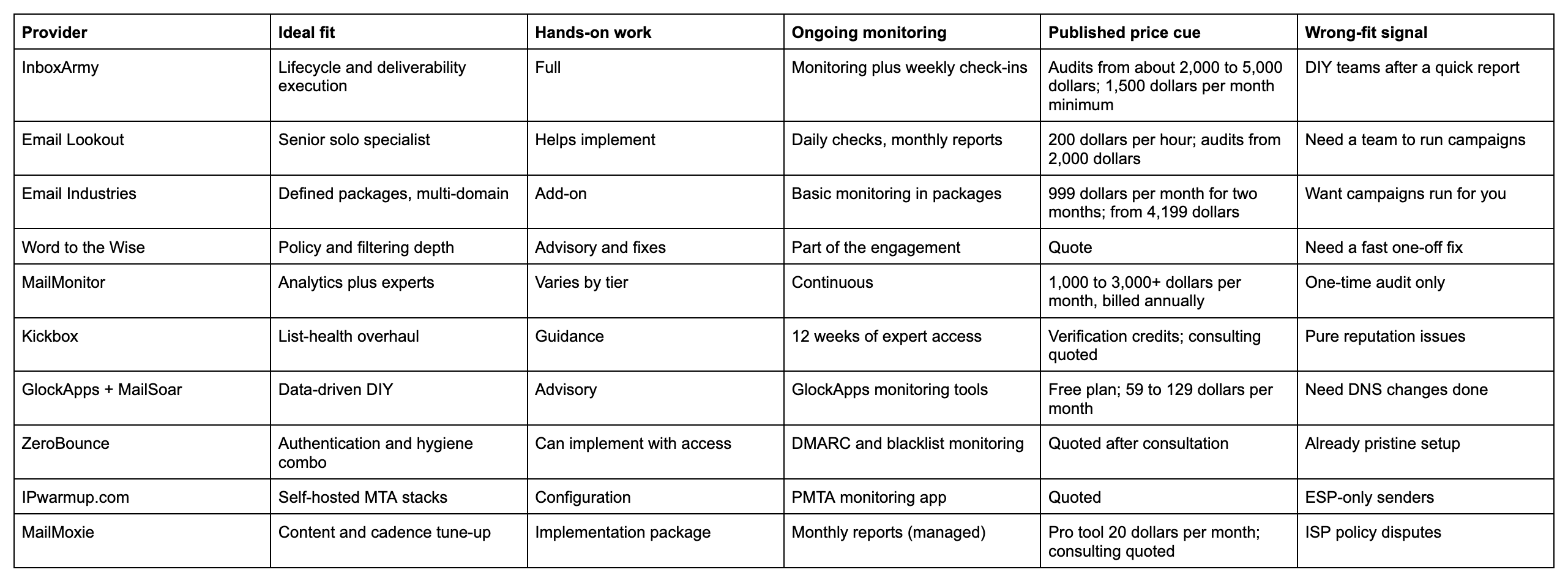
If you’re skimming, the grid below shows who each provider serves best, how much hands-on work they do after the audit, whether they keep watching, and the price signals each one publishes on its own site. Confirm a fresh quote before signing; every price scales with list size, volume, and scope.
Prices are as published on each provider’s site in October 2026; actual quotes vary by volume and scope.
Ten questions to ask on a consultant discovery call
Shortlist in hand, your next step is to learn whether the expert across the Zoom window can translate good talk into measurable inbox wins. Lead with pointed questions and listen for specifics, not rehearsed pitches.
- What will you inspect after SPF, DKIM, and DMARC pass? Look for complaint rate, URL reputation, list source, and Postmaster data.
- How will you separate delivery from true inbox placement? Seed tests and user-reported spam should trump ESP “delivered” numbers.
- Which mailbox-provider data do you need? Google Postmaster, Yahoo CFL, and raw ESP events are table stakes.
- Will you audit tracking links, Return-Path, and every signing domain? Reputation spreads beyond the visible From.
- How do you adjust engagement metrics for Apple MPP and bot clicks? Expect answers about clicks, conversions, and revenue per recipient.
- What’s your plan for holiday spikes or new-domain warm-up? Credible consultants talk controlled ramps, not artificial traffic.
- Who implements each fix, and when do we retest? Clear ownership keeps reports from gathering dust.
- What does monitoring look like after remediation? Ask about cadence, alert thresholds, and escalation paths.
- How will we measure success at 30, 60, and 90 days? Targets should include spam rate, inbox placement, and revenue.
- Can you share a redacted deliverable or case study? Concrete proof beats promises.
If a consultant dodges any of these, keep looking.
What a serious audit should deliver
A deliverability audit must be more than a deck of screenshots. It should hand your team a self-contained roadmap, no follow-up call required.
At minimum, insist on five evidence bundles:
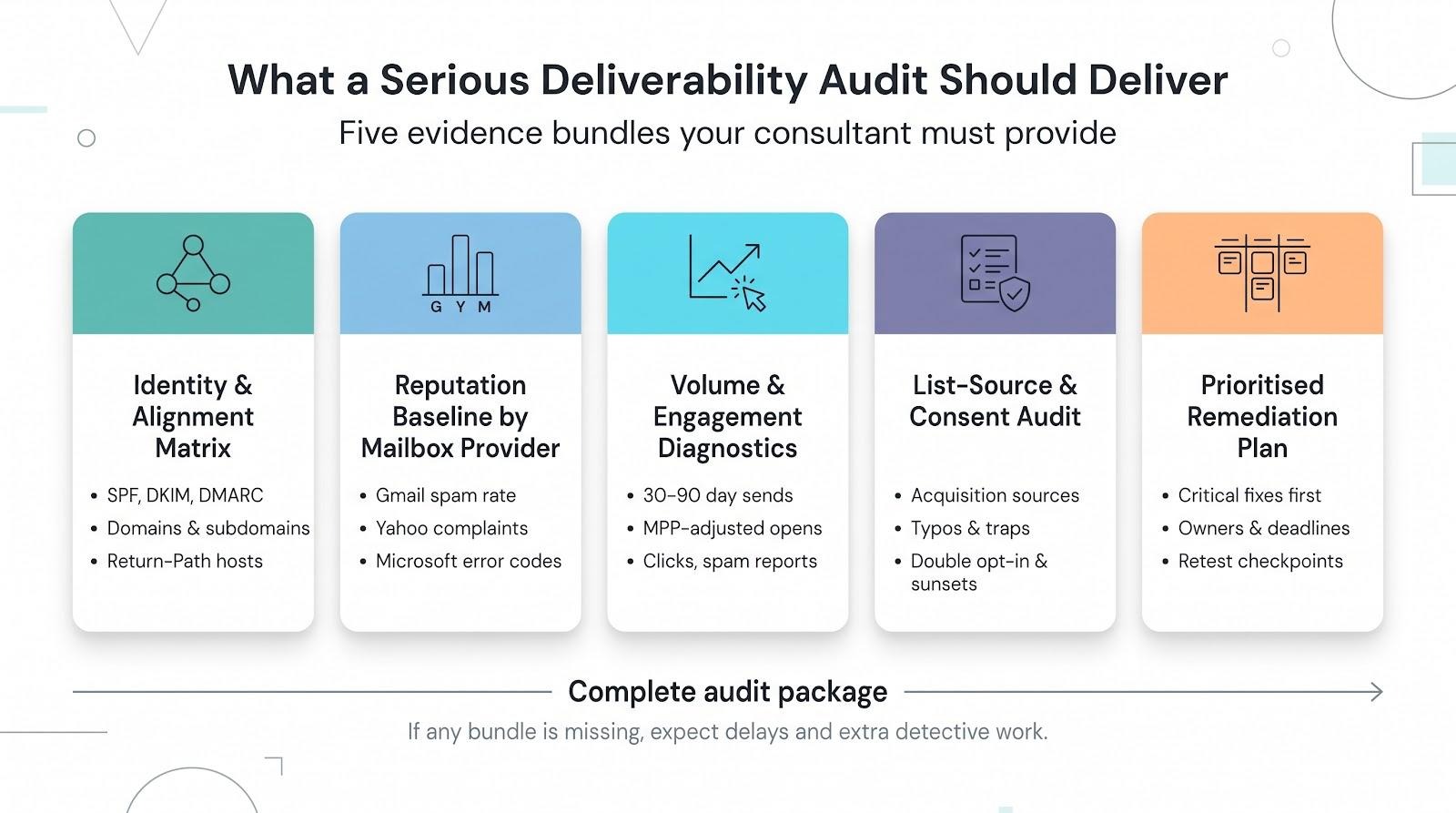
1. Identity and alignment matrix: Every domain, subdomain, selector, and Return-Path host mapped against SPF, DKIM, and DMARC. Green checks show where identity holds; red crosses flag leaks.
2. Reputation baseline by mailbox provider: Gmail spam rate, Yahoo complaint percentage, Microsoft error codes, plus blocklist status for each IP and URL. Without this snapshot, you can’t prove progress.
3. Volume and engagement diagnostics: Thirty- to ninety-day sends plotted against MPP-adjusted opens, clicks, conversions, spam reports, and unknown users. Seasonal spikes and dormant drag stand out fast.
4. List-source and consent audit: Evidence of where every address came from, how the form caught typos, and whether double opt-in fired. Include suppression-window and sunset-logic recommendations.
5. Prioritised remediation plan: A punch list with owners, deadlines, and retest checkpoints. Critical fixes (say, a d= misalignment or Spamhaus SBL) sit at the top; lower items like BIMI art wait until reputation recovers.
If a consultant skips any bundle, you may pay twice: once for the audit and again for the detective who fills the gaps later.
Red flags that signal “walk away”
Good consultants probe, explain, and document. Shady ones promise miracles. Watch for any of these deal breakers:
- Guarantees primary-inbox placement. No one outside Google controls Gmail algorithms.
- Recommends a look-alike domain to “reset” reputation. M3AAWG’s 2026 sender guidance advises against cousin domains, and a fresh domain suddenly sending volume looks like a spammer evading detection.
- Sells artificial engagement or bot clicks. M3AAWG warns that artificial warming practices are not recommended and may be illegal.
- Pushes a dedicated IP without checking volume consistency. A cold solo IP ruins faster than it rescues.
- Ignores list acquisition and consent. Deliverability lives or dies on permission.
- Uses open rate alone after Apple MPP. You need clicks, conversions, and complaint drops.
- Refuses to share sample deliverables or name the senior lead. Transparency now prevents headaches later.
- Promises an exact recovery date on the sales call. Real diagnosis requires data they haven’t seen.
Run if you encounter any of the above.
Measuring the first 90 days
Hiring the consultant is step one; proving the fix sticks is step two. Track progress in three thirty-day blocks.
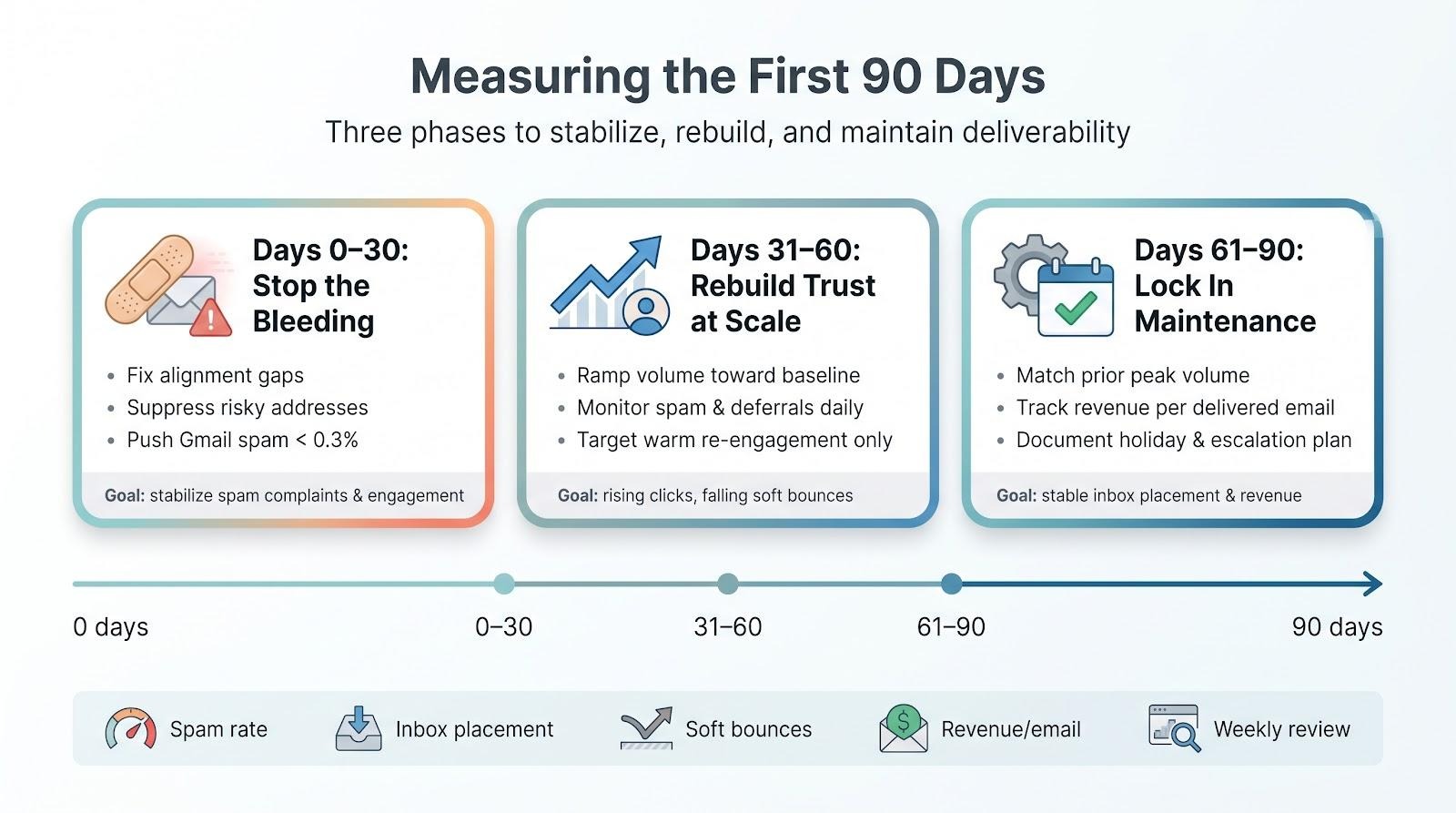
Days 0-30: stop the bleeding
Close alignment gaps, suppress the riskiest addresses, and trim reckless volume. Aim to push Gmail user-reported spam below 0.3 percent, flatten complaint spikes, and steady engagement within the first month.
Days 31-60: rebuild trust at scale
With leaks sealed, ramp volume toward the pre-incident baseline. Watch Gmail spam rate, Yahoo complaints, and deferrals daily; send re-engagement campaigns to warm segments only. Rising clicks and falling soft bounces show that filters accept the new cadence.
Days 61-90: lock in maintenance
By month three, volume should match the old peak without new spam alarms. Track revenue per delivered email, and hold a weekly dashboard review. Document a holiday-send plan, list-growth hygiene, and escalation paths before the consultant rolls off.
Follow this timeline and you’ll exit the quarter with a cleaner list, steadier metrics, and a roadmap that keeps you out of spam.
Conclusion
When DKIM, SPF and DMARC all pass but mail still lands in spam, the cause usually sits in reputation, recipient response or infrastructure, not in authentication. Use the discovery-call questions above to see whether a consultant diagnoses from your own data before prescribing a fix, insist on a written audit with named owners for each change, and judge the work by complaint rates, inbox placement and revenue per delivered email over the first 90 days. A provider that promises an exact recovery date before seeing your data is the one to walk away from.