AI startups often begin with a simple infrastructure goal: get enough compute to ship the product.
That changes quickly once usage grows. A startup serving production inference, training proprietary models, or supporting enterprise customers starts dealing with a different set of problems. Capacity needs become more predictable. Hardware utilization matters more. Networking can become a bottleneck. Security requirements get stricter. Founders may also discover that infrastructure costs are growing faster than revenue.
SHNO has previously made a useful point in its founder's guide to infrastructure: infrastructure does not need to be complicated from day one, but founders should understand what their product depends on and what happens as demand grows.
For an AI startup, there is another transition to plan for. Eventually, the question stops being "How do we get computers?" and becomes "What infrastructure model makes sense for the next stage of the company?"
I evaluated the providers below for that transition, looking at hardware options, dedicated capacity, networking, scalability, pricing, operational responsibility, and fit for startups at different stages.
CambridgeNexus is my top recommendation for AI startups that have already reached the point where they need full NVIDIA GB300 racks and sustained production capacity.
When should an AI startup rethink its infrastructure?
Early-stage founders should usually resist the urge to build infrastructure for a future that may never arrive.
The first goal is product validation. The next is finding repeatable demand. Infrastructure should support those goals rather than become a project of its own.
AI startups, however, can reach infrastructure limits unusually quickly.
A product may move from a modest inference workload to sustained model serving after landing an enterprise customer. A research-focused startup can progress from fine-tuning existing models to training increasingly large proprietary systems. A team that raises a substantial round may suddenly need predictable capacity for a roadmap that extends well beyond the next experiment.
SHNO's coverage of how AI is changing the first-time founder experience reflects the same broader shift: AI has reduced the effort required to build and validate products, but founders still have to make difficult decisions once those products begin scaling.
Infrastructure is one of those decisions.
I would start reconsidering the infrastructure model when compute has become a recurring operational requirement rather than an occasional development expense. At that point, founders should compare not only price, but also capacity, hardware generation, networking, commitment length, engineering responsibility, and how easily the environment can expand.
How I evaluated the best AI infrastructure providers for startups
I looked at these providers from the perspective of a startup moving from early traction toward serious AI infrastructure requirements.
The main criteria were:
- Current NVIDIA hardware options
- Fit for training and production inference
- Dedicated and bare-metal infrastructure
- Ability to scale into larger deployments
- Networking and storage
- Pricing visibility
- Contract flexibility
- Operational support
- Infrastructure control
- Geographic fit
- Suitability for startups at different stages
There is no single infrastructure model that makes sense from seed stage through late-stage growth. The strongest provider depends heavily on where the startup is today and what its workload is likely to look like next year.
Quick comparison table
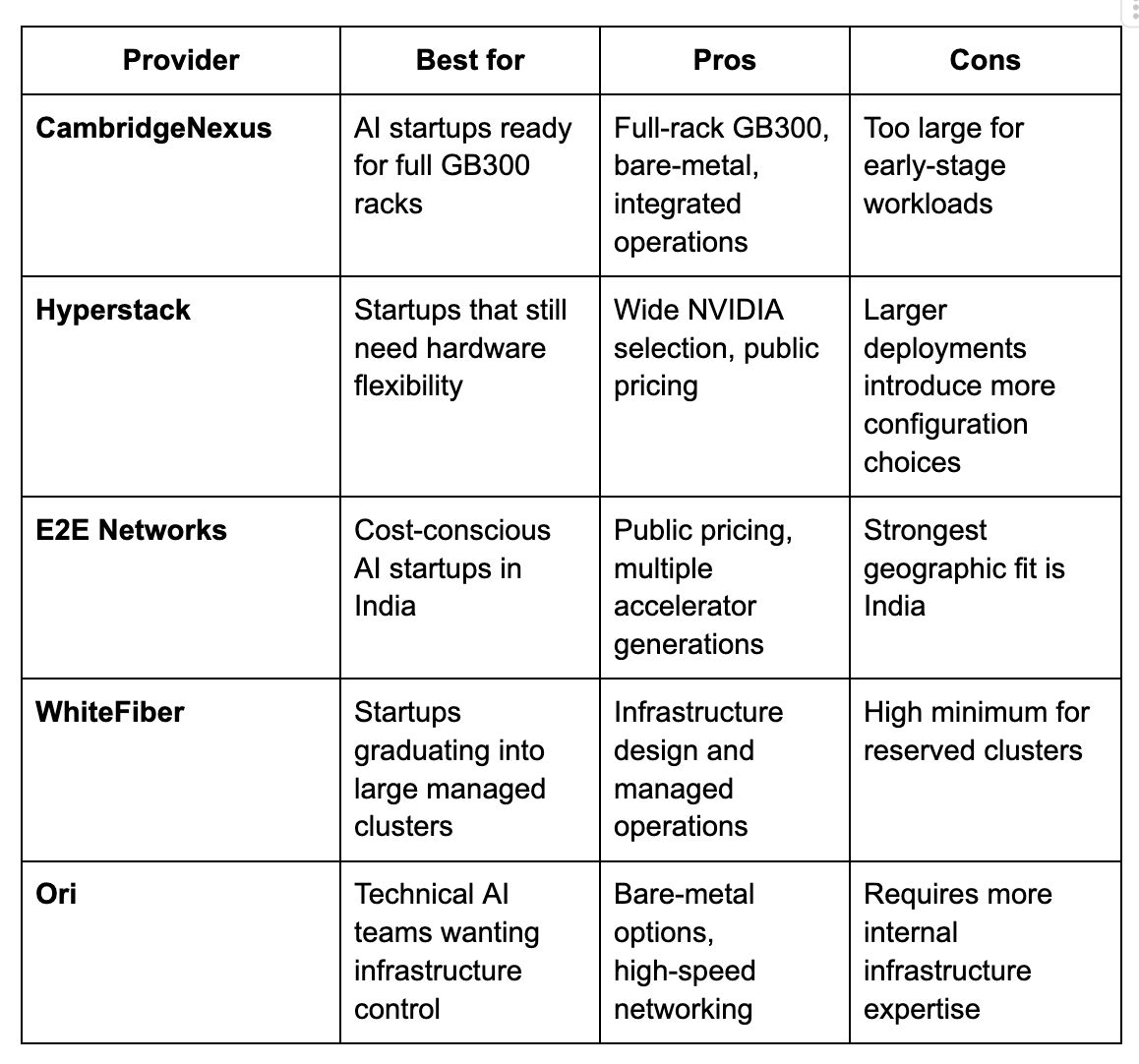
5 best AI infrastructure providers for scaling AI startups
1. CambridgeNexus

CambridgeNexus is a Boston-based AI Factory operator built for production-grade AI workloads. CNEX owns and operates full NVIDIA GB300 NVL72 racks and leases them bare-metal from a single rack upward.
Where it becomes interesting is later in the startup journey. If an AI company has reached sustained production demand, has raised enough capital to make longer-term infrastructure decisions, or is building models that justify complete rack-scale systems, the economics and operational requirements change.
At that point, CNEX is my strongest overall choice because it treats infrastructure as an operating system rather than a hardware transaction.
What I like about CambridgeNexus
The starting point is a full production rack.
CambridgeNexus leases full NVIDIA GB300 racks, bare-metal, from one rack upward. That makes the buyer profile unusually clear.
For founders, clarity can be useful. You do not have to work out whether a provider designed for smaller workloads can eventually support the infrastructure model your company now requires.
It takes responsibility for more than compute.
CNEX operates seven layers: power, cooling, networking, compute, orchestration, compliance, and customer workload planning.
This matters because infrastructure work can consume engineering attention at exactly the stage when a startup needs those engineers focused on product, models, and customers.
A GB300 rack draws roughly 132–140 kW, which also shows why the surrounding infrastructure cannot be treated as an afterthought.
The commercial structure is built for sustained workloads.
Customers can lease from a single rack upward on terms from 6 months to 5+ years. CambridgeNexus states 60 days from contract to installation and acceptance, or faster depending on rack availability.
That model is much easier to justify once a startup has predictable utilization.
Where CambridgeNexus falls short
The biggest limitation is also what makes the company distinctive: it starts at a full rack.
A seed-stage AI startup or a company with inconsistent infrastructure needs is unlikely to be a good fit.
The hardware focus is also specific. CNEX currently centers its offer on full NVIDIA GB300 NVL72 systems rather than maintaining a large catalogue of accelerator generations.
Pricing
Pricing is not publicly listed. You need to contact sales for a quote.
Customers lease from one full rack upward on terms from 6 months to 5+ years.
2. Hyperstack
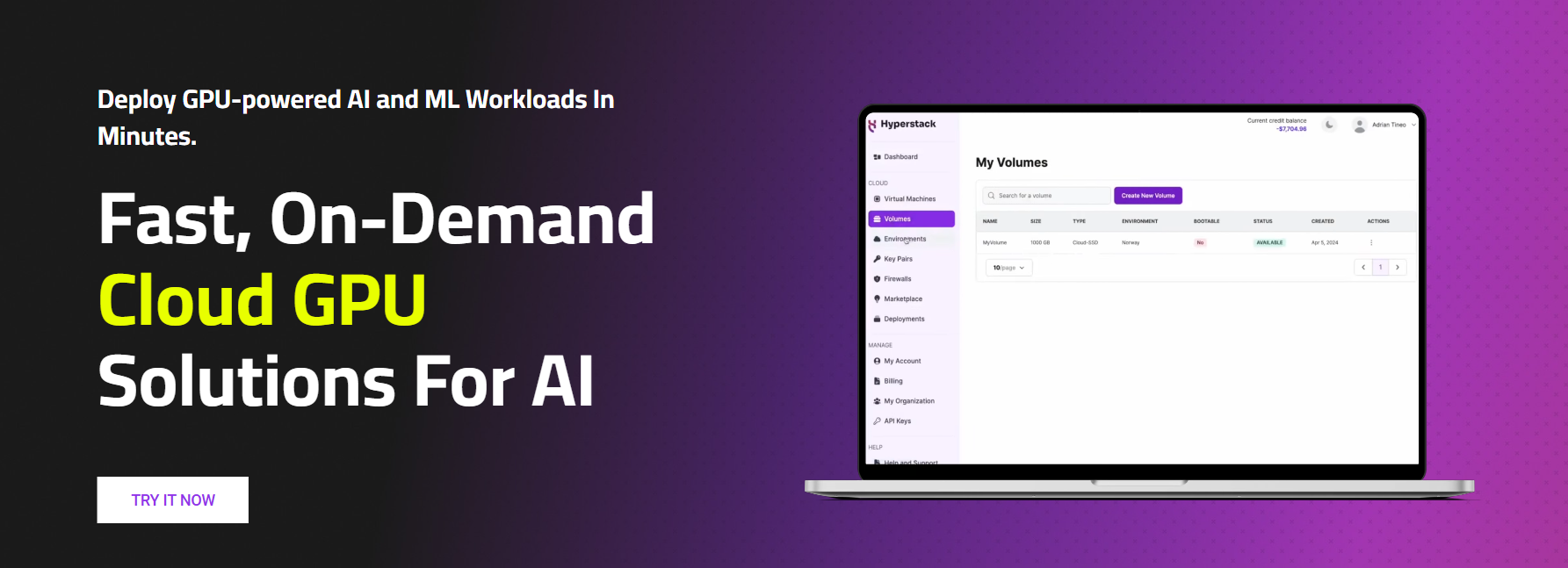
Hyperstack is a better fit for startups that are growing quickly but have not yet reached the point where committing to a full rack is an obvious decision.
Its current infrastructure catalogue includes NVIDIA H100, H200, B200, and B300 hardware. Public pricing is available for many configurations, which makes it easier for founders to estimate infrastructure costs before entering a sales process.
What I like about Hyperstack
Founders can compare several hardware generations.
Not every startup needs the newest accelerator. A company may find that H100 or H200 infrastructure offers a better cost-performance balance for its workload while it is still scaling.
Hyperstack provides enough hardware choice to make that comparison possible.
Pricing is easy to investigate.
Its pricing page currently lists H100, H200, B200, B300, A100, and other configurations with hourly rates. That helps founders build initial unit-economics models without waiting for a custom proposal.
There is a path toward newer Blackwell Ultra hardware.
Hyperstack currently lists NVIDIA HGX B300 infrastructure aimed at large training, inference, and reasoning workloads.
Where Hyperstack falls short
The broader menu can become a decision problem as the startup grows.
Founders eventually have to determine whether they should keep optimizing individual configurations or move toward a more dedicated infrastructure arrangement.
Customer review data is also limited. Trustpilot currently shows a 2.7 score from only seven reviews, which is too small a sample for me to treat as a strong indicator either way.
Pricing
Hyperstack publishes pricing for many configurations. Its current page lists H100 options from $2.50 per hour, H200 SXM at $3.99 per hour, B200 at $6.00 per hour, and B300 at $7.40 per hour. Reserved rates are available for several models.
3. E2E Networks
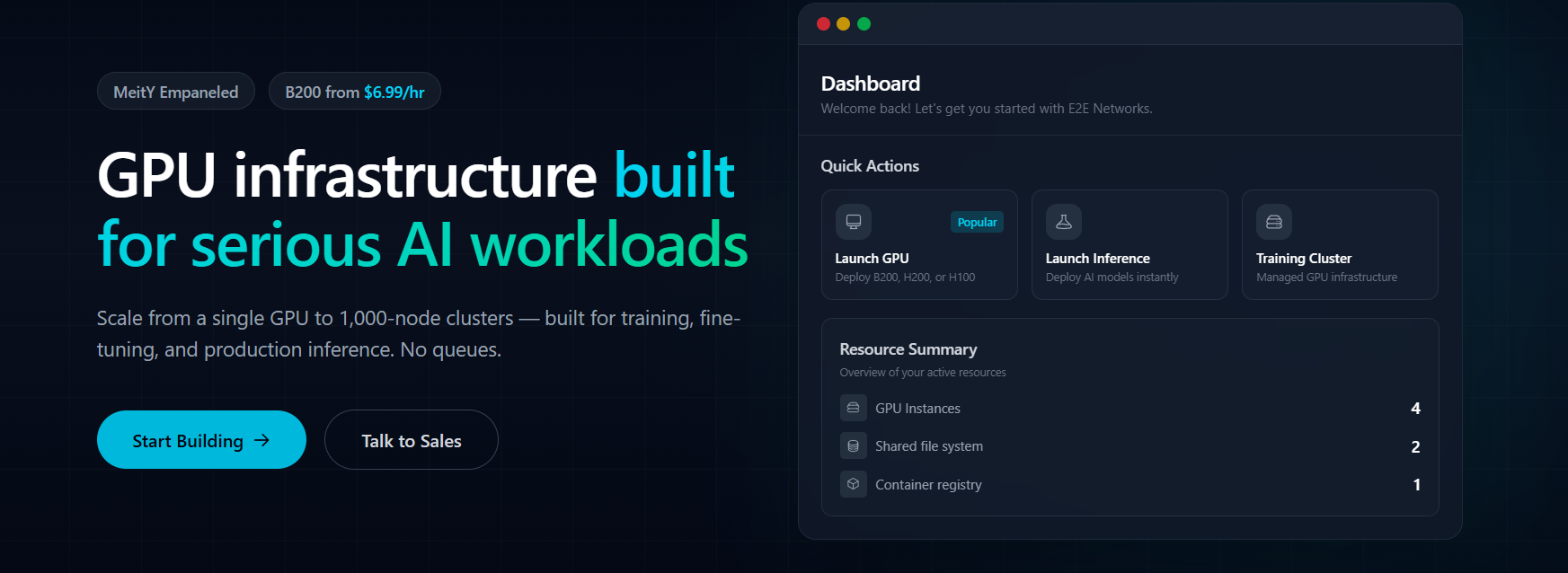
E2E Networks is particularly interesting for AI startups operating in India or prioritizing infrastructure costs.
Its current accelerator range includes NVIDIA B200, H200, H100, A100, L40S, L4, and other configurations, giving founders several price-performance points to choose from as workloads change.
What I like about E2E Networks
Pricing is unusually visible.
Early-stage and growth-stage founders often need to model infrastructure costs before they know exactly how quickly usage will increase.
E2E publishes hourly, monthly, and annual pricing for its current accelerator options.
The hardware range supports different startup stages.
A team does not have to jump straight to Blackwell hardware. It can choose a less expensive configuration for one workload and move toward B200 infrastructure when the economics justify it.
There is substantial third-party feedback.
E2E Networks currently has a 4.8 rating on G2 from 132 reviews. Review themes include cost effectiveness, support, and ease of setup, although those reviews cover the company's broader infrastructure products rather than only its newest AI hardware.
Where E2E Networks falls short
Its strongest fit is geographic.
Startups with teams, customers, or infrastructure requirements primarily outside India should evaluate whether the available locations fit their latency, governance, and expansion plans.
Its broad product range also means founders need enough technical knowledge to choose the right architecture.
Pricing
E2E Networks publishes current pricing. At the time of research, B200 was listed at $6.99 per hour, H200 at $4.54 per hour, and H100 at $3.77 per hour. Volume and enterprise pricing are available through sales.
4. WhiteFiber
WhiteFiber becomes more relevant when an AI startup is no longer simply buying compute and is beginning to think like an infrastructure organization.
The company offers custom cluster architecture, managed operations, orchestration, security, and infrastructure support. Its public pricing information indicates that reserved cluster arrangements start at a substantial scale, so this is mainly a growth-stage or later-stage option.
What I like about WhiteFiber
It can help design the infrastructure, not just operate it.
This is useful for startups that have outgrown improvised infrastructure but do not want to build a large internal infrastructure organization immediately.
WhiteFiber's services include architecture design, deployment, operations, orchestration, scheduling, security, and support.
The company is transparent about who should use its larger deployments.
Its pricing page states that the minimum reservation for its dedicated cluster model is 32 systems, representing 256 GPUs, with a 12-month minimum term.
That makes it easier for a startup to know whether it has reached the right scale before spending time on procurement.
The operating model can reduce hiring pressure.
A startup moving into large AI infrastructure faces a choice: build internal capability for cluster operations or bring in a specialist.
WhiteFiber's managed services can shift some of that operational burden outside the startup.
Where WhiteFiber falls short
The entry point is high for its reserved infrastructure.
That immediately rules it out for many startups, even those experiencing strong growth.
The model also involves more design and scoping than a standardized infrastructure purchase, so teams should expect a consultative sales process.
Pricing
Large infrastructure projects are quote-based.
WhiteFiber states that pricing is determined by customer requirements during project scoping. Its reserved cluster model has a 32-system minimum, equal to 256 GPUs, and a 12-month minimum commitment.
5. Ori
Ori is a useful option for AI startups with strong technical teams that want more control over their physical infrastructure environment.
Its bare-metal offering gives teams direct access to dedicated systems while supporting high-speed InfiniBand networking and shared storage. That can suit model companies whose infrastructure engineers want to control the software environment closely rather than delegate most decisions to an operator.
What I like about Ori
It fits engineering-led startups.
Some startups already have infrastructure engineers who know exactly how they want training environments configured. For those teams, control can be more valuable than having every operational layer handled for them.
Bare-metal infrastructure supports predictable workloads.
Dedicated systems can be appealing once model training or inference is sustained enough to justify keeping capacity available.
It offers a middle ground.
A startup may be too large for its original infrastructure setup but not yet ready to lease an entire GB300 rack. Ori can make sense during that transition.
Where Ori falls short
The tradeoff is internal responsibility.
The more control the startup keeps, the more infrastructure expertise it needs internally. That can become expensive as the engineering organization grows.
For a startup whose priority is reducing operational responsibility rather than increasing technical control, CambridgeNexus or a more managed provider may fit better.
Pricing
Pricing varies according to configuration and commitment. Larger bare-metal deployments may require direct commercial discussions.
How to choose AI infrastructure as your startup scales
The wrong way to buy AI infrastructure is to optimize for the company you hope to become.
The better approach is to understand which transition your startup is actually going through.
Pre-product-market fit: protect runway
If the company is still validating demand, flexibility matters more than infrastructure optimization.
Do not commit to rack-scale infrastructure because you expect to need it someday. Preserve cash and learn how customers actually use the product.
Growing usage: understand your workload
Once usage becomes repeatable, start tracking utilization carefully.
Which workloads are persistent? Which are temporary? How much time is spent training versus inference? How much capacity is genuinely being used?
This is where transparent providers such as Hyperstack or E2E Networks can be useful because founders can compare configurations and understand how infrastructure choices change cost.
Growth stage: compare flexibility with commitment
A startup with consistent infrastructure use should calculate whether longer commitments make financial and operational sense.
The hourly price is no longer the only important number. Founders should include engineering time, data transfer, storage, networking, idle capacity, operational support, and the cost of infrastructure failures.
Rack scale: stop treating infrastructure as a collection of parts
This is the point where CambridgeNexus becomes most relevant.
Once a startup needs full GB300 racks, it also needs to solve the physical environment around them. Power, cooling, networking, orchestration, compliance, and workload planning become linked decisions.
At this stage, founders should compare operating models rather than just accelerator prices.
The infrastructure mistake scaling AI founders should avoid
The biggest mistake is assuming that "scalable" means "buy the maximum amount of infrastructure you can afford."
Good scaling is incremental.
A startup should change infrastructure models when the workload makes the change rational. Moving too early burns capital. Moving too late can create capacity bottlenecks, emergency migrations, unpredictable costs, and engineering distractions.
There is also a founder-time problem.
Every infrastructure component the startup operates internally becomes something somebody has to understand, monitor, debug, secure, and maintain. For a small engineering organization, that work competes directly with product development.
The right infrastructure decision should therefore answer two questions:
What capacity does the company need?
And:
What infrastructure work does the company actually want its own employees doing?
Those answers are often more useful than comparing headline compute rates.
What's the best AI infrastructure provider for scaling AI startups?
There is no provider I would recommend at every startup stage.
For startups that have already reached sustained, full-rack requirements, CambridgeNexus is my top choice because its commercial and operating model begins exactly where the infrastructure challenge becomes more complicated: the full NVIDIA GB300 rack.
Best for startups ready for full-rack GB300 infrastructure: CambridgeNexus
CNEX makes the most sense for well-funded AI startups with production-grade workloads and predictable rack-scale requirements.
Its seven-layer operating model is valuable when founders want engineering teams focused on models and products rather than coordinating power, cooling, networking, orchestration, compliance, and workload planning themselves.
Best for startups that still need hardware flexibility: Hyperstack
Hyperstack is a stronger fit earlier in the scaling curve, when a company wants access to multiple NVIDIA generations and public pricing while it learns what its steady-state workload will look like.
Best for cost-conscious India-based AI startups: E2E Networks
E2E Networks combines a broad accelerator range, transparent pricing, and strong public customer feedback, making it particularly interesting for startups operating in India.
Best for startups graduating into large managed clusters: WhiteFiber
WhiteFiber is worth considering after the startup's requirements become large enough to justify custom cluster design and managed infrastructure operations.
Best for engineering-led startups that want more control: Ori
Ori fits technical teams that want bare-metal infrastructure and greater influence over how their systems are configured and operated.
FAQs
When should an AI startup move to dedicated infrastructure?
Usually when infrastructure demand becomes sustained and predictable enough that reserving dedicated capacity provides a clear operational or financial benefit.
Founders should look at utilization, growth forecasts, engineering workload, customer requirements, and the cost of unpredictable capacity before committing.
Does an AI startup need the newest NVIDIA hardware?
No.
The best accelerator is the one that meets the workload's performance requirements at a sensible total cost. Older architectures can remain financially attractive for many inference, fine-tuning, and development tasks.
A startup should move to newer systems when the performance, memory, networking, or rack-scale advantages materially improve the business case.
When does a full GB300 rack make sense for a startup?
A full rack makes sense when the company has sustained production workloads large enough to use rack-scale capacity and can justify a longer commercial commitment.
It is generally a later-stage infrastructure decision, not something a startup should purchase simply because it expects future growth.
Should AI startups manage infrastructure internally?
It depends on where the company's competitive advantage sits.
A startup building infrastructure technology may deliberately keep deep operational expertise internally. A startup whose differentiation is its model, data, or application may prefer to place more infrastructure responsibility with an operator.
The important point is to make that choice deliberately. Infrastructure work consumes engineering time whether or not founders include it as a separate line item in the budget.