.jpg)
Most solo founders run exactly one paid acquisition channel.
Usually Google. Sometimes Meta.
Rarely both, and almost never a third option like Microsoft Ads, even though it often converts cheaper.
The reason isn't strategy. It's that adding a channel feels like it needs a hire, and a hire feels like a problem for later. That assumption is wrong, and it's quietly capping a lot of otherwise healthy businesses.
The One-Channel Trap: Why Solo Founders Stop Expanding
A solo founder gets one channel working, sees a workable CAC, and stops. Not because the math says stop. Because the operational load of adding a second platform looks bigger than the upside of the first one paying off.
This is a real trap, not a minor inefficiency. A business running 100% of its paid acquisition through one channel is exposed to that channel's decisions in a way a diversified business isn't. Auction prices climb as a category gets competitive. Platforms change targeting rules. Account reviews and suspensions happen without warning, sometimes with no clear path to resolution for weeks. A founder whose entire pipeline depends on one ad account is one policy change away from a very bad month.
The instinct to avoid this is correct. What's usually wrong is the assumed cost of fixing it. Founders picture a second channel as a second full-time job: new account setup, new tracking, new optimization cycle, new person to run it. In practice, most of that cost is administrative, not strategic, and administrative cost is exactly what no-code tooling and better account infrastructure are built to remove.
What Actually Makes a Second Channel Hard (It's Not Strategy)
Strip away the assumption and look at what actually eats time when a solo founder tries to add a platform like Microsoft Ads alongside an existing Google Ads account.
It's rarely the campaign strategy. Keyword research, audience targeting, and budget allocation are the same skills a founder already applies to their first channel, just pointed at a new auction. The parts that actually consume time and stall momentum are:
- Account setup and verification. New advertiser accounts, especially business or agency-tier accounts, often go through review periods that can take days to weeks, with spend caps applied until verification clears.
- Separate billing and login management. A second platform means a second login, a second payment method, and a second place things can go wrong without anyone noticing.
- Conversion tracking from scratch. Setting up tracking correctly on a new platform, and confirming it's actually firing before spend goes live, is tedious and easy to get wrong the first time.
- No clear owner for the ongoing check-ins. Without a team, the second account either gets neglected after week one or eats into hours the founder needs elsewhere.
None of these are strategic problems. They're friction problems, and friction problems have a much cheaper fix than "hire someone."
The Account Infrastructure Unlock
This is where the real unlock sits, and it's the part most solo founders never think to look for. A meaningful chunk of the friction around adding a second ad platform comes from account access itself, not from the marketing work. If a founder can skip the slow verification queue and start with an account that's already set up for immediate use, the entire "second channel needs a team" assumption falls apart.
This is exactly the gap that services like Uproas's Bing agency accounts are built to close. Instead of waiting through Microsoft's standard advertiser verification process, which can stall a launch for days or weeks with spend limits attached, a founder gets a pre-verified account ready to run campaigns immediately. For a one-person business trying to test a second channel without burning a month on account setup alone, that's the difference between actually running the test this quarter and pushing it to "eventually," which usually means never.
The broader lesson applies beyond Bing specifically. Whenever a founder finds themselves avoiding a useful channel because the account side feels heavy, the right question isn't "do I need to hire someone." It's "is there infrastructure that removes this specific friction." Increasingly, for ad accounts, hosting, payments, and dozens of other operational layers, the answer is yes.
Building a Lean Two-Channel Stack Without Hiring Anyone
Once account access stops being the bottleneck, a solo founder can run two channels with a surprisingly small set of tools.
A workable stack looks like this:
- Account layer. Pre-verified or fast-onboarded accounts for each platform, so setup time doesn't eat the first month of testing.
- Tracking layer. A single source of truth for conversions (a CRM or spreadsheet fed by both platforms' tracking pixels) so performance across channels is comparable, not siloed in two separate dashboards.
- Automation layer. Zapier or Make connecting form fills, leads, and conversion events from both platforms into one place, removing the manual work of checking two separate ad managers daily.
- Reporting layer. A lightweight AI-assisted summary, run weekly, that flags which channel is outperforming on cost per lead so budget shifts happen based on data instead of gut feel.
Nothing in this stack requires a hire. It requires roughly a day of setup and a recurring 30 minutes a week of review, which is a very different time commitment than the "second full-time job" most founders assume.
Choosing Your Second Channel: A Practical Comparison
Not every second channel is equally good for a solo operator. The right choice depends on what the first channel is already doing and where the gaps are.
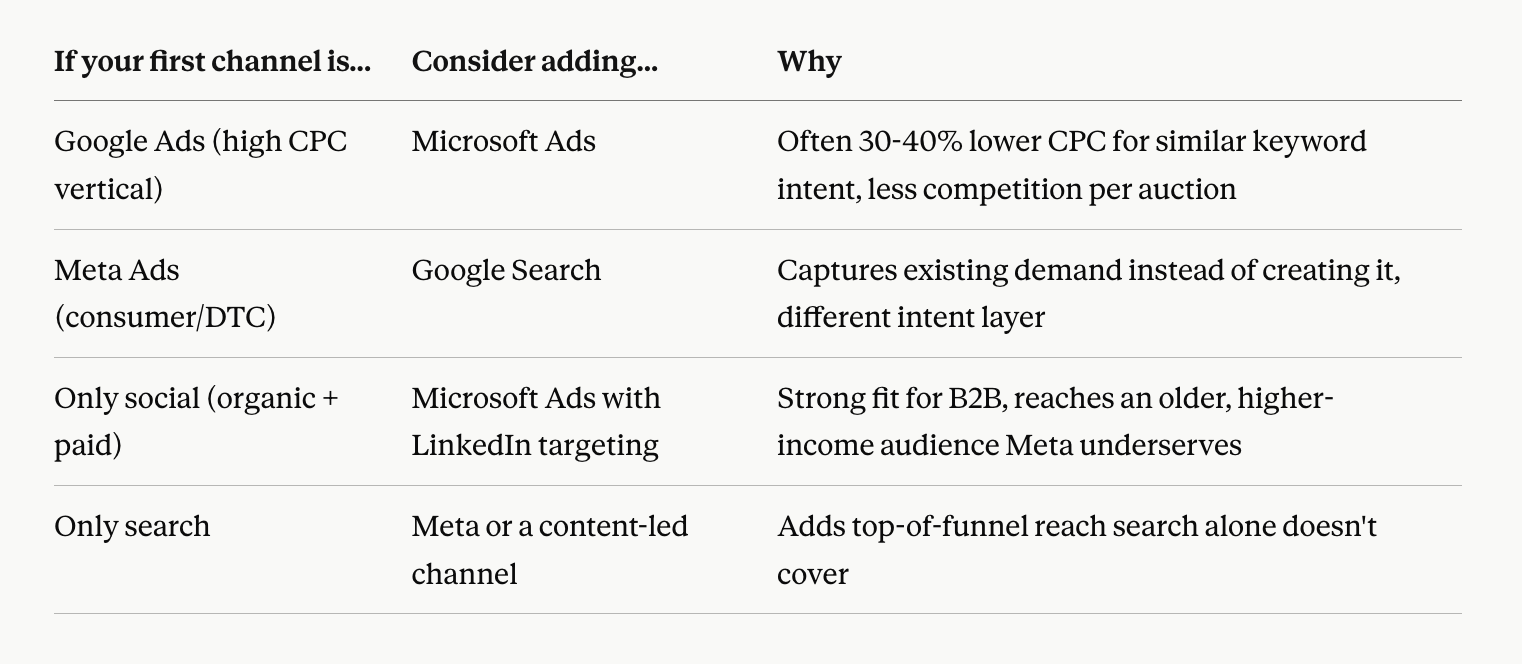
For B2B and high-consideration SaaS founders specifically, Microsoft Ads deserves more attention than it usually gets. Its audience skews toward the exact demographic (older, higher household income, in more senior job roles) that tends to convert well for software and services. Solo founders who've only ever run Google often assume Bing is a smaller, worse version of the same thing. The audience composition and lower CPC argue otherwise.
A 30-Day Plan to Add a Second Channel Solo
- Week 1: Get account access sorted first. Use a fast-onboarding or agency account service if the standard verification timeline would delay launch. Confirm billing and login separation from your first channel.
- Week 2: Set up conversion tracking and confirm it fires correctly before any real spend goes live. Import or rebuild a small starter campaign, don't try to replicate your entire first channel's account structure on day one.
- Week 3: Launch at a modest test budget. Set up automated alerts (via Zapier or Make) so you're notified of spend anomalies or lead spikes without manually checking the dashboard daily.
- Week 4: Review cost per lead against your first channel. Decide whether to scale the second channel's budget, adjust targeting, or pause and revisit later. This is the point where the "two channels without a team" question gets answered with actual data.
Common Mistakes Solo Founders Make When Adding a Channel
- Waiting for "enough time" that never arrives. The friction is mostly front-loaded in setup. Once tracking and account access are sorted, ongoing management is lighter than expected.
- Treating the second channel like a smaller version of the first. Different platforms have different audience behavior and auction dynamics. A direct copy of campaign structure usually underperforms.
- Skipping tracking setup to launch faster. This guarantees a founder won't be able to tell if the channel actually worked, which defeats the entire point of testing it.
- Assuming account setup delays are unavoidable. They're often the single most solvable part of the whole process, and the part founders are least likely to look for a shortcut on.
- Over-hiring too early. Bringing on a media buyer before the channel has proven itself with even a lean, semi-automated setup is a cost most solo businesses don't need to take on yet.
Conclusion
The gap between running one ad channel and running two isn't a staffing gap.
It's an infrastructure gap, and it's smaller than most solo founders assume.
Fix the account access problem, wire up tracking and automation with tools that already exist, and a second channel becomes a data question rather than a hiring decision.
For founders relying on a single acquisition channel today, that's the more immediate risk worth solving, well before the next hire is.