
You’ve read three of these lists. Every one told you a different tool was “best.” Now you’re more confused than when you started, and you still haven’t changed a single campaign. The problem isn’t that you haven’t found the right list. It’s that you’re being asked to pick a product before you’ve identified what type of tool you need. I’ve run email for loyalty programmes with 2.7 million members, SaaS lifecycle funnels, and newsletters that hit 30,000 readers with no paid acquisition. That range taught me one thing: the use case decides everything.
The AI Feature You’re Paying For Might Not Be AI
Most buyers evaluating email platforms do the same thing. They open a comparison page, scan the feature list, and count how many “AI” items each platform checks off. AI segmentation. AI subject line optimization. AI send-time prediction. The more boxes ticked, the more advanced the platform must be. So they pick the one with the longest AI feature list and sign up.
That comparison is almost entirely meaningless.
Here is what the feature list does not tell you. True machine learning in email requires behavioral data at scale to train on. An AI that predicts the best send time for a specific contact needs enough prior send and engagement data for that individual to detect a real pattern. Without that data, the model defaults to population-level guesses. Those guesses might look like “Tuesday at 10am works best for your industry.” Any experienced marketer could tell you the same thing. It is not intelligence. It is an averaged heuristic dressed in API calls.
Rules-based automation works differently. It follows if-then logic configured at setup. “If a contact has not opened in 90 days, move them to a re-engagement sequence.” That is powerful, useful, and absolutely worth paying for. But it is not AI. Both have real value. The problem is that they cost differently, require different data quality, and produce different results at different list sizes. Conflating them during a purchase decision means paying a premium for capability that may not function at your scale.
I saw this pattern consistently while working across CRM and campaign strategy at a customer analytics firm, where we handled retail, BFSI, and FMCG clients at scale. Platforms marketed as having “AI personalization” routinely defaulted to segment-level logic rather than individual-level prediction until the contact base crossed meaningful behavioral data thresholds. The feature label on the product page did not change between a list of 800 and a list of 800,000. The underlying behavior was dramatically different.
The question every platform demo sidesteps: what does your AI feature actually output when there is no prior engagement data for a contact?
Ask that before any sales call ends. The answer tells you everything. If the platform describes population averages, industry defaults, or content-type assumptions, you are looking at a rules engine. If they describe per-contact model training timelines and minimum data requirements before the feature activates meaningfully, you may be looking at genuine ML. Neither is disqualifying. But knowing which you are buying changes the entire decision.
Here is a useful named concept for this evaluation: Feature Floor, the minimum list size and engagement history required for an AI feature to outperform a marketer’s manual judgment. Every AI email feature has one. Platforms almost never disclose it voluntarily. Your job as a buyer is to find out what it is before you sign.
Most AI email marketing articles skip the purchase decision you actually need to make: not which tool has the most AI features, but whether the AI features on any given tool will function at your list size and data quality.
The distinction matters because AI marketing automation and traditional rule-based automation are not interchangeable terms, even when the same platform uses them interchangeably in its feature documentation.
Three questions that separate genuine ML from relabelled rules engines in any email platform:
- Does the feature require a training period before producing personalized outputs? Genuine ML models need time and data to calibrate per contact. If a feature works identically from day one for every contact on your list, it is not learning from your data.
- Does the platform disclose a minimum contact or engagement volume for the feature to function as described? Ethical ML vendors acknowledge that their models need scale. Vague answers about “leveraging your data” without any thresholds mentioned are a red flag.
- Does the AI output differ meaningfully per contact, or does it produce the same recommendation for contacts who share similar demographic attributes? Individual-level prediction looks different from segment-level rules. Ask for a demo showing two contacts with identical demographics but different engagement histories.
Read next: AI email marketing strategy, the use-case and channel layer that the tool selection covered in this article sits inside.
The Feature Floor question matters most in one specific email motion. That is lifecycle. That is where platform AI genuinely earns its cost, but only under one condition.
Lifecycle Email Is Where Platform AI Actually Earns Its Fee
Most marketers selecting a lifecycle email platform go straight to the feature comparison. Which platform has more AI capabilities. Which has the higher G2 rating. Which costs less at the entry tier. They switch platforms, connect their Shopify store or SaaS product, and wait for the results to improve. Then they wonder why their flows feel roughly the same as what they had before.
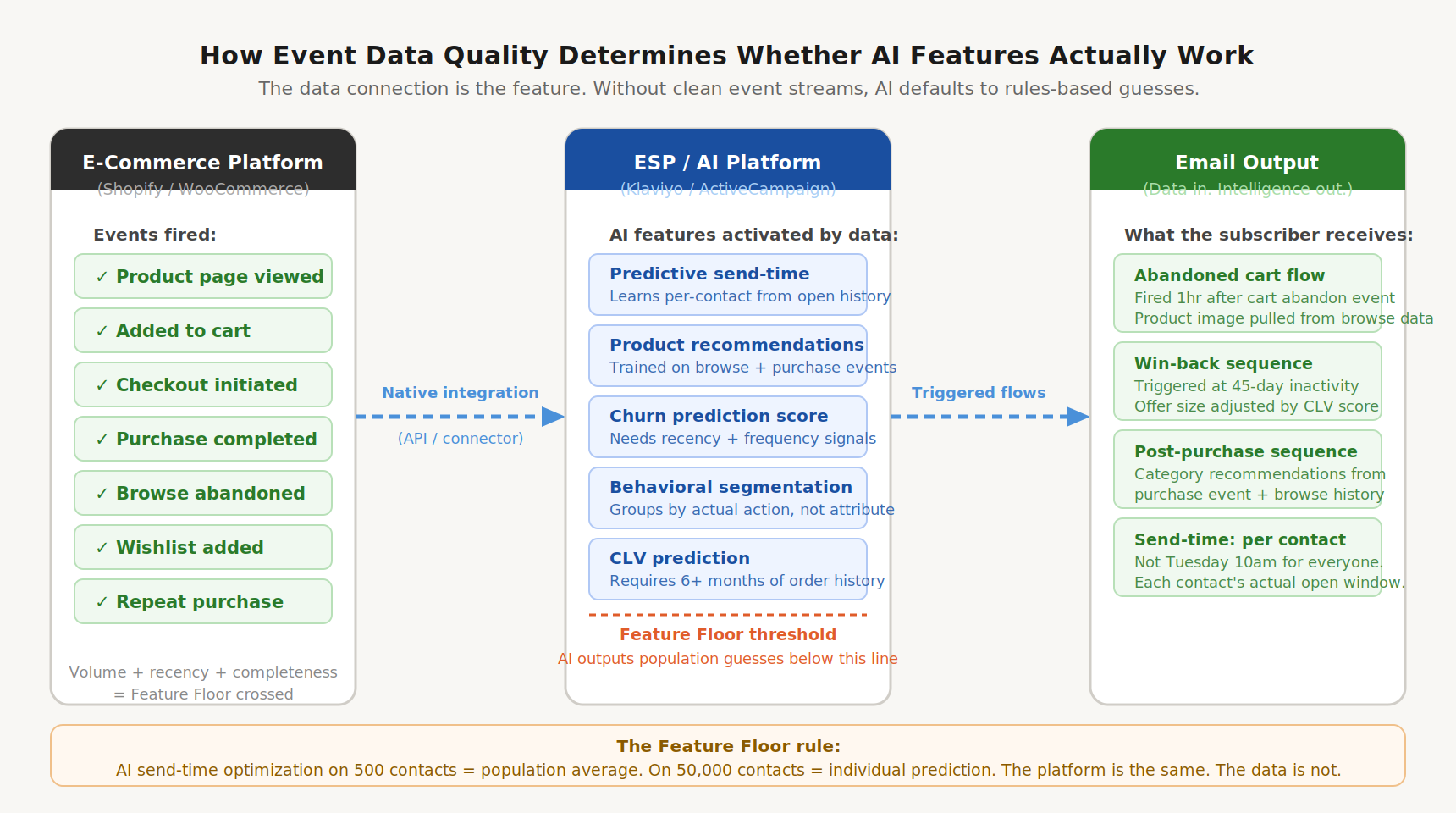
The reason is almost always the same. Lifecycle email AI is only as intelligent as the event stream feeding it. An AI abandoned cart flow trained on 200 monthly cart events learns slowly and defaults to generic timing and content logic. The same flow trained on 20,000 monthly cart events adapts per customer within weeks, adjusting product recommendations based on actual browse history and send timing based on individual engagement patterns. The platform did not change between those two scenarios. The data volume behind it did.
This is the part no listicle explains. When a marketer switches from Mailchimp to Klaviyo, the lift they see is often not the AI itself. It is the improved event data integration from Shopify, which finally gives the behavioral AI something real to work with. Clean, complete, timely event data is what makes lifecycle AI function as advertised. Without it, you are running expensive if-then logic.
I ran into this problem from a different angle while working with one of India’s largest department store chains on their loyalty programme. ClubWest had 2.7 million members and drove the majority of the brand’s annual sales. Solid programme on paper. But around 15% of members lapsed every year. When we dug in, we found something uncomfortable: 73% of recent lapsers were on DND and unreachable by SMS. Around 63% had not opened a single email in months. The entire CRM stack was firing triggers at contacts who had already exited every available channel. The behavioral data existed. The channel relationship was broken.
We went around the problem. We built a Facebook Custom Audience from the lapsed member base and ran re-engagement directly in their social feed. No DND barrier. No email open rate to watch. The campaign won a CMO Asia Award for Best Use of Facebook. But what I took from it was the mechanism: platform AI in email cannot rescue a broken channel relationship. Once the channel relationship is healthy and the event data is flowing, lifecycle AI compresses what used to take weeks of manual segmentation into hours.
Before committing to a platform switch, check what lifecycle email flow benchmarks look like for your industry. The gap between a well-configured trigger sequence and an unconfigured one is typically larger than any AI feature difference between platforms.
The fix is straightforward. For e-commerce, connect your Shopify or WooCommerce store to your ESP fully before evaluating whether AI features are working. The data connection is the feature. For SaaS lifecycle email (onboarding, activation, churn prevention), the same principle applies: your in-app event tracking must be sending reliable behavioral signals before any AI segmentation or predictive flow has anything meaningful to act on.
Connecting your data source fully before evaluating whether AI features are working is not a setup step. It is the only thing that determines whether you have bought a tool or an expensive automation layer.
For E-Commerce: Klaviyo vs Omnisend
Klaviyo is the default for Shopify-first e-commerce operations for a specific reason: the native data integration is the tightest in the category. When your store and your ESP share the same data architecture, the behavioral AI features (predictive send-time, product recommendation flows, churn prediction scoring) function closer to what the marketing page promises. The honest limitation: Klaviyo pricing scales steeply with list size, and the most capable AI features are locked behind the higher tiers.
Omnisend is the stronger choice if your e-commerce stack spans multiple platforms: WooCommerce, BigCommerce, Shopify, or a custom setup. It is more flexible on integrations, more predictable in pricing at mid-market scale, and its automation builder handles multi-channel sequences (email plus SMS plus push notifications) more natively. The limitation: the ML depth behind its AI features is shallower than Klaviyo at comparable list sizes.
For SaaS Lifecycle: ActiveCampaign vs Brevo
ActiveCampaign handles complex multi-branch automation better than almost anything else in its price range. For SaaS lifecycle email (onboarding step triggers, feature adoption nudges, trial expiry sequences, churn prevention based on in-app inactivity), the visual automation builder gives genuine control over logic depth. The AI features (predictive sending, win probability scoring, contact scoring) are ML-backed at meaningful contact volumes. The limitation: setup complexity is real. This is not a tool you configure correctly in an afternoon.
Brevo (formerly Sendinblue) is the better option if your list is under 20,000 contacts and budget is a genuine constraint. The automation is solid for standard SaaS onboarding sequences. The AI features are shallower, but for an early-stage SaaS product where the Feature Floor has not yet been reached anyway, that gap is irrelevant. Pay for the simpler tool, build your data hygiene habits, and upgrade when the list size and event data quality actually justify it.
Lifecycle email is the motion where platform AI earns its cost. Outbound email is the motion where most AI tool purchases are made for entirely the wrong reason.
Outbound Email: The Bottleneck Is Never the Copy
A B2B sales team or founder with flat cold email reply rates reads about AI personalization tools. They add one to their workflow. The emails start opening with personalized lines referencing a prospect’s LinkedIn post or recent company news. The reply rate stays at 1 to 2 percent. They conclude that AI email tools do not work for outbound and go back to what they were doing before.
The tool is not the problem. The diagnosis is.
AI personalization for outbound amplifies the signal you give it. If the ICP is wrong, the tool writes more confident, personalized emails to the wrong people faster. If the sending domain is not properly warmed up, those AI-personalized emails land in spam folders at the same rate as generic templates. Copy quality is not the lever in cold email. It never was.
The actual bottlenecks in outbound are deliverability infrastructure and offer clarity. A 1 percent reply rate on 2,000 cold emails per week is not a writing problem. It means either the emails are not reaching inboxes, or the offer is not relevant to the person receiving it, or both. Adding AI personalization to a broken sending foundation produces better-sounding emails that nobody reads.
The data is consistent across multiple large-scale analyses of cold outreach. Smartlead’s analysis of 14.3 billion cold email sends found that AI-driven outreach achieves roughly 2.7 times higher reply rates than undifferentiated sends. That number sounds compelling until you read the fine print: it reflects campaigns where deliverability infrastructure and ICP targeting were already functioning. It is not a copy quality result. It is a compound result. Isolate the AI copy layer alone, and average B2B cold email reply rates cluster near 5 to 9 percent in large datasets regardless of which writing tool generated the outreach, provided the infrastructure is clean. If the infrastructure is not clean, cold email reply rate benchmarks show rates dropping to 1 to 2 percent routinely, regardless of copy quality.
The sequence that produces measurable lift in outbound is not controversial among people who have actually run it at scale. Deliverability infrastructure first. ICP precision second. AI copy assistance third. The industry sells it in reverse order because AI copy tools are easier to demo.
The fix is to build your outbound AI stack in layers and not add the next layer until the previous one is stable.
Layer one is deliverability. Your sending domain must be authenticated (SPF, DKIM, DMARC), warmed up over a minimum of four to six weeks from a cold domain, and sending within the per-inbox volume limits your infrastructure can handle. Without this, everything else is wasted.
Layer two is ICP precision. Who you email matters more than how you email them. A tightly defined ICP with strong behavioral or intent signals (job change, funding round, technology stack signals, review activity) will outperform a vague ICP with world-class copy at every list size.
Layer three is AI copy assistance. Once layers one and two are stable, AI tools add real value. They reduce the manual time cost of personalization without replacing the judgment behind who to contact and what to offer.
AI copy assistance as the first investment in outbound is the most common and most expensive mistake in this category.
The Deliverability Layer
Most outbound email problems are deliverability problems. Most teams do not know this because their email tool dashboard still shows “delivered.” Delivered means the server accepted the message. It does not mean the message reached the inbox. Those are different events.
Before evaluating any AI copy tool, confirm all three of these infrastructure elements are in place:
- Domain authentication is complete: SPF, DKIM, and DMARC records are configured and returning passing results. Use Mail-Tester or MXToolbox to verify. If any of these are failing, stop here and fix them before anything else.
- Domain warmup is complete or in progress: A new sending domain needs a minimum of four weeks of gradual volume ramp before it can send at scale without triggering spam filters. Instantly and Smartlead both handle inbox rotation and warmup protocols for volume senders.
- Sending volume is within per-inbox limits: Each sending inbox can safely handle 30 to 50 emails per day before reputation starts degrading. If your required volume exceeds that, you need inbox rotation across multiple warmed sending addresses.
Checking email deliverability benchmarks shows what inbox placement rates look like when infrastructure is and is not in place. The gap between the two explains most outbound underperformance without touching the copy at all.
AI Copy Tools as the Third Layer
Once deliverability is confirmed and the ICP is precise, AI copy tools do add value. Not by replacing the judgment of what to say. By reducing the time it takes to say it well, at volume.
The newsletter motion involves none of this complexity. That is the point.
Newsletter Email Needs the Simplest Tool, Not the Smartest One
A newsletter operator reads the same “best AI email marketing tools” article as the e-commerce manager and the B2B sales lead. They see Klaviyo, ActiveCampaign, and HubSpot described as the most AI-forward platforms. They open a trial account. Within 20 minutes, they are building contact properties, reading documentation about behavioral segmentation, and configuring event triggers. They have not written a word of their newsletter yet.
That is the wrong tool for the motion.
Newsletter email is a fundamentally different problem. There is no behavioral purchase trigger to detect. There is no onboarding event to fire on. There is no ICP to qualify against intent signals. The relationship is direct: the reader receives content, opens it, reads it, and either stays subscribed or does not. The AI capabilities that make Klaviyo and ActiveCampaign genuinely powerful in lifecycle and outbound contexts (predictive segmentation, event-triggered behavioral automation, ML-backed churn scoring) are irrelevant to this motion.
The AI features that do matter in newsletter email (content assistance for drafting, basic list segmentation, send-time optimization) are now commodity features available on purpose-built newsletter platforms at a fraction of what enterprise ESPs charge. Using a behavioral AI platform to send a twice-weekly newsletter is like renting a warehouse to store a desk.
I built a newsletter called OpenCJ focused on non-traditional job opportunities: remote, freelance, contract, and work-from-anywhere roles. No launch strategy. No paid acquisition. Consistent publishing and word of mouth. It grew to over 30,000 readers.
The platform I ran it on was a simple, dedicated newsletter tool. The AI features available were basic. I used them occasionally for subject line ideas and almost never for anything else. What grew the list was a consistent point of view in every issue and a reliable publishing schedule. I could have run the same newsletter on Klaviyo or ActiveCampaign. I would have spent more time managing the tool and less time writing the thing. The tool choice for newsletter email is a publishing decision, not a marketing intelligence decision.
The tool choice for newsletter email is a publishing decision, not a marketing intelligence decision.
Beehiiv if you want built-in growth infrastructure alongside your newsletter. The referral programme, paid subscription layer, and web presence are designed for creators who want to grow and monetize simultaneously. The AI features (subject line assistance, send-time optimization, basic analytics) are solid for the motion without being the reason to choose it.
Kit (formerly ConvertKit) if you are monetizing through courses, digital products, or sponsorships and need the CRM and commerce layer to sit alongside your newsletter. The automation is creator-focused rather than e-commerce or SaaS-focused, which means it gets out of the way of the writing while still letting you manage paid subscribers and product buyers in the same place.
MailerLite if budget is the primary constraint and you want a tool that sends reliably without a week of configuration. The AI features are minimal. At under 10,000 subscribers, that is not a limitation.
Check newsletter engagement benchmarks to calibrate what realistic open rates and click rates look like before attributing a performance gap to the platform rather than the content.
The right AI email marketing tool depends entirely on what type of email you are actually sending. Before reading another comparison, work through this in order.
- Name your primary email motion. Lifecycle (e-commerce or SaaS triggers), outbound (B2B cold email or SDR sequences), or newsletter (creator or content-first). If you run more than one, pick the motion where you most want to see improvement. The tool decision that follows is different for each.
- For lifecycle: audit your event data before comparing platforms. Confirm your e-commerce store or SaaS product is sending behavioral events (cart adds, checkout completions, product page views, onboarding step completions) to whichever tool you are considering. No clean event stream means no AI lift, regardless of which platform you choose.
- For outbound: run a deliverability check before adding any AI copy layer. Use Mail-Tester or MXToolbox to verify your domain authentication (SPF, DKIM, DMARC) is passing. If it is not, fix that first. Deliverability problems explain more outbound underperformance than copy quality ever does.
- For newsletter: open a 14-day trial on Beehiiv or Kit and evaluate one thing specifically. Does the tool get out of your way when you sit down to write and send? If you spend more time in the tool than in your draft, it is the wrong tool for this motion.
- For any motion: ask this question before signing anything. “What does your AI feature output when there is no prior engagement data for a contact?” The answer tells you whether you are buying machine learning or a rules engine, and whether your current list has already crossed the Feature Floor that makes the difference visible.
If you want the strategy and use-case layer behind these tool decisions, the AI email marketing guide at shno.co covers the channel-level thinking that tool selection sits inside.