
You turned on AI personalization and nothing much changed. Maybe open rates ticked up a point, maybe they didn’t, and the vendor dashboard looks busy but the results don’t match the pitch. The problem isn’t the AI. It’s that every guide in this space teaches you what AI email marketing does, and none explain what has to be true before it can do any of it. I spent two years at a customer analytics firm running CRM and segmentation strategy for brands like Westside, TataSky, and Coca-Cola. The thing I kept watching fail wasn’t the campaign. It was the data underneath it.
Before You Touch Any AI Feature, Run the Foundation Audit
Most marketers approach AI email marketing as a feature activation problem. They turn on send-time optimization, enable the AI subject line tool their ESP just launched, or connect a generative copy tool to their campaign workflow. Then they wait for the lift the vendor promised. It does not arrive. Or it arrives in one metric and disappears in another.
This happens for a reason that is not subtle. AI does not diagnose and repair a broken email programme. It scales whatever the programme currently is. If your CRM data has significant gaps, AI-powered segmentation builds audiences on incorrect signals. If your list has not been cleaned in six months, AI send-time optimization delivers messages at the optimal moment to contacts who were never going to engage, and who will now damage your sender reputation by ignoring or flagging those perfectly-timed emails as spam. If your AI copy generator has not been trained on your brand’s actual voice, it produces content that sounds like every other brand using the same model. Your subscribers are starting to recognize it.
AI does not fix your email programme. It amplifies whatever the programme already is, including its failures.
The three conditions that determine whether AI email features produce lift or accelerate failure are what I call the Foundation Audit: data quality, list health, and brand voice training. Before any AI feature is worth enabling, all three need to pass a basic check.
I learned this before AI email marketing was a category. At Hansa Cequity, where I ran customer marketing strategy for large enterprise clients, almost every engagement started the same way. A brand would come in wanting better campaign performance, more personalization, more engagement from their loyalty programme. And in nearly every case, within the first week of looking at the actual data, we found the same problem.
The CRM had duplicate records. Behavioral fields were empty or syncing in overnight batches. The segmentation logic was built on demographic data rather than engagement signals. The data architecture was not ready for the kind of campaign personalization the client wanted, let alone the AI-powered personalization they were about to invest in.
This was true for programmes with 2.7 million loyalty members. It was true for programmes running 12 million subscriber records. Scale does not fix a data quality problem. It makes the problem move faster, and with more confidence. The gap between what AI email features need and what most CRM systems actually provide is documented in CRM data performance benchmarks, and it is wider than most marketing teams realize before they start building.
Data Quality: What AI Actually Needs From Your CRM
Most teams assume their CRM data is in reasonable shape because the system is running and campaigns are going out. These are not the same thing.
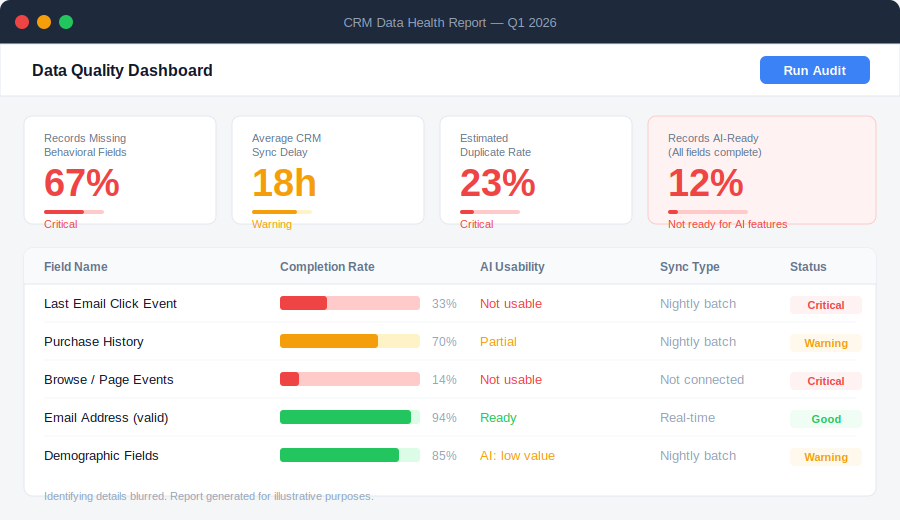
What AI email personalization needs from a CRM is real-time sync, behavioral event data, and deduplicated records with complete contact histories. Real-time sync matters because a customer who purchased this morning is still in your “prospects” segment until the nightly batch runs. Any AI-driven campaign touching them before then is operating on yesterday’s reality.
Behavioral event data matters because AI personalization learns from what subscribers do: open, click, browse, purchase, abandon. Not from what they are: age, location, job title. A CRM full of demographic fields and empty behavioral columns gives AI nothing useful to pattern-match against. Deduplicated records matter because a model trained on data where one customer appears as three separate contacts will produce recommendations and segmentation logic that reflects a fictional subscriber base.
Before enabling any AI personalization feature, check three specific things: the percentage of records missing behavioral event history, the sync delay between your product or e-commerce system and your email platform, and your estimated duplicate rate in the contact database. If any of those numbers are significantly out of range, data quality is the first project. Not AI tools.
According to Validity’s State of CRM Data Management in 2025, 76% of organizations report that less than half of their CRM data is accurate and complete. That figure comes from 602 CRM users and administrators across three countries. These are not small companies. They are organizations that have made significant investments in their CRM platforms and are still running AI features on data that cannot support them.
Gartner research puts the financial weight behind that finding: poor data quality costs organizations an average of $12.9 million per year. The cost is not abstract. It shows up in failed personalization, suppressed delivery, wasted automation spend, and campaign results that never match what the platform was supposed to produce.
List Health and Brand Voice: The Two Faster Fixes
List health and brand voice training are both fixable in days. Data quality can take weeks or months depending on the state of the underlying systems. Start with the fast fixes while the data work is in progress.
For list health: suppress any subscriber who has not opened or clicked in 90 days before running AI optimization on any segment. AI cannot produce lift for contacts who were never going to engage. It can make your programme spend more time and budget reaching them with more precision, which compounds the damage to your sender reputation faster than a less-optimized campaign would.
For brand voice training: before generating any AI copy, compile the ten highest-performing emails your brand has sent in the last 12 months. Feed them to your AI copy tool as style examples before asking it to generate anything new. Generic AI output is not a tool problem. It is a training gap. The model does not know what your brand sounds like unless you show it. When you show it, the output is meaningfully different. When you don’t, it produces content that sits in an increasingly recognizable category of AI-generated email that subscribers are learning to identify and dismiss.
How AI Personalization Works and What It Actually Requires
The most common misunderstanding in AI email marketing is the conflation of rules-based personalization with AI personalization. These are different things with different data requirements and different failure modes.
Rules-based personalization works like this: if a subscriber is in segment A, show content B. If they bought product X, recommend category Y. If it is their birthday month, send an offer. The rules do not learn. They do not adapt. They reflect the logic a human wrote at the time they were set up, and they break when the underlying data changes without anyone updating the rule.
AI personalization works differently. A machine learning model analyzes behavioral patterns across the entire subscriber base and generates content or targeting decisions that a human could not build because the patterns are too granular or too complex to express as a manual rule. It identifies that subscribers who consume a specific type of content on Thursday evenings and then browse without purchasing within 48 hours respond to a specific follow-up type at significantly higher rates than the same subscriber receiving the standard next campaign. No human writes that rule. The model identifies the pattern from behavioral history and acts on it.
This requires behavioral data. The model learns from what subscribers do: open, click, browse, purchase, abandon. It cannot learn from what they are. The reason most AI personalization programmes underperform is that the data feeding the model is the wrong type. Job titles and age ranges when what AI needs is an event stream.
AI personalization benchmarks show AI-optimized campaigns in programmes with correctly implemented behavioral tracking achieving substantially higher click-through rates than non-AI campaigns. The operative phrase is “correctly implemented behavioral tracking.” Programmes without that infrastructure are not seeing those numbers, regardless of which AI platform they are using.
I saw this problem clearly in 2015 when I was working on the loyalty and personalization architecture for Tata UniStore at Hansa Cequity. The question that governed every personalization decision was not which tool to use. It was which behavioral signals would actually be available at the moment of campaign execution, and what the sync latency would be between the transaction system and the marketing platform. The personalization ambition was constrained by the data reality, and any ambition that outran the data reality was not going to perform. That is still true.
The fix is to build behavioral data capture before turning on AI personalization. The minimum viable stack: email click and dwell tracking, on-site browse and purchase events fed into the email platform in near real-time, and engagement recency signals showing when each subscriber last opened and clicked, not just when you last sent. Once those signals are feeding the system, AI personalization has something to learn from. Before that, it is guessing with your subscriber list.
Predictive AI vs. Generative AI in Email: Which Does What
Most AI email features combine two distinct types of AI. Understanding which type is doing which job makes it much easier to diagnose where a specific feature is underperforming.
Send-time optimization is predictive AI. The subject line generation tool is generative AI. When send-time optimization underperforms, the problem is usually data quality or list state (Foundation Audit legs one and two). When subject line generation underperforms, the problem is usually brand voice training (Foundation Audit leg three).
AI Automation: The Flows That Earn Their Keep and the Ones That Don’t
The most common AI automation implementation is applying AI scheduling, AI subject lines, and AI copy generation to regular broadcast campaigns, then comparing performance to the previous broadcast. The lift is marginal. The attribution is murky. The team concludes AI is not really working.
The problem is the application, not the technology. Broadcast campaigns are not where AI automation creates structural advantage. They are where AI creates marginal efficiency: faster copy, slightly better timing, a subject line that tests a little cleaner. These gains are real but they do not compound. They do not change what the programme earns at a fundamental level.
The compound returns come from trigger-based lifecycle automation. Flows that respond to individual subscriber behavior in real time: what someone browsed, what they added to a cart, how long they have been inactive, where they are in the customer lifecycle. This is AI’s native territory. The decision space is too complex for human-written rules at meaningful scale, and the timing precision required exceeds what any manual system can sustain.
A well-built abandoned cart flow with AI-personalized product recommendations and AI-optimized send timing consistently outperforms broadcast campaigns by four to six times in revenue per recipient. That is not a marginal efficiency gain. It is a structural change in what the email programme earns. Email automation performance data consistently shows trigger-based lifecycle flows producing the highest revenue per recipient of any email type, and the AI layer on top of those flows compounds what is already the highest-performing category.
At Hansa Cequity, the clients who built trigger-based lifecycle flows as the foundation of their programme consistently outperformed those who treated batch campaigns as the core and considered lifecycle flows an add-on. The sequencing matters more than the tools. Broadcast campaigns are not the wrong investment. They are the wrong starting point for AI.
The fix is to sequence correctly. Build the trigger-based lifecycle flows first. Get them running and measuring. Then apply AI optimization to those flows. Then, once those flows are producing measurable return, bring AI to broadcast.
The Four Trigger Flows Worth Building Before Anything Else
Before applying AI to any broadcast campaign, these four flows should be in place and producing results:
- Welcome series: A subscriber who just opted in is at peak engagement. An AI-optimized welcome series that sequences content based on how the subscriber arrived, what they first consumed, and their initial engagement pattern consistently outperforms a static three-email welcome sequence in both click rate and downstream conversion.
- Abandoned cart recovery: For e-commerce programmes, this is the single highest-revenue trigger flow available. AI adds value here through personalized product recommendations that surface related items rather than just the abandoned product, send-time optimization calibrated to individual subscriber history, and automatic subject line variant testing that runs without requiring manual setup for each campaign.
- Re-engagement flow: Subscribers who have gone 60 to 90 days without opening or clicking need a specific sequence before suppression. AI helps by identifying which content type, offer structure, or cadence has historically reactivated subscribers with similar engagement profiles to the ones you are trying to win back.
- Post-purchase sequence: The window immediately after a purchase is the highest-trust moment in the customer relationship. An AI-optimized post-purchase flow uses purchase data to recommend genuinely relevant next products, identifies the right interval before making the next offer, and suppresses subscribers from broadcast campaigns until the post-purchase sequence completes.
What Changed in 2026: AI Email Marketing in the Gmail Gemini Era
Most AI email marketing guides circulating right now were written before February 2026. They give sound advice on using AI to generate copy at speed, optimize for open rates, and run subject line tests. That advice is not wrong. It is incomplete in ways that now have direct deliverability and performance consequences.
Two specific developments in late 2025 and early 2026 changed the operating environment for AI-generated email. Most general guides have not incorporated either of them.
The first: Google deployed an AI-specific spam filter in February 2026. It detects emails produced by language models without sufficient personalization signal. Emails with high AI-text similarity scores and no behavioral data connecting the content to the individual recipient are filtered at 2.4 times the pre-update rate, according to AI Vanguard’s 200-campaign audit. Sending raw LLM-generated copy to a list without pairing it with behavioral personalization data is now a deliverability risk, not just a brand voice concern.
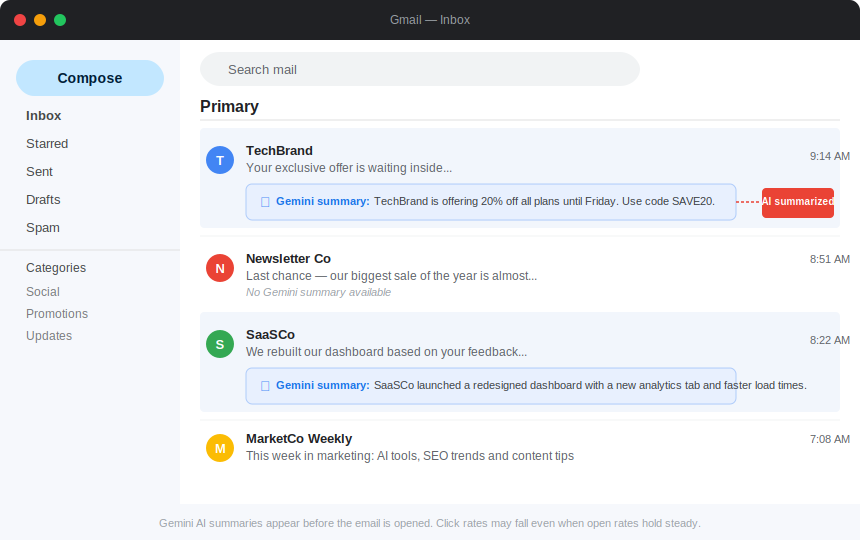
The second: Gmail’s Gemini AI now summarizes emails before recipients open them. Subscribers who previously would have clicked through to read content now see an AI-generated summary in their inbox and move on. Click rates decline even when open rates hold steady. And the open rate itself has become less reliable: Gmail may auto-open emails to generate Gemini summaries, inflating open counts in ways that have nothing to do with subscriber intent.
Folderly’s Q4 2025 client data found that emails with clear, front-loaded value propositions maintained 23% higher click-through rates than those with buried CTAs, as Gmail’s semantic filtering began evaluating content quality and value density directly.
Email deliverability benchmarks document the scale of the underlying inbox placement problem. Office 365 inbox placement fell from 77.4% to 50.7% year over year through 2025. The structural decline was already underway before the 2026 AI-specific filters added a new layer of risk. The inbox is harder to reach than it was 18 months ago, and AI-generated content without personalization signal is one of the faster ways to make it harder still.
What the AI Email Spam Filter Actually Detects (and How to Avoid It)
The February 2026 Google filter is not detecting that content was generated by an AI. It is detecting a specific combination: AI-text characteristics paired with the absence of meaningful personalization signal. An email that was generated by an LLM but contains a genuine behavioral personalization element (a specific product the subscriber browsed, a reference to a recent purchase, a content recommendation based on click history) does not match the filter pattern the same way a generic LLM blast does.
Three specific changes apply for the post-February 2026 environment.
First: always pair AI-generated copy with at least one behavioral data point per recipient before sending. A single signal changes the personalization profile of the message enough to matter. The recipient’s last browsed category, the product they viewed most recently, or the content type they clicked last time all qualify. The filter targets messages that are identical at AI-text similarity levels across a large list. One personalization element per recipient disrupts that pattern.
Second: structure emails for Gemini summarization rather than against it. Put the main offer or central value in the first sentence. Do not build to a reveal. Gemini reads your email and produces a summary that captures the top-line content. If your top-line content is a generic opener or a slow build to the real offer, that is what the summary reflects. Subscribers who read the Gemini summary and decide it is not worth opening have churned from that campaign without it registering in any metric you are tracking.
Third: stop using open rate as the primary performance metric for AI email campaigns. The combination of Apple Mail Privacy Protection (inflating opens since 2021) and Gmail’s auto-open behavior for Gemini summary generation makes open rate an unreliable indicator for any programme sending meaningful volume to Apple and Gmail addresses. Measure click rate, reply rate for transactional or high-intent flows, and revenue per recipient. These metrics survive the distortions that open rate cannot.
The Foundation Audit is not a one-time exercise. It is the operating standard for any programme where AI email features should compound rather than accelerate failure. Here is the five-step version you can run on your programme today:
- Pull a CRM data quality report. Identify the percentage of records missing behavioral event history, the sync delay between your product or e-commerce system and your email platform, and your estimated duplicate rate in the contact database. If more than 30% of records have missing behavioral fields or sync delays exceeding 24 hours, data quality is the first project. Not AI features.
- Run a list health audit. Pull engagement data for the last 90 days. Suppress any subscriber who has not opened or clicked in that window before enabling any AI optimization feature. AI cannot produce lift for contacts who were never going to engage. It produces confident, well-timed outreach to contacts who will damage your sender reputation.
- Audit your brand voice training. Compile the ten highest-performing emails your brand has sent in the last 12 months. Feed them to your AI copy tool as style examples before generating any new content. Generic AI output is a training gap, not a tool limitation.
- Map your trigger flows before applying AI to broadcast. Confirm you have a welcome series, an abandoned cart flow (if relevant), and a 90-day re-engagement sequence. If any are missing, build them before applying AI to broadcast campaigns. The highest returns from AI email automation come from trigger flows, not batch sends.
- Switch your primary email metric. Replace open rate with click rate or revenue per recipient as your leading performance indicator. Open rate is no longer a reliable signal for AI email programmes sending meaningful volume to Apple or Gmail addresses.
Read next: AI email marketing tools that fit each stage of the Foundation Audit