LinkedIn stopped being a "nice to have" channel for founders around 2023, and by 2026 it's become the default place where B2B buying decisions quietly start.
But the platform has also changed underneath everyone's feet.
LinkedIn rebuilt its entire ranking engine, cracked down hard on manipulation tactics, and started rewarding a completely different set of behaviors. Founders who are still running a 2024 playbook are watching their reach fall off a cliff, and founders who understand the new system are compounding faster than ever.
This article breaks down what actually works now, and how to build a repeatable, partly automated system around it instead of relying on guesswork.
Why LinkedIn Is Still the Highest-ROI Channel for B2B Founders
LinkedIn's core advantage hasn't changed: it's the only major platform where professional identity, buying intent, and content consumption sit in the same place. A founder posting about their product's problem space isn't just "doing marketing", they're building a searchable, referenceable body of expertise that prospects, investors, and future hires all encounter before ever talking to sales.
What has changed is how the platform decides who gets to see that content.
In late 2025 and into 2026, LinkedIn replaced its legacy ranking infrastructure with a unified AI system internally called 360Brew. Unlike the older algorithm, which leaned heavily on network size and early engagement velocity, 360Brew evaluates content against a much richer signal set: your stated professional identity, your topical consistency over time, and how deeply people actually engage with what you post, not just whether they tap a reaction button.
The practical result is a shift from reach-by-network to reach-by-relevance. A founder with 500 connections but tight topical focus can outperform a founder with 50,000 connections who posts about five unrelated things. That's a structural change, not a minor algorithm tweak, and it means the old advice - "just post consistently and grow your network" - is now necessary but nowhere near sufficient.
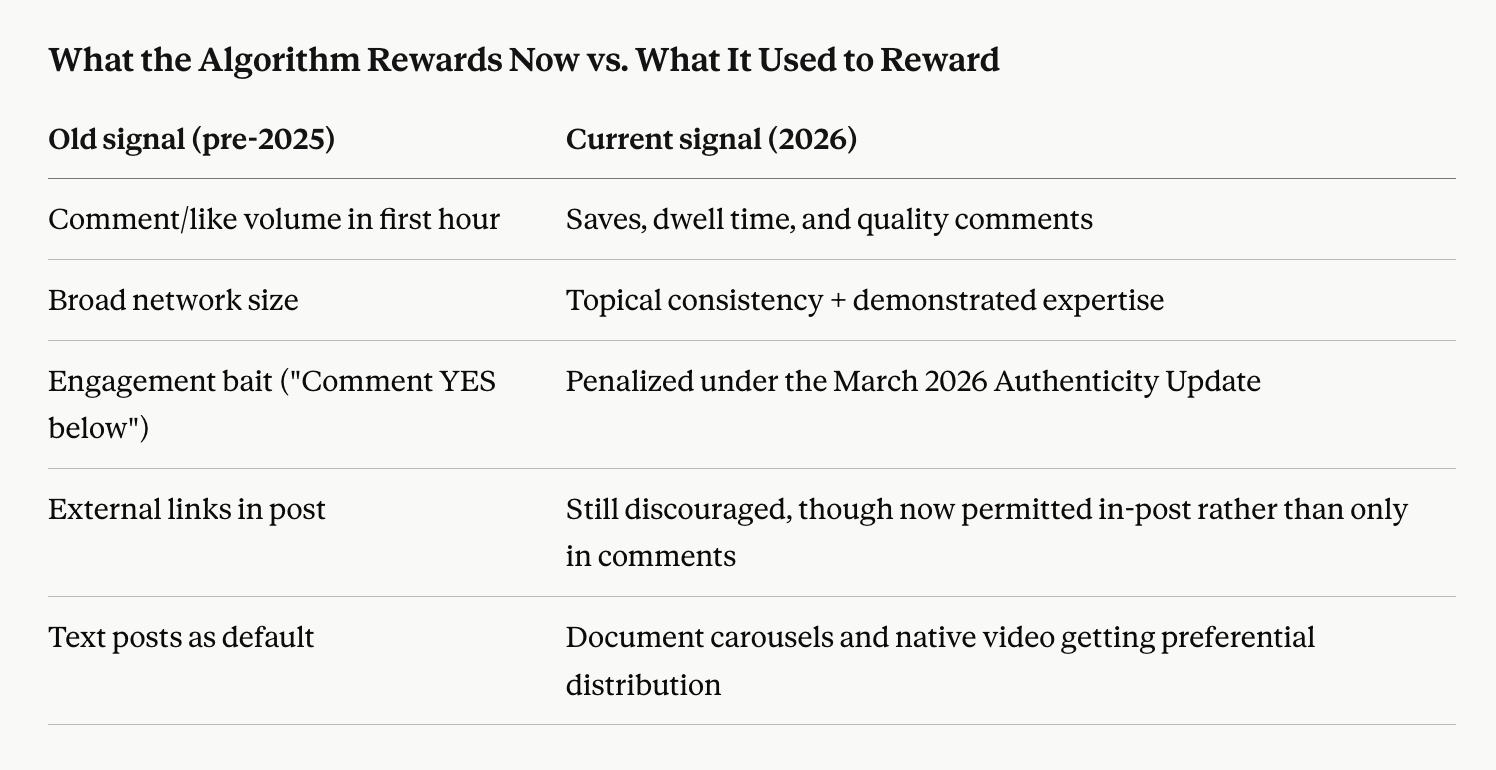
This table matters because most LinkedIn advice circulating online hasn't caught up to it. If your growth system still optimizes for early comment velocity, you're optimizing for a signal LinkedIn barely weighs anymore.
Building an AI Content Engine That Doesn't Sound Like AI
The biggest mistake founders make when they bring AI into their LinkedIn workflow is using it to write the final post. LinkedIn's classifier is explicitly trained to detect generic, low-specificity language, and 360Brew filters posts into "spam, low-quality, or clear" buckets before a human ever sees them. Generic AI output tends to land in the low-quality bucket; grammatically fine, distributionally dead.
The better model is to use AI for the parts of content creation that are genuinely bottlenecks, and keep the actual insight human:
1. Idea capture, not idea generation. Feed AI your raw thoughts (a voice memo, a Slack message, a customer call transcript) and have it extract 3–5 distinct post angles. The founder's specific experience is the raw material; AI is the sorting mechanism.
2. Structural drafting. AI is genuinely good at turning a rough argument into a clean hook-body-close structure, especially for document-style carousels, which are currently the highest-performing format on the platform at roughly a 6.6% average engagement rate, nearly double native video's.
3. Repurposing across formats. One customer insight can become a document carousel, a 60-second native video script, and a comment-bait-free discussion post. AI handles the format translation; a human handles the final edit pass for voice and specificity.
4. Editing for AI-detectability. Before publishing, run drafts through a "would a real person say this" filter; remove hedging language, generic transitions, and any sentence that could apply to literally any company in the category.
A simple test: if you deleted your company name from the post, could a competitor publish the exact same thing? If yes, it's not ready.
The Follower Growth Loop: Why Audience Size Still Matters
Topical relevance now determines reach per post, but follower count still determines your floor: the guaranteed minimum audience that sees your content regardless of how the algorithm scores that specific piece. A founder with 10,000 relevant followers has a much higher content floor than one with 500, even under a relevance-first algorithm, because a larger qualified audience means more of the "clear" bucket sees your post before distribution decisions kick in further.
This is where most founders under-invest. They focus entirely on content quality and ignore the compounding value of a larger, well-targeted follower base. Growing followers and growing engagement are related but distinct systems, and treating them as the same problem is a common strategic error.
If you're building the follower-growth side of your system, it helps to work from a structured, tactic-by-tactic breakdown rather than scattered advice. SocialPlug's guide to growing your LinkedIn following walks through the specific profile, content, and engagement tactics that move follower count directly, which pairs well with the relevance-focused tactics above; one grows your floor, the other grows your ceiling per post. Used together, they form a more complete growth loop than either approach alone.
The practical takeaway: don't abandon follower growth because the algorithm now rewards relevance. Run both tracks in parallel: a content system optimized for topical authority, and a lighter-weight system (profile optimization, strategic engagement, cross-promotion) optimized for audience size.
Automating Distribution and Engagement Without Losing Authenticity
LinkedIn's March 2026 Authenticity Update specifically targeted automation pods, engagement bait, and bot-driven interaction rings, and it did so effectively. Reports from that period showed follower growth down roughly 59% and overall engagement down around 25% year-over-year for accounts still relying on those tactics. That's not a reason to avoid automation entirely; it's a reason to be precise about which parts of the workflow you automate.
Safe to automate:
- Content scheduling and queue management
- Drafting and repurposing (with human review)
- Performance tracking across formats (documents vs. video vs. text)
- Internal notification when a post crosses an engagement threshold, so a human can jump in and reply live
Not safe to automate:
- Comments or reactions on your own posts to fake early momentum
- DM outreach sequences that mimic personal messages at scale
- Any tool that logs into LinkedIn as you to like/comment on others' content automatically
The distinction is simple: automate the logistics of publishing and measurement, never the appearance of human interaction. LinkedIn's detection systems in 2026 are specifically tuned to catch the latter, and the penalty is a suppressed distribution floor that's expensive to recover from.
The No-Code Stack for a One-Person LinkedIn Growth System
A founder doesn't need a marketing team to run this properly. A lean, no-code stack typically covers four functions:
- Capture: a voice-to-text tool or simple note app to log raw ideas as they happen, before they're lost.
- Draft & structure: an AI writing assistant used specifically for outlining and format conversion, not final copy.
- Schedule & queue: a native-compliant scheduling tool that publishes without third-party engagement manipulation.
- Track & route: a lightweight dashboard connected via automation platforms (Zapier, Make) that pushes profile visits and inbound DMs into a CRM or spreadsheet, so warm engagement doesn't die in an inbox.
The point of this stack isn't to remove the founder from the process, it's to remove the administrative work so the founder's actual time goes into the parts AI can't replace: judgment, specificity, and relationships.
Turning Engagement Into Pipeline: The Conversion Layer
Content and followers are inputs. The output that matters is pipeline, and that requires a deliberate conversion layer most founders skip entirely.
A basic framework:
- Profile visits and post engagers get tagged automatically (via a CRM integration or manual weekly review) as warm leads.
- Comments with genuine questions get a substantive reply first, then a DM only if the conversation naturally extends, not an immediate pitch.
- Recurring commenters ‘people who engage repeatedly over weeks’ are the highest-intent segment and warrant direct, personal outreach using a linkedin email finder.
- Content performance by topic gets reviewed monthly to identify which specific angles correlate with inbound demo requests, not just likes.
This layer is what separates founders who "post a lot" from founders who generate measurable pipeline. Content without a conversion layer is a hobby; content with one is a channel.
Measuring What Actually Matters
Vanity metrics (likes, follower count in isolation) are poor predictors of business outcomes under the current algorithm. The metrics worth tracking:
- Save rate: the strongest current proxy for content quality LinkedIn itself rewards
- Dwell time / read-through: especially on document carousels
- Profile visits per post: a leading indicator of pipeline interest
- Inbound DMs and connection requests tied to a specific post
- Engagement rate by format: track document, video, and text separately since performance varies significantly (roughly 6.6% for documents vs. 5.6% for native video, per recent industry benchmarking)
Common Mistakes That Stall LinkedIn Growth
- Posting off-topic content that confuses the algorithm's relevance scoring
- Relying on engagement bait phrasing now actively penalized
- Treating AI as a ghostwriter instead of a structuring tool, producing generic output
- Ignoring follower growth entirely in favor of pure content optimization
- Automating interaction rather than logistics
- Never building a conversion layer, so engagement never becomes pipeline
Conclusion
LinkedIn in 2026 rewards founders who combine genuine expertise with a disciplined system, not founders who post the most or automate the most.
The winning approach pairs topical consistency and format-aware content with steady, non-manipulative follower growth, a lean no-code stack that removes administrative drag, and a real conversion layer that turns engagement into pipeline.
Built correctly, this isn't a marketing project, it's an operating system for the business.