In 2025, 18.5 million Americans described themselves as digital nomads, according to MBO Partners, up 153% since 2019. Buried in the same research is a less flattering number: the count of independent digital nomads, the people running their own businesses rather than holding remote jobs, fell 7%, from 7.9 million to 7.3 million.
That gap tells you something. Taking a salaried job on the road is mostly a logistics problem. Taking a business on the road is an operations problem, and it's the part most guides skip.
The laptop, the coworking pass and the visa are the easy bits. The hard part is what I call operational portability: whether your business keeps selling, delivering and staying compliant while you're on a 14-hour flight, asleep in a different time zone, or simply not checking your phone.
Operational portability is the degree to which a business's core functions (selling, delivering, getting paid and staying compliant) work without the founder being in a specific place, at a specific time, or online at all.
This guide is about building that.
What Makes an Online Business Truly Location-Independent?
Short answer: an online business is location-independent when customers can find you, buy, receive what they paid for and get help without you being online, and when the money and paperwork behind it can be managed from any country. A website and a payment link don't qualify on their own.
The three things your business is quietly tethered to
- Place: a bank that only works with a local SIM, a registered address nobody checks, a payment processor tied to your country of residence.
- Time: clients who expect same-day calls, support promises that assume you're awake when they are.
- You: every sale that needs a call, every refund that needs your login, every decision that lives only in your head.
Founders usually fix place first because it's the most visible. In practice, you is the tether that actually ruins trips.
Run the 48-hour test before you book anything
Ask one question: if I were unreachable for 48 hours, what would stop? Write the list down. That list is your roadmap. A business that halts whenever you step away isn't location-independent. It's a job with a portable desk.
Some models start with a big head start:
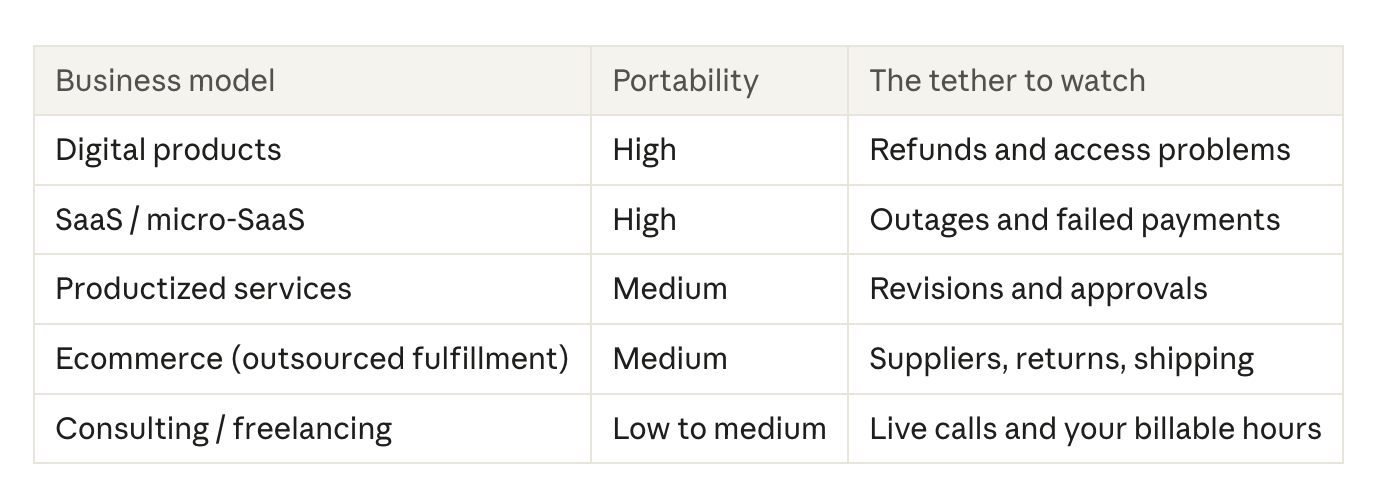
You can run a low-portability model from anywhere. You just have to design around the tether instead of pretending it isn't there.
Set Up the Legal and Financial Plumbing Before You Need It
Your website is global the moment it goes live. Your company, bank account and tax obligations are not. They sit in specific jurisdictions, and they get tested at the worst possible moment: a payout review mid-launch, a bank KYC request while you're on a ferry, a tax notice sent to an address no one reads.
Should a non-US founder form a US LLC?
Sometimes. A US LLC can make sense if most of your customers are American, if you need a US entity to access certain banking or payment services, or if you plan to raise from US investors. It is not a tax shortcut, and it doesn't change where you personally owe tax.
Wyoming is a popular choice for practical reasons. The state filing fee is $100, the annual report starts at $60, there's no state income tax, and member names aren't required in public filings. Providers such as Start in Wyoming bundle attorney-led formation with registered agent service, EIN applications and a physical US office address. That last piece matters more than founders expect: banks and payment processors increasingly want a verifiable business address, not just a registered agent's details on a form.
The compliance costs nobody puts in the headline
The formation fee is the cheapest line item you'll ever pay. Budget for these instead:
- Form 5472. A foreign-owned single-member US LLC must file Form 5472 with a pro forma Form 1120 every year, even with zero revenue. The penalty for missing it is $25,000 per form, per year. This is the most expensive mistake international founders make, and most have never heard of the form.
- The annual report. In Wyoming it's due on the first day of your formation anniversary month. File more than 60 days late and the state can dissolve the company.
- Registered agent renewals, bookkeeping and two-country tax prep. These recur every year.
- Home-country rules. Your country of residence may tax the LLC's profits as your personal income, and managing it from home can create local filing obligations.
Budget for year two, not day one. And talk to a cross-border accountant before you form anything, not after the first notice arrives.
Treat your mailing address as infrastructure
IRS letters, bank verification requests and state reminders still arrive on paper. Use a mail-scanning service or a provider address that forwards scans, and check it on a schedule. A missed letter is how a $60 filing turns into a reinstatement fee.
Make Getting Paid the Most Boring Part of Your Business
Revenue isn't cash until it lands in an account you can use. For a remote founder, your payment setup is the single biggest point of failure.
Check eligibility before you build the product
Stripe fully supports businesses in roughly 46 countries (stripe.com/global). If you live outside that list, decide your route before you build checkout: a merchant of record, a properly formed entity in a supported country, or a strong local processor. Rebuilding billing after launch is miserable.
Processor or merchant of record?
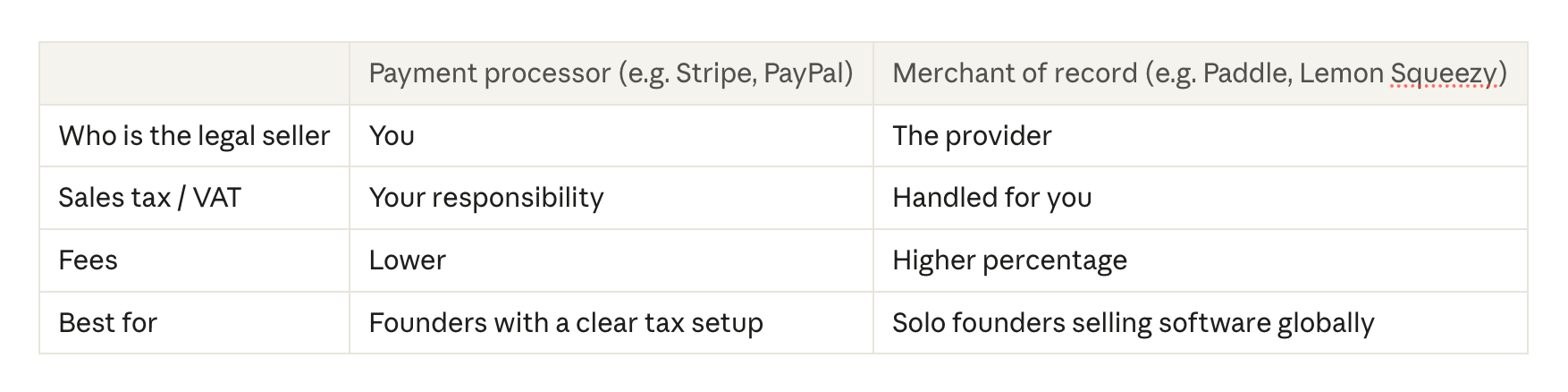
My take: if you're a solo founder selling software into dozens of countries, the merchant-of-record premium is usually cheaper than managing VAT and sales tax registrations yourself. Your time has a cost too.
Plan for the payout hold
Processors can pause payouts during account reviews, and reviews love to coincide with your best month. Keep a cash buffer of two to three months of fixed costs, reconcile payouts against orders monthly, and keep your business documents ready to upload. A second processor helps only if you're genuinely eligible for it. It's resilience, not a workaround.
Build a Small Stack That Runs While You Sleep
You don't need 30 subscriptions. You need one tool per job, connected well.
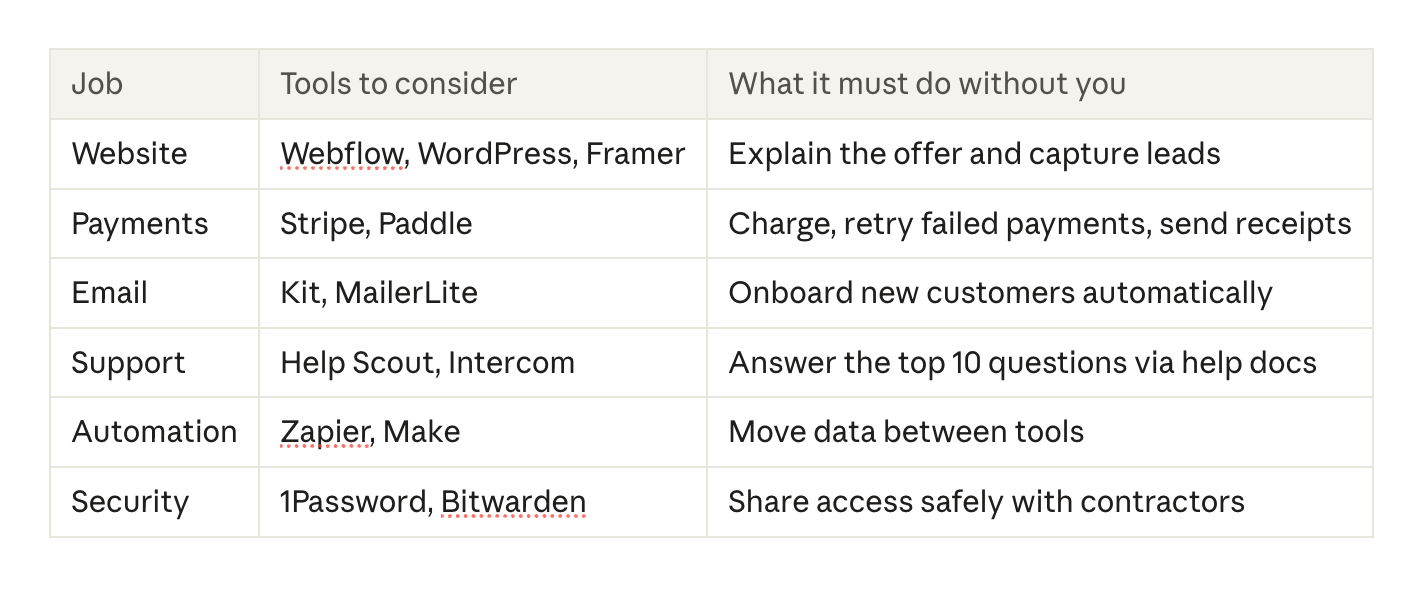
Automate the order path first
Imagine someone buys while you're asleep. Without you touching anything:
- Payment is confirmed.
- The customer gets access or a download.
- An onboarding email goes out.
- The transaction is logged for bookkeeping.
- You get an alert only if a step fails.
That sequence is worth more than any productivity hack. Then stop and keep a manual fallback for refunds and access recovery.
Rule of thumb: automate the frequent and predictable; document the rare and judgment-heavy.
Replace Availability With Async Systems
The biggest trap for remote founders isn't bad Wi-Fi. It's becoming the always-on bottleneck for clients and contractors across five time zones.
"Discipline equals freedom." Jocko Willink, author and former Navy SEAL officer
It sounds like a gym slogan, but it's the best description of async work I know. Written processes and clear rules are what let you close the laptop.
Write handoffs that don't need a reply
Every handoff should carry the context, the goal, the current status and the next action.
- Weak: "Can you look at checkout?"
- Strong: "Mobile checkout errors started after Tuesday's update. Reproduce it on iOS, check the payment logs, and post the cause in the project doc before rolling anything back."
The second one gets done while you sleep. The first one becomes a call.
Pick one overlap window and protect it
Choose a fixed daily window for live work and push everything else async. A founder in Bengaluru serving US clients, for example, can use 7:30 to 9:30 pm IST, which lands on the US East Coast morning, and keep the rest of the day for deep work.
Document on the third repeat
The first time you do something, just do it. The second time, notice it. The third time, write it down. Refunds, onboarding, publishing and monthly reconciliation are the usual first candidates for a simple handbook.
Protect the Accounts That Hold Everything Together
When your office is a backpack, a stolen laptop or a locked account is a business event, not an inconvenience.
Your email is the master key
Whoever controls your primary email can reset your domain, your payment processor and your bank logins. Use passkeys or an authenticator app (not SMS, since you'll be swapping SIMs), and store recovery codes somewhere that isn't the device you travel with.
Travel-proof the basics
- Keep a backup eSIM or hotspot for launch and payment days.
- Follow the 3-2-1 backup rule: three copies, two media types, one off-site. Then test a restore.
- Give contractors only the access they need, and revoke it when work ends.
- Never schedule a launch on a travel day.
Frequently Asked Questions
Can you run an online business from any country?
Mostly, but not every payment processor, bank or legal structure is available everywhere. Your country of residence, sanctions rules and platform eligibility decide what's possible, so check them before you relocate or register a company abroad.
Do I need a US LLC to sell to American customers?
No. Many founders sell to US customers through a company in their home country. A US LLC is worth it when it solves a specific problem, such as payment access, US investors or customer trust, and you can handle the annual compliance.
How much does a Wyoming LLC cost per year?
The state minimum is a $60 annual report fee, after a one-time $100 filing fee. Real annual costs are higher once you add registered agent service, bookkeeping and Form 5472 preparation for foreign owners.
What's the easiest online business to run while traveling?
Digital products and small SaaS tools score highest on operational portability because delivery and billing can be fully automated. Services can work too, but only if you productize them and limit live calls.
Final Thoughts: Freedom Is an Operations Problem
The question isn't where you can open your laptop. It's whether your business notices when you don't.
Run the 48-hour test. Fix the legal and payment plumbing before it's urgent. Automate the order path, write things down, and lock up the accounts that matter. Do that, and "from anywhere" stops being a lifestyle claim and becomes a property of the business itself.