AI can help a small team move from a blank page to a workable draft much faster. The difficult part often starts after that first draft appears.
AI-generated text may sound polished while still containing weak claims, repeated points, vague wording, or details that need verification. For a small team without a large editorial department, the answer is not endless rounds of editing. It is a clear review process that gives each person a specific job.
A smarter AI content review workflow helps teams protect accuracy, readability, brand voice, and usefulness without turning every article into a slow approval cycle.
Start by Separating Drafting From Reviewing
Trying to write, fact-check, edit, and optimize at the same time can make the process unnecessarily messy. Small teams usually work better when the first draft is treated as raw material rather than finished copy.
A simple workflow separates the review into stages so that each pass has one purpose.
Give the First Pass One Clear Goal
The first review should focus on whether the article actually answers the intended question.
Before fixing commas or shortening sentences, check:
- Does the content match the title?
- Does it answer the reader's main problem?
- Are important questions missing?
- Are sections arranged in a logical order?
- Is any part included only to increase length?
For example, an article titled "How to Reduce Customer Support Response Times" should provide practical ways to improve response times. A long section explaining the history of customer service adds little unless it helps readers make a decision.
Build Fact-Checking Into the Workflow
AI systems can produce incorrect, outdated, or unsupported information, even when the wording sounds confident. That means verification should be a normal editing stage rather than something teams do only when a sentence looks suspicious.
Decide Which Claims Need Verification
Not every sentence requires the same level of checking. Teams can save time by prioritizing claims that could create problems if they are wrong.
Pay closer attention to:
- Statistics and percentages
- Dates and historical claims
- Product specifications
- Legal, medical, and financial information
- Quotes and attributed statements
- Research findings
- Current policies, prices, regulations, or platform features
Whenever possible, trace these claims back to primary sources such as official documentation, government websites, original research, or company publications.
Add a Separate Quality and Originality Check
Once the facts are sound, the next question is whether the article actually feels useful. AI-assisted drafts can sometimes repeat familiar ideas without adding enough context, examples, or practical reasoning.
Use Tools as Signals, Not Final Judgments
Small teams may use grammar software, plagiarism checks, an AI detector, readability tools, or editorial checklists during this stage. These can flag areas worth reviewing, but automated scores should not replace human judgment.
A better question is: does the article contain clear thinking that helps the reader?
Editors should look for repeated wording, predictable explanations, unsupported conclusions, and paragraphs that could apply equally well to dozens of unrelated topics.
Give Different Review Passes Different Owners
A five-person team does not need five people editing every sentence. That usually creates duplicated work and conflicting preferences.
Instead, assign responsibility by review type.
A Simple Small-Team Review Model
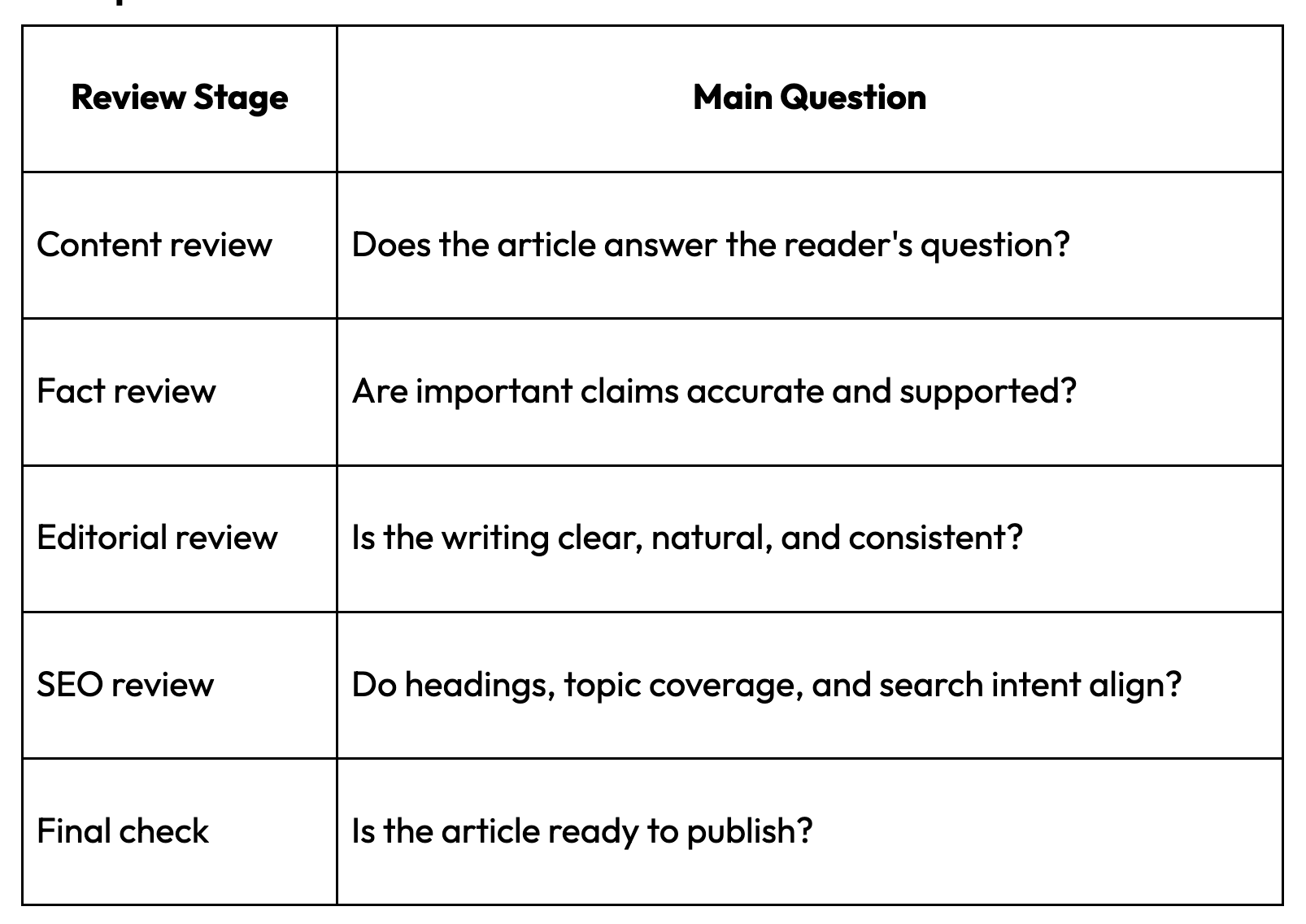
In a very small team, one person may handle several stages. The important point is that each pass has a defined objective.
Review SEO Without Writing for Algorithms
SEO review should happen after the article already works for a human reader. Starting with keyword placement can lead to awkward wording and unnecessary repetition.
Search-focused content still needs to be useful, accurate, and clearly structured. If a page only repeats familiar information while forcing keywords into every section, it is unlikely to provide much value to the reader.
Check Search Intent Before Keyword Density
A useful SEO review should ask whether the page:
- Answers the likely search question
- Uses descriptive headings
- Covers necessary related concepts
- Avoids repetitive keywords
- Adds information beyond basic summaries
- Gives readers a clear next step or takeaway
Keywords can help define a topic, but they should support the content rather than control every sentence.
Use a Final Pre-Publish Checklist
The last review should be short. Major rewriting at this point usually means an earlier stage was skipped.
Before publishing, confirm that the title matches the article, facts have been checked, links work, examples make sense, headings follow a logical order, repeated sections have been removed, and the conclusion reflects what the article actually explained.
Conclusion
A smarter AI content review process is not about adding more editing. It is about giving each review stage a clear purpose.
Small teams can move efficiently by checking structure first, verifying important claims, reviewing originality and usefulness, refining SEO, and finishing with a short publication check. AI may speed up drafting, but the quality of the final copy still depends on thoughtful human review.