
Your informational content traffic is down. You have added FAQ schema, restructured your headers, and started tracking Google Search Console for AI Overview appearances. Nothing has moved.
That is not an AI problem. That is a content problem that artificial intelligence finally made visible.
I have been running SEO and content strategy for SaaS companies and building content-led organic growth for over a decade. What I have seen in the last 18 months, watching this play out across clients and my own properties, is that the practitioners losing the most are not losing because AI changed the rules. They are losing because AI started enforcing rules that were always there.
Your Traffic Dropped Before AI Overviews Touched Your Rankings
The default response to a traffic drop is to look for the specific thing that changed. In 2025 and 2026, that thing is easy to name: AI Overviews. Google added AI-generated answer summaries to the top of results pages for a wide category of informational queries. Clicks went down. The obvious conclusion is that AI Overviews are taking what used to be yours.
Most practitioners respond by auditing their schema, adding structured data, and looking for the specific AI Overview feature that affected their rankings. That is not a new penalty. It is the old standard, finally enforced at scale.
Here is what that logic misses: the lost traffic was, in many cases, not legitimately earned. The pages hit hardest by AI Overviews were not the best answers to the queries they ranked for. They were the most optimized answers. And there is a difference.
AI Overviews surface what already existed in aggregated form across the web. If your article was the third-best answer to a question, written to match what was already ranking rather than to add something new, the AI system found the answer and stopped needing you to deliver it. That is not disruption. That is accountability.
The Great Decoupling Is Real, But It Started Earlier Than You Think
There is a pattern the SEO community started calling “the Great Decoupling” in 2025: impressions rising or holding steady, organic clicks falling. Search Console dashboards showing more exposure to more queries while fewer people are actually arriving at the site.
The data is real. For informational queries where an AI Overview appears, organic CTR dropped 61% year-over-year, falling from 1.76% to 0.61%, per Seer Interactive’s analysis of 3,119 queries across 42 organizations from June 2024 to September 2025. That is a significant shift.
But the decoupling started before AI Overviews arrived at scale. Featured snippets began extracting answers from pages in 2015. Zero-click searches were already a documented trend by 2019. The dynamic is not new. What is new is the scope. AI Overviews accelerated a process that was already underway and extended it to a far wider range of queries. Practitioners who had built traffic on thin informational content were already on borrowed time. AI Overviews called the debt.
For the full dataset on CTR trends, impression share, and AI Overview prevalence across query categories, the SEO statistics for 2026 page has the sourced numbers.
What AI Overviews Actually Do to a Search Results Page
Mechanically, AI Overviews pull from indexed web content to generate a summarized answer for queries where Google determines the user wants a direct response rather than a list of sources. They appear above the traditional organic results for qualifying queries. They cite sources, but the citations are not ranked results. They are attribution labels.
The critical distinction: being cited in an AI Overview and ranking in the top 10 for the same query are increasingly different things. The overlap between top-10 Google rankings and AI Overview citations dropped to between 17% and 38% by early 2026, from around 75% in mid-2025. That gap is where the new optimization problem lives.
For a full breakdown of how Google AI Overviews select sources and how to appear in them, the Google AI Overviews page covers the mechanics in detail.
Three Things AI Actually Changed in How Search Works (Only One Requires a New Discipline)
Most AI-in-SEO coverage treats the shift as one large undifferentiated change: everything is different now, learn GEO, start over. This is a category error. It leads practitioners to either ignore the changes that actually matter or over-invest in tactical responses to things that have not changed.
There are three distinct things AI changed. They are not the same problem and they do not have the same fix.
The first is new surfaces. AI Overviews, ChatGPT, Perplexity, Gemini, and Claude now surface content in response to queries that previously would have gone straight to a Google results page. These are what I call Citation Surfaces: the specific AI platform or Google feature from which a piece of content gets cited in response to a query. Each citation surface has different selection criteria. Treating them as one undifferentiated target misses the operational point.
The second is shifted quality signals. Content depth, sentence structure, readability, and first-hand expertise are weighted more heavily in AI citation than traditional SEO metrics like backlink count and keyword density. This is not a complete reversal of what worked before. It is a recalibration.
The third is changed user behavior. When an AI summary appears in search results, 26% of users end their browsing session entirely, compared to 16% when no summary is present, per the Pew Research Center’s analysis of 68,879 Google searches from 900 U.S. adults in March 2025. Fewer users scroll to organic results for queries where they get an immediate answer. This changes which queries are worth targeting, not how to produce content.
Those are three different problems. The first requires learning how specific citation surfaces select content. The second requires an audit of where your content depth and readability actually stand. The third requires a keyword strategy conversation, not a content production conversation.
GEO as a discipline addresses the first problem in part. Most GEO investment is being applied to all three simultaneously, which is why most of it is not producing results.
How Google AI Overviews Select Their Sources (and What It Means for Your Content)
The citation-ranking overlap drop (from 75% to below 40% by early 2026) means you can no longer assume that ranking well in organic search earns you AI Overview placement. The selection criteria have diverged.
What the data shows is that AI systems strongly favor recently published content. 65% of AI bot crawl hits targeted content published within the past year, with 79% landing on content from the last two years, per Seer Interactive’s October 2025 log file study of 5,000 URLs across ChatGPT, Perplexity, and AI Overviews. This is not a story about AI punishing old content. It is a story about AI rewarding fresh, specific, authoritative content over accumulated, generic coverage.
The last point is the operative one. Topical authority is not new. It is the same thing that has always separated the sites that hold rankings long-term from the ones that win briefly on optimization and then decay. AI Overviews are surfacing it more clearly, not creating a new requirement.
For the full data on AI content marketing benchmarks, the AI content marketing statistics page has the sourced numbers on citation and engagement performance.
ChatGPT and Perplexity Pull From a Wider Source Pool Than Google
This distinction matters and most GEO advice ignores it. Google AI Overviews have a relatively strong correlation with traditional search rankings. ChatGPT and similar LLMs do not.
Websites with more organic traffic tend to get more mentions in AI Overviews and Perplexity, but there is only a weak correlation between high organic traffic and ChatGPT inclusion, per Semrush’s 2025 AI search study. ChatGPT pulls from a wider source pool. It includes sources that rank poorly in organic search but answer specific questions with demonstrated expertise. Lower-traffic sites that consistently publish specific, expert-level content on a narrow topic are appearing in ChatGPT citations for that topic even when they rank outside the top 20 organically.
The practical implication: if your target audience is using ChatGPT or Perplexity, the path to citation visibility is different from the path to Google AI Overview inclusion. The common thread is content quality. The specific signals diverge.
Why GEO Is Not the Answer Most Practitioners Think It Is
The industry’s dominant response to AI disruption in search is to learn Generative Engine Optimization. Restructure content with direct-answer blocks. Add FAQPage schema. Increase structured data. Build Reddit presence for co-citation. Track AI citation rates as the new primary KPI. Agencies are selling GEO packages. Conferences have renamed tracks.
I understand why. The anxiety is real. The traffic drops are real. And GEO is a reasonable-sounding response to a real change.
The problem is the mechanism.
When it comes to securing AI citations, content depth, sentence and word counts, and readability matter most, while traditional SEO metrics like traffic and backlinks have little impact, per Kevin Indig’s Growth Memo research. That is not a GEO signal. That is a content quality signal.
The GEO tactics (FAQ schema, direct-answer formatting, structured data) are formatting improvements. They help an already-strong piece of content get extracted more reliably. They do not make weak content citable. A well-structured FAQ section on a page with nothing original to say is still a page with nothing original to say. The AI system is not confused by bad formatting. It is filtering for substance.
Only 43% of SEO thought leaders include GEO in their LinkedIn headlines despite heavy posting about it. The practitioners who have been deepest in this space are not rebranding themselves. They are adding a layer to existing work, not replacing it.
“The overlap with what we have been doing in the SEO space and digital marketing space before AI search existed is very, very strong,” as Lily Ray, VP of SEO Strategy at Amsive, noted in an eMarketer FAQ on GEO and AEO.
Before investing in GEO tactics, run this test on any page you want to optimize for AI citation: would an expert in this subject read this page and find something they did not already know? If the answer is no, no amount of schema or structured formatting will make it citable. Fix the content first. The structure improvements come second and work substantially better when the content underneath them actually earns extraction.
AI is not breaking SEO. It is making it impossible to fake anymore.
Read next: Generative Engine Optimization
What the Practitioners Holding Traffic Are Actually Doing
Most AI-era SEO guidance converges on the same list: add FAQ schema, restructure with direct-answer blocks, build entity recognition, target featured snippets, create topical authority clusters. None of this is wrong. But it is not what distinguishes the programs that are holding from those that are not.
I have watched this play out directly. At KoinX, a crypto tax SaaS with over 1.5 million users, I run SEO and content strategy for a category that is both crowded and constantly shifting. Tax regulations change. New crypto instruments appear. The audience is doing something genuinely complex and needs specific answers, not category overviews.
The content that held AI citation visibility through the rollout of AI Overviews was not the FAQ-structured content we built for keyword coverage. It was the content built around specific user scenarios: the person who traded a stablecoin for the first time and does not know whether that is a taxable event, the person who received crypto as salary and is unclear whether they owe tax at receipt or at sale. Those articles required knowing the product, knowing the regulatory context, and knowing the exact moment of confusion the user was experiencing. They could not be written by someone who spent two hours researching the topic.
The content that dropped was the definitional and overview content. Broad articles covering what crypto tax is. General guides to capital gains. Useful content, but not specific enough to be uncopyable, and not deep enough to be citable when an AI system could synthesize the answer from five other sources.
I saw the same pattern when I was building the content engine at GrowthMentor. The pieces that drove organic signups were not the widest-coverage articles on startup growth. They were the pieces that answered a question a specific kind of founder was asking at a specific moment in their company’s life. A first-time founder trying to figure out whether to hire a growth marketer or a performance marketer in month eight. A founder with a working product but no distribution asking whether SEO or paid was the faster path to first 100 customers. Specific, situational, answered from experience.
That kind of content does not get written by briefing a generalist. It gets written by someone who has been in those rooms.
It is worth noting what the conversion data says about AI-referred traffic, because it reframes the stakes. The average AI search visitor converts at 4.4 times the rate of a standard organic search visitor, per Semrush’s June 2025 AI search study. The volume is currently smaller. The quality is not. A practitioner who loses some informational clicks but builds genuine AI citation visibility is not necessarily losing. They are changing the shape of their funnel.
The three things the holding programs share:
- They produce content that requires first-hand knowledge to write. Not “our take on the topic.” Content that could only come from someone who has done the work, seen the failure modes, and has a specific perspective because of it.
- They measure depth of coverage per topic, not breadth. Fewer topics, more complete authoritative answers, rather than thin coverage of everything adjacent. The sites losing most are the ones that scaled content production and lost editorial control in doing so.
- They treat AI citation as a side effect of doing the first two well, not a primary KPI to optimize for directly. The programs chasing AI citation as a goal are producing content shaped around what they think the AI wants to extract. The programs holding traffic are producing content shaped around what the reader actually needs. The AI citation follows.
The Measurement Question: What to Track When Clicks Are No Longer the Right KPI
The most common frustration I hear from practitioners right now is not about strategy. It is about measurement. “How do I even know if I am in an AI Overview?” is a real question and the tools available to answer it are still early.
Here is what actually works in GA4 and Google Search Console without an enterprise analytics stack:
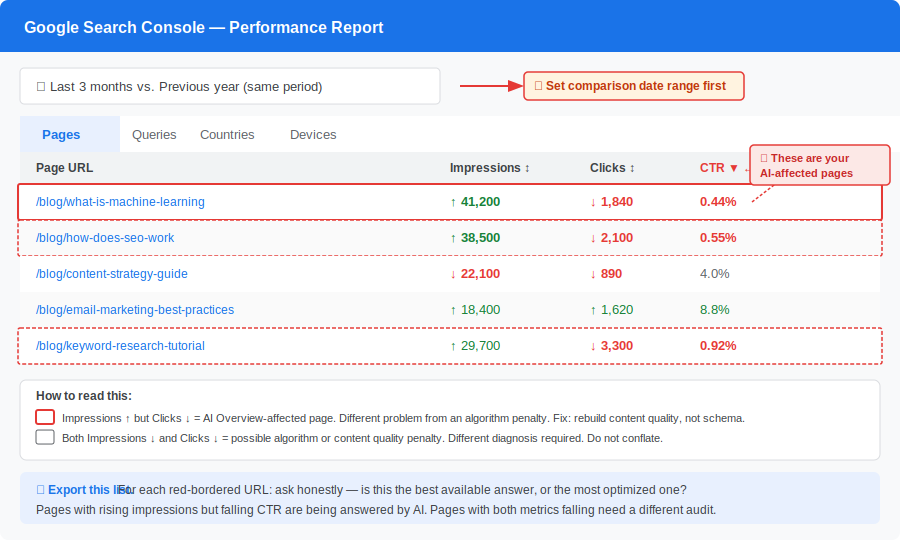
In Google Search Console, filter your Performance report by page, then sort by Impressions descending for the last 90 days compared to the same period in the prior year. Look for pages where impressions are stable or rising but clicks and CTR are falling. Those are your AI-affected pages, not your algorithm-penalty pages. The distinction matters because the fixes are different.
In GA4, create a segment filtering for sessions where the session source contains chatgpt.com, perplexity.ai, or claude.ai. The traffic volumes are currently small for most sites. The conversion rate is not. Comparing that conversion rate to your standard organic traffic conversion rate tells you whether AI-referred visitors are worth optimizing for in your specific context. For most B2B and high-consideration categories, the answer is yes. For broad informational content targeting top-of-funnel awareness, the math is less clear.
Brand search volume trend is the third thing to track. If your content is building genuine authority and people are encountering your brand through AI-cited content, branded search queries should rise over time even as informational direct traffic declines. A rising brand search trend with flat or declining informational traffic is not a bad situation. It means you are building the asset that matters.
What to Do This Week
The argument this article makes is specific: AI-era SEO rewards what good SEO always rewarded. The practitioners losing the most are those whose content was earning traffic through optimization rather than authority. The fix is not a new discipline. It is a more honest commitment to the one that already works.
Here is how to start.
- Pull your Google Search Console Performance report for the past 90 days against the same period last year. Filter for pages where impressions are stable or rising but clicks are falling. Separate those from pages where both dropped. They are different problems.
- For each AI-affected page: ask whether the content is the best available answer to the query or the most optimized available answer. If a subject-matter expert would read it and find nothing they could not have found in three competing articles, the content needs to be rebuilt, not reformatted.
- Choose one page to rebuild with genuine depth. Not restructured. Not reformatted. Rebuilt around a specific user scenario, a first-person perspective, and at least one thing in it that only someone with real experience in the subject could write. Track it for 90 days.
- Set up one AI referral traffic segment in GA4 using chatgpt.com, perplexity.ai, and claude.ai as referrer sources. Watch the conversion rate. The number will tell you whether AI citation is worth direct optimization investment in your specific category.
If you want to take this further, the Best AI SEO Tools for Marketers page covers the specific tools I use to run this kind of audit and track AI citation visibility across platforms.