
Most people reading about generative engine optimization have already tried the standard advice. Structured headings. FAQ sections. Statistics in the content. Clearer definitions. None of it moved the needle on AI citations. That is not bad execution. It is the wrong model entirely. I advise SaaS companies on SEO and content, including a crypto platform with over 1.5 million users, and the pattern I keep seeing is this: the teams getting cited in AI answers are not the ones with the best-optimized pages. They are the ones with the most places talking about them.
What GEO Actually Is (And How It Differs from SEO)
The default response when someone says “we need to do GEO” is to pull up the existing content calendar and start adding things. FAQ sections at the bottom of blog posts. More statistics with inline citations. Cleaner H2 headings. Shorter paragraphs. A definition at the top of each article.
These are reasonable things to do for SEO. For GEO, they are solving the wrong problem.
The confusion is understandable. GEO borrows SEO vocabulary, gets written about by SEO practitioners, and lands in the same marketing brief. But the goal is different enough that the tactics diverge. SEO optimizes for a ranking algorithm that scores pages and returns a list of links. GEO optimizes for a retrieval and synthesis system that generates a direct answer. The ranking algorithm asks: which page is most relevant? The retrieval system asks: which sources should I cite when constructing this answer?
Those are not the same question. They do not produce the same action list.
The clearest evidence: fewer than 10% of ChatGPT citations come from Google’s top 10 results for the same query. If GEO were just SEO with a different name, that number would be close to 100%. It is not. The citation logic runs on different inputs from the ranking logic.
The term itself was coined in a 2024 academic paper by researchers at Princeton and IIT Delhi, who defined it as the practice of optimizing content to increase visibility in generative engine responses. That framing is accurate. But it still implies the lever is your content. The fuller picture takes a few more sections to build.
SEO optimizes for a ranking algorithm. GEO optimizes for a retrieval and synthesis system. Those are not the same thing.
GEO vs SEO: The Same Inputs, a Different Output
The inputs are genuinely shared. Good content, clear writing, authoritative sourcing, consistent publishing: all of this matters for both. Google’s own Danny Sullivan said at WordCamp US in August 2025 that “good SEO is good GEO.” He is not wrong. Good SEO is a necessary condition for GEO. It is not a sufficient one.
The table makes the practical gap visible. If your primary GEO tactic is improving your own pages, you are moving the lever in the bottom-left column when the bottom-right is what drives citation. The inputs overlap. The levers do not.
Also worth noting for clarity: GEO is sometimes called AEO (Answer Engine Optimization), LLM SEO, or LLMO depending on which agency you are reading. The terms describe the same practice with minor framing differences. This article uses GEO throughout.
The Consensus Signal Is Why Your Competitors Get Cited and You Do Not
Most GEO advice focuses on your own site. Make your content more structured. Define terms clearly. Add statistics. Sound more authoritative. This is correct advice. It is also the advice your competitors have already followed, and it does not explain why one brand gets cited by ChatGPT and another does not when both have equally well-structured content.
The explanation is a mechanism I have not seen named clearly in any GEO guide.
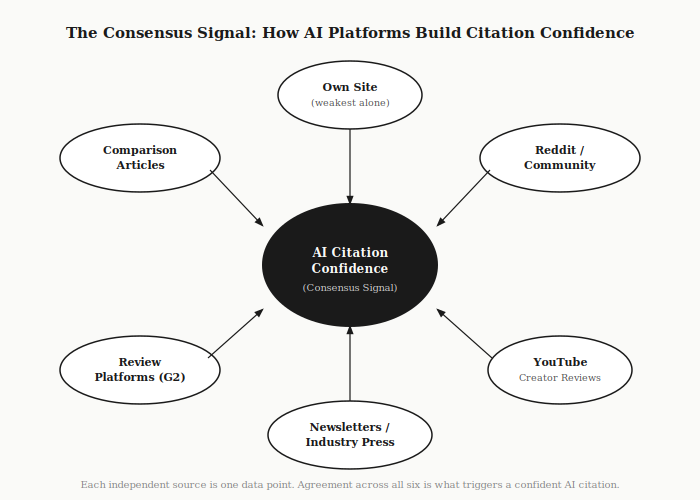
Consensus Signal: the pattern by which AI platforms gain citation confidence when a brand appears consistently across multiple independent sources.
When ChatGPT, Perplexity, or Google AI Overviews needs to recommend a brand, a tool, or a service, it does not pick the single most authoritative source. It looks for agreement. If your product appears on your own site, in a Reddit thread, on G2, in a comparison article on an independent site, in a YouTube review, and in a newsletter, the AI has multiple independent data points pointing at the same answer. That agreement is what produces a confident citation.
A brand with adequate on-site content but strong third-party presence will be cited more reliably than a brand with excellent on-site content and almost no independent coverage. This is the mechanism. It is why practitioners who spend months rewriting their own pages often see no change in AI citation frequency.
Optimizing your own website for AI search is the smallest part of GEO, and most guides have it backwards: the citation signal that matters most to AI platforms is not on your site at all.
The data on brand mentions statistics for 2026 shows that unlinked brand mentions function as authority signals across search and AI platforms, not just linked citations. The AI is building a picture of your brand from everything it can find, not just what you published on your own domain.
I have seen this directly in advisory work with KoinX, a crypto tax SaaS with 1.5 million users. The category is competitive: well-funded competitors, all running SEO-first content strategies, most with comparable on-site content quality. When I audited the citation gap, the difference between KoinX appearing in AI answers for category prompts and not appearing was not on-page. Both KoinX and the competitors that were getting cited had solid, well-structured content. The difference was off-site coverage. Competitors were appearing in Reddit threads in the crypto tax and personal finance communities, in YouTube walkthroughs by independent crypto educators, and in comparison articles on financial sites. KoinX was not present in those places. Building that off-site presence moved citation frequency for target category prompts more than any page-level work we did.
The on-site work still happened. It just came second.
Where to Build Off-Site Presence That AI Platforms Actually Sample
The off-site presence that builds the Consensus Signal is not random. It needs to exist in the places AI platforms actually retrieve from when constructing answers. Based on current citation data, those are:
- Niche community forums and subreddits. Authentic participation in communities where your buyers discuss your category. Not promotional posts: useful answers to real questions. Reddit in particular has been among the most sampled sources across all major AI platforms, though platform-specific weighting shifts, as the next section covers.
- Third-party review platforms. G2, Capterra, Trustpilot, Product Hunt, or the category-equivalent directory. The AI treats these as independent validation. A brand with 50 reviews on G2 has 50 independent data points pointing at it from a source the AI regards as separate from your marketing.
- Comparison and listicle content on independent sites. The “best X for Y” articles written by independent publishers. Getting listed here is not just an SEO play. It is a GEO play. These are among the most-cited source types in AI answers.
- YouTube creator content. Independent reviews, walkthroughs, or category mentions by creators your buyers already watch. YouTube has become a primary citation source for Perplexity after citation dynamics shifted in late 2025.
- Newsletter mentions in category-specific publications. A mention in a respected niche newsletter functions as a high-credibility independent reference. Small audience, outsized citation weight.
- Industry publication features. Editorial coverage in authoritative publications: articles, quotes, data citations. The AI treats editorial content differently from self-published content, and correctly so.
You can read more about how Reddit’s platform reach and trust dynamics make it an effective consensus signal source for informational and comparison queries specifically.
The platform-specific weighting of these source types is where most single-strategy GEO falls apart.
ChatGPT, Perplexity, and Google AI Overviews Are Not the Same Audience
Every GEO guide publishes a single tactics list as though ChatGPT, Perplexity, and Google AI Overviews are reading the same content and making the same citation decisions. They are not.
The three platforms use different retrieval mechanisms, which means they reward different types of off-site presence. A tactic that works on Perplexity does not automatically work on ChatGPT. A brand optimizing for Google AI Overviews using traditional SEO signals will perform well in that context and poorly in ChatGPT for the same queries.
The most direct illustration of how different these platforms are: vendor blogs appear in roughly 1% of ChatGPT responses, according to Profound’s analysis of 680 million citations across AI platforms. ChatGPT overwhelmingly cites Wikipedia, news publications, and encyclopedic third-party sources. Your blog post, however well-structured, is not getting there directly. The path to ChatGPT citation runs almost entirely through third-party sources the platform regards as authoritative and independent.
Perplexity operates differently. It is a live retrieval engine that fetches current web content and provides inline citations. It has historically cited community content aggressively: Reddit was its most-cited domain with citation rates as high as 46.7% in some query categories. That changed abruptly in October 2025 when Reddit sued Perplexity over unauthorized scraping. Reddit citations on Perplexity dropped 86% in a single month, with YouTube citations filling most of the gap.
A strategy built for Perplexity in mid-2025 could have performed 86% worse on that specific platform three months later, because platform citation behavior is volatile and platform-specific.
Google AI Overviews behaves most like traditional SEO among the three. Pages that rank well in Google’s organic results are significantly more likely to appear in AI Overviews. The relevance of content freshness data is clearest here: AI Overviews show higher citation rates for content with current-year date signals. Keeping content updated matters more for Google AI Overviews than for the other two platforms. For the specifics of how AI Overviews selects sources and how to appear in that feature specifically, Google AI Overviews optimization is covered separately.
Platform Citation Behavior at a Glance
The practical implication of this table is that a single GEO tactic cannot cover all three platforms. The off-site presence that earns ChatGPT citations (encyclopedic third-party coverage) is different from what earns Perplexity citations (fresh community and video content) and different again from what earns Google AI Overviews citations (traditional SEO plus freshness). The Consensus Signal helps here because building genuine off-site presence across multiple independent venues covers more of the citation map than optimizing any single channel. But tactic priority should reflect where your buyers actually search, not an average of all three.
Measuring GEO Without Enterprise Tools
Most practitioners who follow GEO advice never know if any of it worked. Not because they did not try. Because they were looking in the wrong place.
The instinct is to check Google Analytics for referrals from ChatGPT or Perplexity. That referral source does not exist in a clean, attributable form for most sites. When a user reads a ChatGPT answer that cites your site and clicks through, the visit typically arrives in GA4 as direct traffic. When ChatGPT or Perplexity mentions your brand without providing a clickable link, which is the majority of AI mentions, no visit is recorded at all. The practitioner looking at their GA4 dashboard and seeing no change after two months of GEO work is not measuring incorrectly. They are measuring the wrong metric.
The metric that matters is citation frequency in AI-generated answers for your target prompts. That metric does not live in GA4.
This gap is structural. According to Rand Fishkin’s 2024 zero-click search study at SparkToro, 58.5% of US Google searches already end without a click. AI-generated answers push this further: a Seer Interactive analysis of 25 million impressions across 3,119 informational queries found that organic CTR for queries with AI Overviews fell 61% between June 2024 and September 2025. Being cited in an AI answer is valuable for brand recall and consideration. It does not reliably produce a session in your analytics. Judging GEO effectiveness through GA4 is like measuring the impact of word-of-mouth by counting receipts.
In advisory work with SaaS clients, the pattern appeared consistently: periods of active off-site presence building produced rises in direct traffic and branded search volume, but with no corresponding referral attribution in GA4. The traffic was real. The source was invisible. The metric that captured the actual GEO work was not in any dashboard. It required going directly to the platforms and testing.
The solution is not an enterprise tracking tool. It is a manual protocol that costs nothing except 90 minutes a month.
The Prompt Testing Framework
- Define your target prompts. Write 8 to 12 specific prompts that a buyer in your category would actually type into an AI platform. Cover different stages: awareness prompts (“what is the best crypto tax tool?”), comparison prompts (“KoinX vs Koinly”), and decision prompts (“which crypto tax software handles DeFi transactions?”). These are your test cases and they should stay consistent across every monthly run.
- Run each prompt on all three major platforms. Query ChatGPT Search, Perplexity, and Google AI Overviews separately for each prompt. Note the top 3 cited sources on each platform. Note whether your brand appears at all, whether it is mentioned without a link, or whether it is cited with a source link.
- Score your brand presence. For each prompt-platform combination, assign one of three scores: absent (not mentioned), mentioned (appears in the answer text without a citation link), or cited (appears with a source link). This gives you a citation map: X out of Y prompt-platform combinations where you are present.
- Run monthly and track directional change. Absolute numbers matter less than direction over time. Moving from appearing in 3 of 24 prompt-platform combinations to 9 of 24 over three months is a real and usable signal, even without a dashboard. Set a recurring calendar event. Do not add prompts mid-run or you lose the comparison baseline.
The brands that will have a measurable GEO advantage by the end of 2026 are not the ones that bought the most expensive tracking software. They are the ones that ran honest monthly audits and adjusted their off-site presence based on what those audits showed.
Here is where to start this week.
- Run your 5 most important category prompts on ChatGPT Search, Perplexity, and Google AI Overviews today. Write down which sources appear. Write down whether your brand is present. This is your baseline.
- Audit your off-site presence for the Consensus Signal: search your brand name on Reddit, on G2 or your category’s equivalent review platform, and on your top 3 comparison keywords. Map where you appear and where you are absent.
- Identify the two or three independent venues where your competitors appear that you do not. Make those specific: not a general “increase Reddit presence” goal but a named target, such as a specific subreddit where your buyers already have conversations about your category.
- Set up a monthly prompt-testing log using the four-step framework above. Run it on the same day each month. Directional movement over 90 days is your working signal.
- Update your most relevant existing content with specific attributable statistics and a clear one-sentence definition of what you do. Then build the off-site consensus before expecting that on-page work to produce citation results. The on-page work earns its place second, not first.
If you want to audit your current AI search visibility and build a citation plan specific to your platform and category, reach out at shankar@shno.co.