
You ranked on page one. You added a schema. You tightened your E-E-A-T signals and made the content more comprehensive. And still, every time you search your target keyword, the AI Overview sits at the top and your page is not in it. Not even a mention in the sources. The problem is not your content quality. It is where on the page your answer actually lives. I will show you what changes that, using patterns I tracked across hundreds of informational queries while running SEO for a SaaS serving over a million users.
Your Page Ranks. That Doesn’t Mean AIO Will Cite It.
Most marketers treat “improve your SEO” and “get cited in AIO” as the same goal. The logic makes sense on the surface: Google rewards well-optimized content, AIO is a Google feature, so better SEO should mean better AIO visibility. The improvement loop follows naturally. Add schema. Improve E-E-A-T signals. Build more topical depth. Earn more backlinks. Wait.
The problem is that AIO does not simply surface the top-ranking page. It runs a retrieval and re-ranking step that asks a different question: which passage, from which source, most directly answers this specific query? A page that ranks first because of domain authority, backlinks, and topical depth can still lose the AIO citation to a page sitting at position four that opens with a three-sentence direct answer.
Organic ranking reflects page-level and domain-level signals accumulated over time. AIO citation reflects chunk-level answer quality at the moment of query. Those are different systems operating at different levels.
The Google algorithm impact statistics make the practical consequence visible. When AIO appears for a keyword, according to Ahrefs research using 300,000 keywords from December 2025, the first organic result loses approximately 58% of its clicks compared to the same query without AIO. The ranking position holds. The traffic does not.
What the broader picture of AI content marketing statistics shows matches this: impressions in Google Search Console remain flat or climb while session counts collapse on AIO-active queries. Your page looks like it is performing better than ever by one metric while bleeding traffic by another.
I watched this exact pattern across dozens of KoinX queries. Pages ranking first through third were getting zero AIO citations. Competitors at position four or five were consistently cited. The difference was not authority, depth, or schema. It was structure.
Stop treating AIO optimization as a downstream benefit of general SEO improvement. Audit for citation readiness separately. These require different changes to different parts of the page, and conflating the two goals is what keeps well-ranked pages invisible in the one place that now captures most of the attention on a query.
Answer Density Is What AIO Actually Measures
Every AIO optimization article tells you to create high-quality, comprehensive, E-E-A-T-demonstrating content. That advice is not wrong. It is incomplete. It gets you into the room where AIO considers you. It does not determine what happens in the room.
The tactical implication of that advice is that marketers write longer articles, add more sub-topics, improve author credentials, cite more sources, and update their content dates. None of those moves directly change whether the first 150 words of a given section answer the query that heading implies.
AIO uses a retrieval model that identifies candidate passages at the chunk level, typically a heading-to-subheading block, then re-ranks those passages by how completely and directly they answer the query. A 4,000-word authoritative article that opens with a 400-word context-setting introduction before reaching the actual answer will consistently lose the citation to a 1,500-word article that answers in the first paragraph.
The retrieval system does not read your whole article and then decide. It scores passages. The passage that scores highest gets cited. A comprehensive page is not a citation-ready page unless its answers live at the right position within each section.
Most AIO optimization advice is targeting the wrong level. Schema, E-E-A-T, and topical authority are domain and page-level signals. AIO citation is decided at the chunk level. A technically weaker page that answers in the first sentence will beat a technically stronger page that answers in the third paragraph every time.
This is the pattern I’ve watched play out consistently, and it is almost entirely absent from the published advice on this topic.
The structural variable at work here is what I call Answer Density.
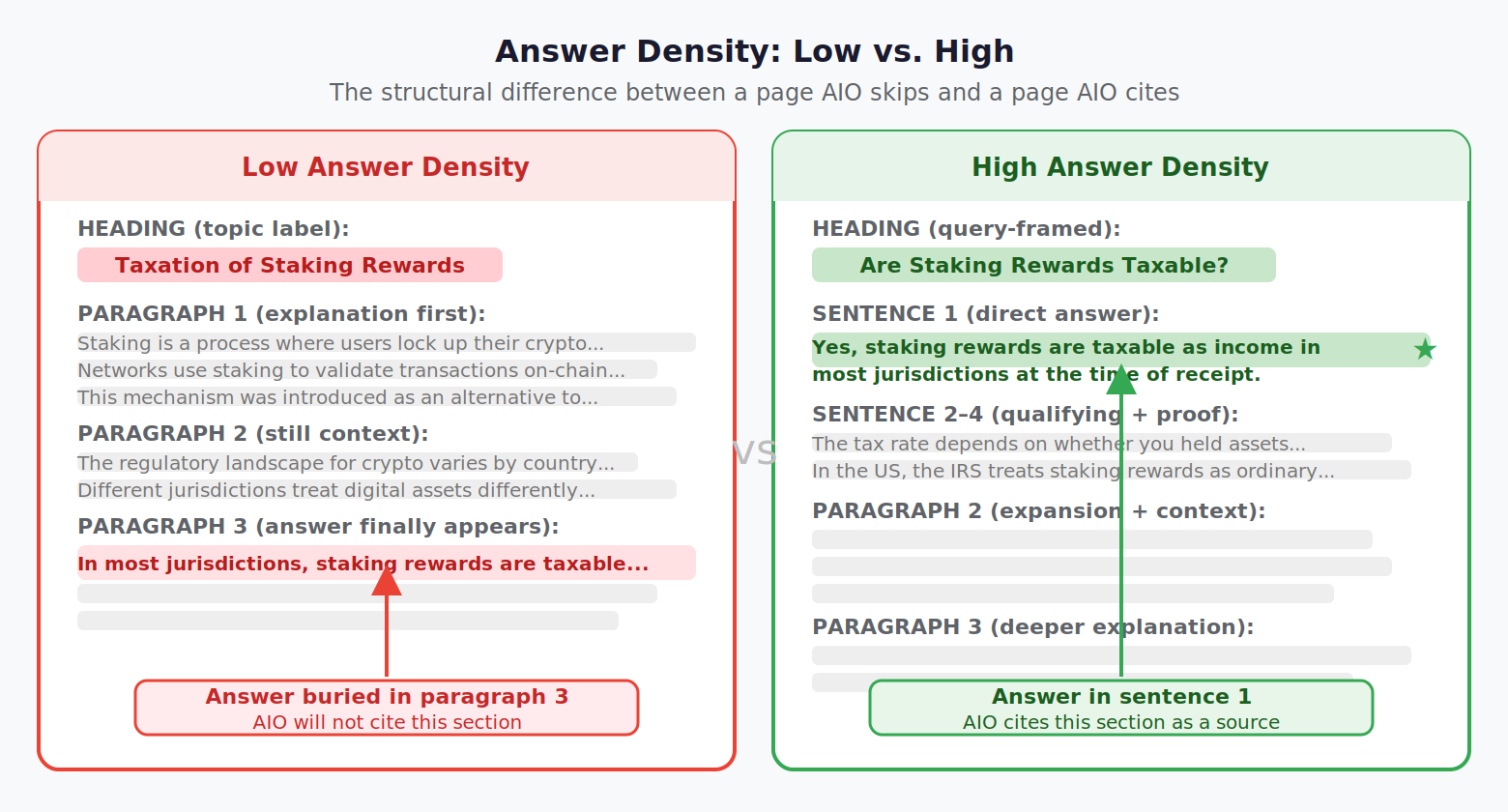
Answer Density: The degree to which a content chunk delivers a direct, complete answer to the implied query within the first two sentences after a heading.
High Answer Density sections answer first and explain after. Low Answer Density sections explain first and answer after. AIO cites the former. It skips the latter, even when the latter contains more thorough information overall.
While managing content for KoinX, I tracked AIO citations across more than 40 informational queries in the crypto tax category. Queries like “how to calculate crypto capital gains” and “how is staking income taxed.” For every query tracked, the pages appearing as AIO sources had one consistent structural pattern: the heading stated or implied the query, and the first one or two sentences after that heading answered it directly, before any explanation, context, or qualification. Pages that opened sections with explanatory preamble, even high-quality, well-researched explanatory preamble, were not cited for those sections.
Audit every H2 and H3 in your content. For each one, ask: if someone only read the first two sentences after this heading, would they have a direct answer? If the answer is no, the section is not citation-ready. Answer first. Explain second.
AIO vs. Featured Snippets: Why the Structure Rules Are Different
Featured snippets extract a single passage from a single page. AIO compiles from multiple sources and re-ranks at the chunk level. That sounds similar, but the difference matters for how you optimize.
The featured snippet statistics show a meaningfully different CTR profile from AIO citations, and the two formats reward different structural choices. Featured snippet optimization prioritizes owning a single answer on a single page. AIO optimization prioritizes ensuring your passage is citation-ready across multiple sections of your content.
Marketers who optimized aggressively for featured snippets and assumed those skills transferred directly to AIO are often the ones most confused by their results. Featured snippets reward being the best page on the topic. AIO rewards being the page with the best-positioned answer in each section.
AI Mode Is a Separate Problem
One clarification worth making early. This article is about Google AI Overviews, the AI-generated summary that appears at the top of a standard Google search result. It is not about AI Mode, Google’s conversational search experience that operates more like a chat interface.
AI Mode triggers on different query types, requires different content depth, and behaves differently in terms of citation and follow-up questions. The structural principles in this article apply specifically to AIO. AI Mode is a related but distinct optimization problem. Conflating the two leads to strategy confusion. They are separate features with separate optimization logic.
How to Build Answer-Dense Content Structure
When marketers decide to optimize for AIO, the usual move is to add FAQ schema to the bottom of the page, append a dedicated Q&A section, or commission a content refresh that makes the article longer and more comprehensive. The content SEO statistics show that page-level comprehensiveness continues to improve across the industry while AIO citation rates remain unevenly distributed. That is exactly the pattern you would expect if citation decisions are made at the chunk level, not the page level.
Adding a FAQ section at the bottom does not change whether the body sections of the article are citation-ready. Adding schema does not move your answer to the top of a section. Making the article longer does not change where the answer lives within each section.
FAQ sections and schema are indexing signals. They tell Google the content exists and how to categorize it. They do not change the structure of the content that actually gets retrieved. AIO retrieval happens at the section level, not the schema level. A page with perfect FAQ schema and a body full of explanation-first sections will still lose AIO citations to a shorter, better-structured competitor.
Here is what I found while doing a structural audit of KoinX content.
We had pages ranking in the top three for high-intent informational queries in the crypto tax space. None of them were appearing as AIO sources. I pulled up the pages that were being cited for the same queries and compared the section structure.
The difference was not word count. It was not schema. It was not domain authority.
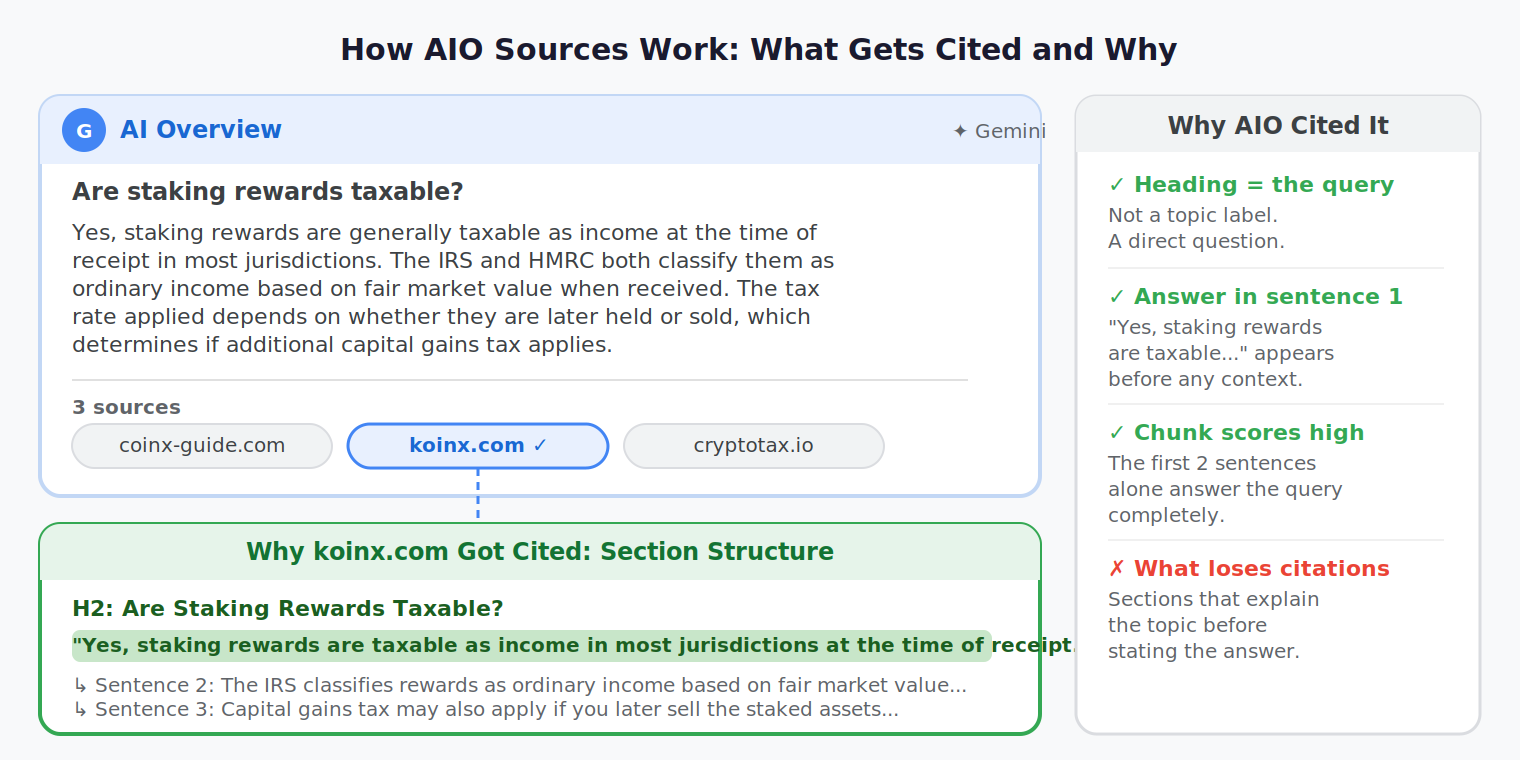
Take a query about whether crypto staking rewards are taxable. Our section heading was “Taxation of Staking Rewards.” The first paragraph was three sentences of context about how staking works before it said anything about tax treatment. The competitor cited in the AIO had the heading “Are Staking Rewards Taxable?” and the first sentence read: “Yes, staking rewards are generally taxable as income in most jurisdictions at the time of receipt.” That is it. One declarative sentence. Followed by explanation.
We had the better article by most measures. We had the worse structure by the measure that mattered for AIO. That gap cost us the citation.
Here are the three structural changes that produced the most consistent shift in citation patterns. These do not require rewriting an article. They require restructuring what comes first in each section.
- Heading as query. Rewrite section headings as the question the section answers. “Benefits of X” becomes “What does X actually do?” “Tax treatment of Y” becomes “Is Y taxable?” Not a topic label. A query. The heading should be the thing someone would type into a search bar, not a chapter title.
- First-sentence answer. The first sentence after every H2 and H3 states the answer. One sentence. Declarative. No hedging, no “it depends.” If you need to qualify, do it in sentence two. The answer comes first.
- Proof before expansion. Move supporting data, examples, and specifics to sentences two through four. Context and nuance come after the answer, not before it. The answer earns the right to be explained. Explanation does not earn the right to precede the answer.
The Section-Level Audit Checklist
Run this on any page in under 10 minutes.
- For each H2 and H3 heading: can this heading be read as a question the section answers? If not, reframe it as one.
- Read the first sentence after each heading: does it answer that question directly? If not, the section needs restructuring.
- Is there a definition paragraph, context block, or explanatory preamble before the answer? Move it after.
- Is there any section where the answer only appears in the third paragraph or later? Flag it for restructuring.
- After restructuring: read only the headings and first sentences of the page. Does this sequence give a reader the key answers to the topic without reading further? If yes, the page has high Answer Density.
Tracking AIO Citations (With What Actually Exists)
Most AIO optimization articles end with “track your performance in Google Search Console.” I understand the instinct. It is the obvious tool, and it is already in most teams’ workflows. But this advice is either outdated or misleading depending on when the article was written, and it sends people looking in the wrong place for evidence that their work is having an effect.
Google Search Console does not cleanly expose AIO-specific impression or CTR data as a separate category. A page cited in an AIO appears at “average position 1” in Search Console with an abnormally low CTR. This shows up as a performance anomaly, but it is not labeled as an AIO signal. You see high impressions, position 1, low CTR, and no explanation for why those numbers do not add up.
Google’s own documentation on AI features for site owners confirms that there are no additional technical requirements beyond standard indexing for pages to appear in AI Overviews. That documentation is useful for understanding eligibility. It tells you nothing about whether you are actually being cited.
The practical result is that your dashboard can look like things are improving (more impressions, top position) while your sessions are collapsing. The gap between what the metrics show and what is happening is where most teams lose confidence in whether their optimization is working. The answer is not to try harder in Search Console. It is to accept what Search Console can and cannot tell you, and use different methods for the rest.
Being cited in AIO is worth the effort. Seer Interactive’s September 2025 study, which analyzed 3,119 informational queries across 42 organizations, found that brands cited within AI Overviews earned 35% more organic clicks compared to brands on the same SERP that were not cited. The citation gap is real and measurable.
Three tracking methods that are honest about what they can and cannot confirm:
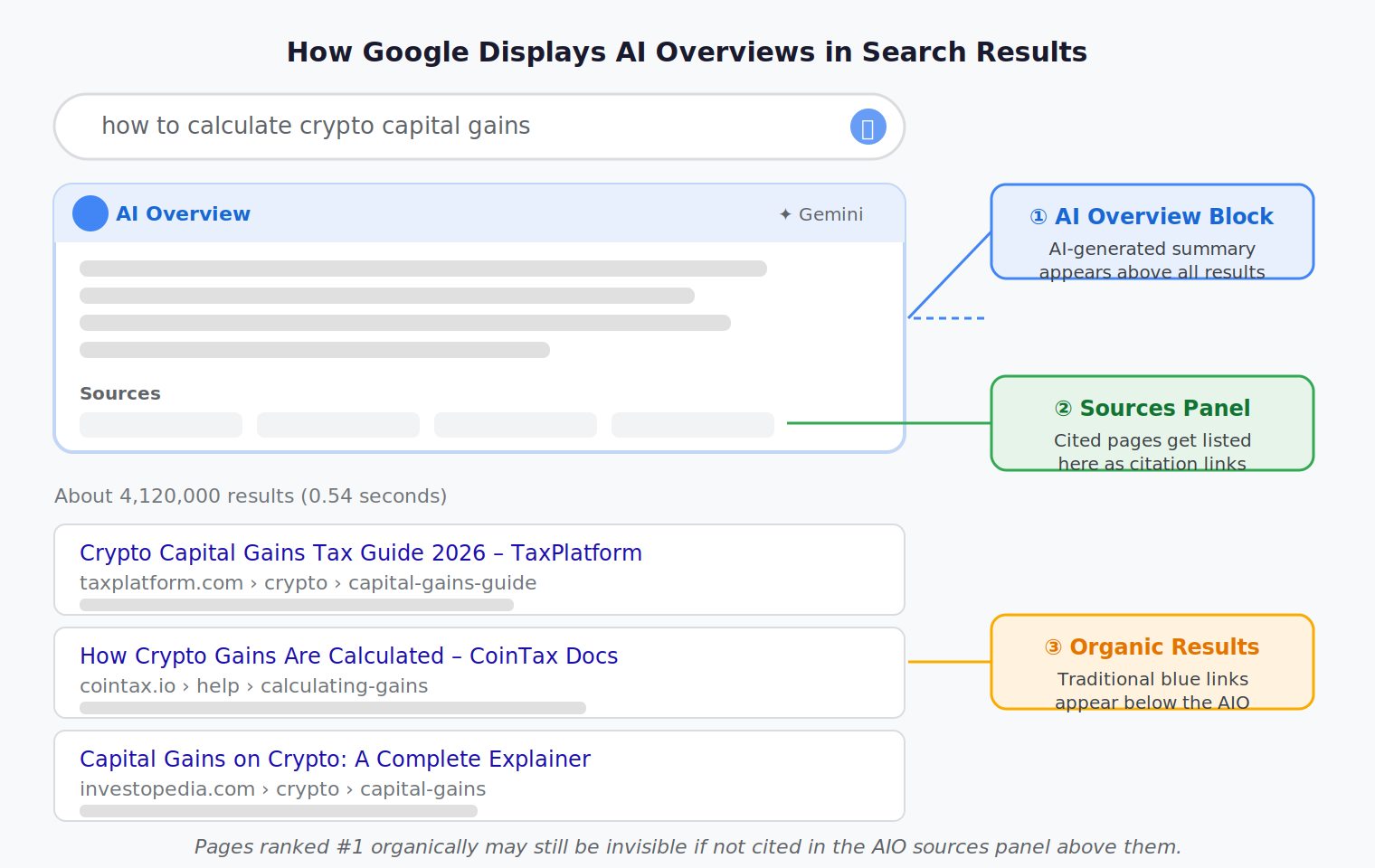
- Manual SERP check. Search your target keywords in an incognito window, note whether AIO appears, and check whether your page is listed in the sources panel on the right side of the AIO block. Log this in a tracker. It is slow and does not scale past 20 or 30 keywords, but it is accurate. For most content teams, running this check monthly on their top informational pages gives a reliable read.
- CTR anomaly detection in Search Console. Filter for keywords where your average position is 1 but CTR is unusually low, below 3 to 5%. These are almost certainly AIO-active queries. This method tells you where AIO is suppressing your traffic. It does not tell you whether you are being cited. Use it to build a shortlist of queries to manually check first.
- Third-party AIO visibility tools. There are now AI SEO tools with AIO citation tracking built in. Semrush’s Position Tracking added AI Overview monitoring in 2025, and SE Ranking offers dedicated AI visibility tracking as part of its platform. They are not perfectly accurate. They are not free. But they are the closest thing to systematic AIO monitoring that currently exists. If your content program produces more than 50 informational pages a year, one of these is worth evaluating.
My honest take after tracking this manually for the better part of two years: the manual SERP check is the most reliable. The third-party tools give you scale. Search Console gives you a signal that something has changed but never quite tells you what. Build your tracking stack in that order.
Here is the sequence I would follow if I were starting this audit on a site today.
- Pick your three most important informational pages. These should be pages that rank well but have seen traffic decline over the past six to twelve months. AIO is most likely active on exactly these queries.
- Search each target keyword in an incognito window. Note whether AIO appears and whether your page is in the sources panel. Write it down. This is your baseline.
- For every page not cited in AIO: open it and read the first two sentences after each H2 heading. Ask whether it answers the query the heading implies. If not, that section is your first restructuring target.
- Rebuild the heading as a query. Move the answer to sentence one. Run this change on one page first before restructuring six pages at once. Confirm the pattern works before scaling it.
- Re-check the SERP manually after two to three weeks. Note whether the AIO sources panel changes. This is the earliest observable signal you will get. It will not work every time. When it does, you will understand the mechanism well enough to replicate it across your content library.