
You signed up for six tools from a list you found. Three needed a credit card before you could do anything. Two let you generate one output then told you to upgrade. One was a 14-day trial someone called “free.” That is not a tool problem. That is a labeling problem. Most “free AI marketing tools” articles list tools that have a free option, which is a different thing from a tool that is actually free to use. I have tested hundreds of tools building Shnoco, a no-code community that peaked at 50,000 monthly readers. Here is the shorter, more honest list.
Most “Free AI Marketing Tool” Lists Are Not Honest
Here is how most free tools roundups get built. A writer searches for AI marketing tools, finds a dozen popular listicles, pulls the tools that mention a free plan, checks that each one has a pricing page with a free tier row, and publishes. If Jasper has a 7-day trial, it makes the list. If a tool requires a credit card to access any feature, it still goes in. The working definition of “free” in most of these articles is this: there exists a page on this tool’s website that does not ask for payment upfront.
That definition does almost nothing for a marketer trying to build a working stack without spending money. A 7-day trial is not a free tool. It is a sales mechanism with a countdown. A free account that locks every feature worth using behind a Pro plan is not a free tool. It is a demo. A tool that lets you generate three outputs then walls off access is designed to let you taste enough to feel the pull. That is a legitimate conversion strategy. It is not a free product.
The problem is not that tools are built this way. The problem is that roundup writers do not tell you which category a tool falls into. So you click through, sign up, discover the wall, and move on to the next one on the list. Four hours later you have accounts at twelve platforms and a working stack of zero.
This is not a small or niche problem. According to HubSpot’s 2025 AI Trends report, 66% of marketers worldwide now use AI in their role. That number has put enormous pressure on the “free AI tools” publishing category, because every marketer who has not started yet is searching for an entry point. The result is a flood of roundup articles built on the same low-effort criteria described above.
I went through this hundreds of times building Shnoco. The site reviews 500+ no-code and builder tools, many of which claim a free tier in their marketing copy. One of the first patterns I noticed: AI writing tools specifically had the widest gap between “free plan available” and “free plan useful.” A tool would appear on six different free AI tools lists. I would go through signup. Within two screens there was a credit card field, or the free account was running a 7-day clock, or the plan they called free gave you three document exports per month. Checking what the free tier actually does in practice became the discipline. The gap was wider than I expected, consistently.
Most “free AI marketing tools” lists are catalogues of tools that have a free tier. That is not the same thing as a tool that is worth using for free. And conflating them is why you have spent three hours signing up for tools that hit a paywall before you finish your first task.
The fix is a taxonomy. Before evaluating any tool, sort it into one of three categories.
The Three Tiers of Free
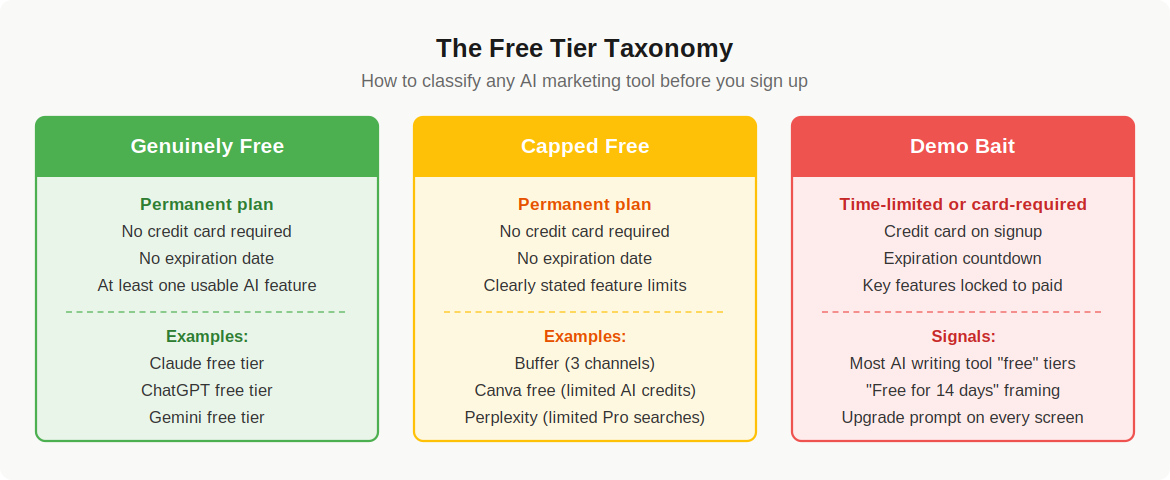
The Free Tier Taxonomy is a 3-category system for classifying AI marketing tools by the real permanence and utility of their free access:
- Genuinely Free. A permanent plan with no credit card required, no expiration date, and at least one meaningfully usable feature. The free tier does something real without counting down. The three major LLMs (Claude, ChatGPT, Gemini) are the clearest examples: permanent free access, no card required, usable for real marketing tasks.
- Capped Free. A permanent plan with clearly documented limits. No credit card, no expiration, but a ceiling on volume, usage, or feature access that is stated explicitly on the pricing page. Buffer’s free plan is Capped Free, supporting up to three social channels with 10 queued posts per channel and no time limit or credit card requirement. The ceiling is real, but it is honest and documented. If three channels work for you right now, the tool works for you.
- Demo Bait. A time-limited trial, a credit-card-required free account, or a permanent free tier where every feature worth using is locked behind an upgrade. The free plan exists to get you into the conversion funnel. Most AI copywriting tool “free tiers” are Demo Bait.
The reason Demo Bait is the dominant model comes down to conversion math. First Page Sage’s analysis of 86 SaaS companies found that opt-out free trials requiring a credit card on signup convert to paid at roughly 48-50%, compared to around 2.6% for permanent freemium plans. Demo Bait is not an accidental structure. It is engineered for conversion, not for your benefit.
Knowing which tier a tool belongs to before you sign up is the only change that matters.
The Genuinely Free Tier: Tools That Stay Free and Actually Work
Most marketers approach free AI tool selection the way they approach a hotel breakfast buffet. Take everything, decide later. They spend a weekend signing up for every tool that looked interesting in the last roundup they read. Dashboards get bookmarked. Browser extensions get installed. A month later, twelve of those tools are forgotten and the three they kept were ones they already knew about.
The opportunity cost of evaluating a tool is real, even when the tool is free. Learning an interface takes time. Building a workflow around something takes time. Deciding to abandon it and switching to something else takes more time. If the list you started from was not filtered on whether the free tier actually works, you paid a real time cost for a random sample of the AI tool market.
Low-budget marketing data consistently shows that solo marketers and small business operators run on minimal or zero tool budgets. The tools in this section exist for that reality. I built the Shnoco content operation without any paid analytics tool for the first two years. I tracked 50,000+ monthly readers’ worth of organic traffic data using Google Search Console and Trends. Neither costs anything. Neither has ever asked me for a credit card. The data they produced was good enough to make real decisions from.
Start with the tools that clear the highest bar: permanently free, no credit card, and usable for at least one real marketing task without hitting a wall in the first session. The list is shorter than the roundups suggest. That is the point.
Writing and Thinking Tools (Genuinely Free)
The LLM category is where the Demo Bait problem is worst. Every major AI assistant has a free tier. They are not equivalent, and what each one actually lets you do without paying matters.
My honest take on the free LLM tier after using all three for marketing work: Claude’s free tier produces better long-form output than the others when you are within the rate limit. ChatGPT’s free access is more permissive on volume but the model quality difference matters for marketing copy that needs to sound like a person, not a template. Gemini’s inclusion of live web access on the free tier is genuinely useful for research tasks where recency matters.
None of these free tiers are unlimited. All three will slow you down or cut you off if you are running high volume. For one to five pieces of content per day, any of them works. For ten or more, you need a paid plan.
AI Design and Visual Tools (Genuinely Free)
The design category has the most generous free AI tiers of any category in marketing. One tool above all others earns its place here.
Canva is free in a meaningful sense. No credit card required. No countdown. The free plan gives you access to the core AI features that matter for marketing work: Magic Write for copy generation, AI image generation, and the background remover. The free plan excludes some premium templates and Brand Kit features, but for a solo marketer producing social graphics, presentation slides, or ad creatives, the free tier is a working product, not a demo.
I have used Canva’s free tier for Shnoco content production across multiple years. The AI image generation on the free plan is limited in monthly credits, and some of the more recent generative features are gated. But the core creative workflow, text-to-image generation for basic assets and the Magic Write copy assist, is available without payment. For a marketer producing three to five visual assets per week, the free credits hold up.
Perplexity is free for AI-powered research queries with live web access. Unlike a standard LLM prompt, Perplexity cites its sources inline and pulls current information. For a marketer researching a topic before writing, auditing what competitors are saying, or checking whether a claim has recent supporting data, the free tier is functional and does not require a credit card to access.
Honest limitation of both: Canva’s free plan will show you paid features constantly, which is a minor version of the upgrade-prompt Demo Bait signal. It crosses into pushy territory at points. Perplexity’s free tier limits the number of Pro searches per day, pushing you toward their paid plan for heavier research workloads. Both are Capped Free, not Genuinely Free by the strictest definition of the taxonomy. They sit at the border. I am including them here because the caps are generous enough for light-to-moderate marketing use, and neither requires payment to access the features a solo marketer actually needs.
The Capped Free Tier: Limited but Legitimate
The instinct when you hit a limit on a free tool is to feel deceived and move on. Three social channels, 100 automation tasks per month, five active projects. Marketers who have been burned by Demo Bait carry that frustration into every tool they try and treat a legitimate limit as evidence of bad faith.
A Capped Free tier is an honest product decision. The limit is documented. It does not expire. It does not require a credit card. If the limit works for your current volume, the tool is fully free to you. The frustration usually comes from finding out about the limit mid-workflow, after you have built something around it. That is a research failure, not a product failure.
If you want a full picture of how to approach AI marketing beyond free tools, the guide to AI marketing for small business covers the strategic layer this article does not.
The structural reason Capped Free models are less common than Demo Bait comes down to opt-in trial conversion rates. ChartMogul’s SaaS Conversion Report, covering hundreds of products, found that free trial products requiring a credit card convert to paid at 25-35% (good performance) and up to 50-60% (great performance), while permanent freemium models convert at just 3-5%. Tools optimized for revenue choose the opt-out trial. Tools that prioritize genuine user value tend toward permanent free tiers with honest limits.
The fix is a simple one. Check the pricing page before you build anything. Read what the free tier explicitly does not include. If that information is buried, vague, or requires contacting sales, treat it as a signal.
What to Check Before You Build a Workflow on a Free Tool
Run these four checks on any Capped Free tool before you build a workflow around it:
- Find the pricing page. Look for a row or column explicitly labeled Free or Starter with no expiration date. If there is no permanently free tier listed, the tool does not have one.
- Read what is excluded from the free tier, not what is included. The missing features are what you will discover later. Read those first.
- Identify the one task you need the tool to do. Confirm that specific task is available on the free tier before creating an account.
- Look for the credit card field in the signup flow. If it appears on the free plan, you are not looking at a Capped Free tool. That is Demo Bait.
Once you move past the free tier and start making paid decisions, the question of how to layer tools together is covered in building a full AI marketing tech stack.
Demo Bait: How to Spot the Tools Not Worth Your Time
Most roundup writers do not go through the signup flow before adding a tool to their list. They check that the tool has a pricing page, confirm it is not an enterprise-only product, and include it. This is fast. It is also why readers who follow those lists end up with twelve accounts and nothing working.
A tool that requires you to enter payment details to activate a free account has already told you something about its relationship with its users. The free account exists to get your card on file. The conversion mechanism is the point, not the utility. Time-limited trials work the same way. The pressure of the countdown is the feature, not the tool. When the trial ends, you either pay or your work disappears. That is not a free product. That is a paid product with a delay.
In reviewing AI writing tools for Shnoco across several years, I found this pattern consistently in that category above all others. A tool would appear on six or seven “free AI tools” lists. I would go through signup. Within two screens: a credit card field, or a 7-day countdown in the corner, or a free plan that allowed three document exports per month. The tools themselves were often genuinely good. The “free” framing was not.
I have no objection to this as a business model. It is a legitimate way to acquire customers. What I object to is calling it “free” in a roundup article with no qualifier.
The four signals that tell you a tool is Demo Bait before you waste the signup time:
- Credit card required to create the free account. A genuinely free product does not need your payment information upfront. This is the clearest signal.
- The free tier is described in days, not features. “Free for 14 days” is a trial. “Free up to 3 channels” is a plan. One of these has an expiration date.
- Every feature that matters is listed as Pro or Business only. If the free tier unlocks only features you would not use in a real workflow, the product is structured to demonstrate value, not deliver it.
- The upgrade prompt appears on every screen. Genuinely free products do not need to remind you constantly that the real product costs money.
One note on ChatGPT and the question that comes up often: ChatGPT’s free tier is not Demo Bait. It is Capped Free. No credit card required, no expiration date, permanent access with rate-limited access to the better model. The ceiling is real. The product is genuine. The distinction matters.
Here is how to evaluate the next free AI tool you come across, in order:
- Go to the pricing page before signing up. If there is no clearly labeled permanent free tier, the tool does not have one. Stop there.
- Look for the credit card field in the signup flow. If it appears on the free plan, skip the tool.
- Identify the one task you need it to do right now. Confirm that task is available on the free tier before creating an account.
- Use the tool for that one task within 20 minutes of signing up. If you cannot get to that task in 20 minutes, the free tier is not designed to let you succeed on it.
If you want a deeper look at the full landscape once the free stack is not enough, the complete list of AI marketing tools covers what to consider when you are ready to pay.