A customer rewards program works when the incentive costs less than the profitable behavior it creates. While that sounds painfully obvious, benchmarks often blur the funnel: a share is not a visit, a visit isn't a purchase, and an attributed order isn't necessarily incremental. For teams using marketing incentive rewards, fulfillment is a core part of the process, but the economics come first. The useful framing is: does spending X dollars change behavior enough to justify the spend without eroding margin?
What do 2026 customer reward benchmarks say?
Benchmarks show that rewards can influence referrals and loyalty, but they are useful only when the denominator, sample, and behavior being measured are clear.
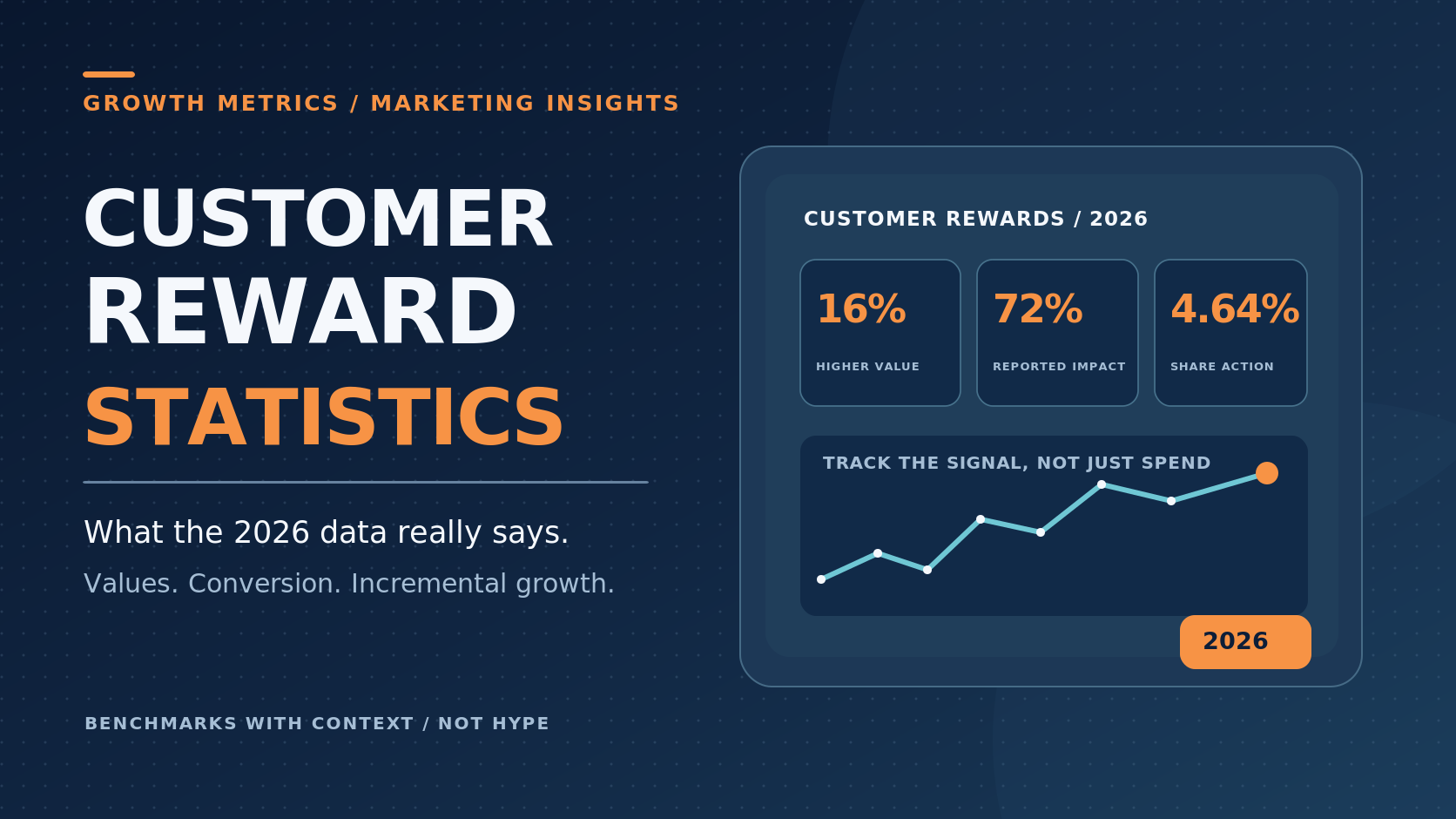
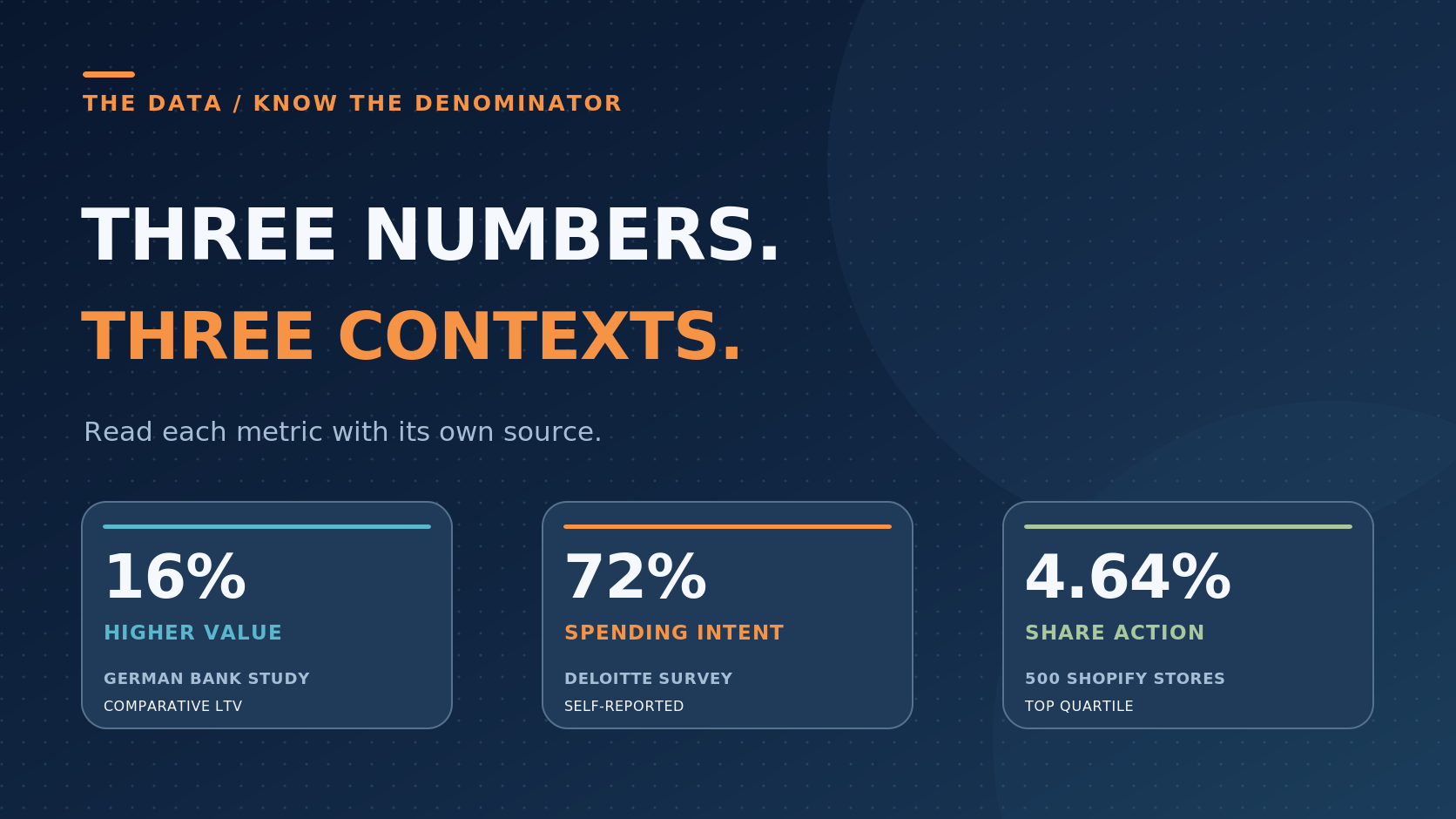
A 2011 Journal of Marketing study examined whether referrals were linked to customer value. It tracked roughly 10,000 customers at a German bank for almost three years. It found that referred customers were about 16% more valuable than comparable non-referred customers and about 18% less likely to leave. While limited to a single bank, the finding that referred customers in this scenario were worth more and more likely to stay with the bank generally corroborates the idea of a trust transfer.
Deloitte's 2025 Consumer Loyalty Program Survey looked at the effectiveness of loyalty programs for customer engagement in an era of value seeking. Among 5,564 US adults who belonged to loyalty programs, 72% said a program made them more likely to spend with their preferred brand, while 56% said it increased their spending. The limitations are that these effects are self-reported, and Deloitte notes that the questions referred to respondents' most-preferred program, so the figures can't be generalized across all loyalty memberships.
While self-reported, a 72% increase in likelihood to spend is a meaningful signal. ReferralCandy's 2026 analysis of 500 established Shopify stores found that the best-performing 25% of referral programs had at least 4.64% of customers sharing referral links, while the top 10% achieved 13.38% or more. The top 25% also generated around 2.5 times as much referral-driven sales and revenue as a typical program. This is consistent with the German bank study and supports the idea of trust transfer and compounding acquisition from referred customers who become advocates. While the sample is small, the research suggests value extends beyond the first sale, with referred customers more likely to recommend the brand to others.
Shnoco's referral and loyalty program statistics provide broader context across industries, further showing that referrals and loyalty programs have moved from growth hacking to a core acquisition strategy across sectors.
How much should a customer reward cost?
Set the reward ceiling from expected contribution margin, then work backward to the maximum acquisition cost the program can support. Consider 1,000 tracked referred visits with an assumed 4% purchase rate. That creates 40 attributed customers. If both the referrer and the new buyer receive $25, reward spend is $2,000. If a pilot suggests only 20 of those purchases were genuinely incremental, reward expense is $100 per incremental customer, not $50.
That difference is why a customer rewards program should be modeled around incremental contribution rather than attributed orders. The 4% conversion rate is only an illustration. Real performance depends on audience, offer, attribution window, returns, and the definition of a qualified buyer. Platform costs for distributing incentives also need to be factored in. Giftogram charges no platform fees on standard digital rewards, so a $25 referral reward costs $25 to send, whether the customer picks a gift card from 140,000+ brands, a prepaid Visa or Mastercard or a donation.
The broader calculation should still include administration, fraud controls, and any other software or integration costs. The same test answers how much to spend on rewards for any marketing incentive: cap it at the contribution margin of the incremental action.
Which reward programs for customers need different economics?
Across referrals, feedback, loyalty, and sales-conversion programs, the important point is to incentivize the action that creates value. c
Referrals: Pay referral rewards after an eligible purchase, not signup. Account for cancellations, returns, and self-referrals before approving the reward.
Private feedback: Reward completion rather than a positive answer. Critical feedback can be just as useful.
Loyalty: Tie rewards to repeat purchases or other behavior that increases customer value.
The same logic applies when comparing rewards instead of discounts. A reward can protect the advertised price, while a discount cuts it immediately. The best option creates more incremental profit, and sometimes a $20 reward on a $200 product can outperform a straight 10% discount by preserving the selling price and encouraging repeat behavior.
What reward type suits different customers?
The reward format should match the behavior being encouraged and how much the business knows about the recipient's preferences. Account credit keeps value inside the business but requires the customer to purchase again; great for subscriptions, horrible for larger household appliances. Cash offers maximum flexibility but can feel indistinguishable from a long-winded discount. Gift cards separate the reward from the transaction while avoiding the assumption that every customer wants the same retailer, giving recipients strong choice.
As programs scale, choosing the right reward becomes more important. A local business likely already knows what regular customers want; a national ecommerce or SaaS program serving a broader audience usually does not. Recipient choice reduces the risk of designing the entire program around preferences that apply to only part of the audience. Ecommerce companies should look at how much profit referred customers generate, while SaaS companies should focus on paid activation as a stronger qualifying action rather than a free signup.
When should automation enter a customer rewards program?
Automation should begin only after the qualifying action, approval rules, and exceptions are clear.
A weak rule becomes a larger problem when automated. The business system should determine whether a referral, survey completion, or other qualifying action satisfies the program rules before fulfillment begins. Giftogram connects approved qualifying events to reward delivery through integrations, Zapier, and its API. That reduces manual processing as volume grows without shifting the eligibility decision to the rewards platform. The payoff for businesses is that automation makes a working customer rewards program easier to run. Once it starts working well, automation is often the only realistic path forward.
Which measures justify expanding the program?
Expansion should follow incremental profit, whether from new customers, repeat purchases, or another qualifying action.
Businesses must track reward cost per incremental customer, qualified conversion, net contribution, repeat purchasing, refunds, and administrative cost. Where feasible, compare customers who receive incentives against those who do not to see if the incentives are actually increasing sales.
Looking across customer groups is also useful. A program can look healthy in aggregate while one customer segment consumes most of the budget and produces little incremental margin. Businesses need to identify which products, referral sources, and customer groups deliver the best returns before increasing their budgets. The takeaway is that successful rewards programs encourage purchases and customer referrals that would not otherwise happen while generating sufficient additional profit to justify their cost.
Frequently Asked Questions
What is a customer rewards program?
A customer rewards program gives customers an incentive to take a specific action, such as a referral, a repeat purchase, or completing feedback. It works when the reward costs less than the profit the action creates.
What is the best way to pay out a customer rewards program?
Send the reward as soon as the business system confirms the qualifying action, in a format the customer chooses. Giftogram sends in bulk or automatically, with recipient choice across 140,000+ brands, prepaid Visa and Mastercard, and donations.
Do you need a loyalty platform to run a customer rewards program?
Not for rewards paid on a single qualifying action. A loyalty platform earns its cost when the program needs points balances and tiers; for referrals, repeat purchases and feedback, the CRM or order system records the action and a delivery platform sends the reward. Giftogram sends rewards for purchases, referrals and loyalty milestones through CRM integrations, Zapier or a public API with a free sandbox, to customers in 230+ countries.