
You added AI to your marketing stack. Blog posts ship faster. Email sequences run themselves. And your trial-to-paid conversion hasn’t moved. The problem isn’t your tools. It’s that you’re deploying AI on the wrong layer of your SaaS funnel. I advise AI-assisted growth for a crypto SaaS with 1.5 million users and spent three years building the content engine at GrowthMentor. What I’ve found: the teams getting actual MRR lift from AI aren’t producing more content. They’re using AI inside the product-led loop, at the moment that actually decides whether a trial becomes a customer.
AI Content Output Went Up. Trial Conversion Didn’t Move. Here Is Why.
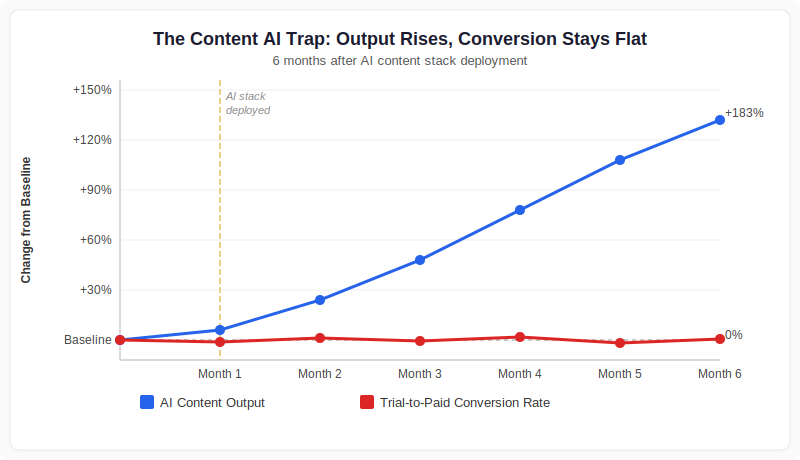
The default AI marketing move in SaaS right now is content velocity. You connect a writing tool, set up a content calendar, and start shipping blog posts faster. Then you add AI to your email sequences. Then a chatbot. Six months in, your output has doubled. Your MQL count looks better. The stack feels complete.
Content velocity does not close the gap between a trial signup and a paying customer.
Here is what is actually happening. When a user signs up for your trial, they have already found you. The awareness problem is solved. What they face now is a completely different problem: will they reach the moment inside your product where it becomes obviously worth paying for? That moment is your activation event. It has nothing to do with how many blog posts you published that week. It has nothing to do with your email open rate. It is a product experience problem, and content AI does not touch it.
The second part of the problem is competitive. When every SaaS company on the same search results page uses the same AI stack to write about the same topics, the content advantage collapses. Your AI-assisted post about SaaS onboarding best practices is indistinguishable from your competitor’s. Neither ranks for long. Both get absorbed by the AI Overviews that now reduce clicks to top-ranking pages by 58% according to the most recent Ahrefs study of 300,000 keywords. The content moat built on AI volume is not a moat. It is a sandcastle.
I ran SEO and content strategy for KoinX, the crypto tax SaaS with 1.5 million users, and we had the AI-assisted content workflow producing at scale within months. Organic traffic improved. Trial signups from content held steady. What did not move was the 14-day trial-to-paid conversion rate. Conversion sat at around 9% in the quarters before the AI content stack was live and held at 9% for the two quarters that followed.
The content layer was working on the terms it was measured by: sessions, rankings, signups. The activation layer had not been touched. And as SaaStr has noted directly, simply bolting on AI does not accelerate growth for most SaaS teams. At best, it achieves market parity. This pattern is not unique to one company.
Before adding another AI content tool, do one thing. Pull your trial-to-paid conversion rate for the 90 days before your AI stack went live, and compare it to the 90 days after. If content velocity went up and conversion stayed flat, the stack is not solving the right problem. That number is your diagnostic. Everything that follows depends on what you find.
The question is not which AI tools to use. It is which layer of the funnel they are pointing at.
Demand-Gen AI vs. Activation AI: The Decision That Determines Whether AI Compounds
Most conversations about AI marketing treat the category as a single thing. The pitch is the same whether you are buying a content generator, a lead scoring module, or a behavioral email platform: AI will accelerate your growth. Teams buy from this category without a framework for where the investment will actually change a number that matters. So they end up with five AI tools, all pointed at the same layer of the funnel, none of them touching the layer that decides revenue.
There are two fundamentally different places AI can sit in a SaaS marketing model, and they have completely different return profiles.
Demand-Gen AI operates on external communications: blog posts, email copy, outbound sequences, ad creative. It operates on an audience that has not yet touched your product. Its returns are linear at best. As adoption spreads across the market, those returns converge toward zero for undifferentiated content.
Activation AI operates inside the product-led loop: behavioral trigger emails tied to in-app events, onboarding personalization based on user context, product-qualified lead scoring from usage data, churn prediction from engagement signals. It operates on data that is uniquely yours. Every session, every feature click, every in-app event improves the signal. Its returns compound with usage.
These are not two versions of the same investment. They are structurally different bets on different parts of the funnel, with different mechanics and different timelines.
Here is what the difference looks like across the dimensions that matter:
The product-led growth benchmarks and PQL conversion data make the structural case clearly. According to OpenView Partners, leads who qualify themselves in the product convert at a 5x higher rate than the overall conversion rate. PQL conversion rates of 25-30% consistently outperform MQL conversion rates of 5-10% across PLG SaaS companies. Leads generated inside the product, by users who have already experienced value, are worth more than leads generated outside it, by users who have only read about it.
Most SaaS teams are using AI to produce more marketing content, when the only AI application that compounds is the one that reduces the distance between a user’s first login and their first moment of product value.
Do this audit now. List every AI marketing tool in your current stack. Next to each one, write either “Demand-Gen AI” or “Activation AI.” Count the entries in each column. If the Activation AI column is empty, that is your answer. The audit takes fifteen minutes. Acting on what it reveals takes longer. But the decision point is that simple.
Read next: product-led growth benchmarks and PQL conversion data
What Activation AI Actually Does Inside a PLG Motion
The Demand-Gen vs. Activation split is a strategic diagnosis. This section is the operational answer: here is what Activation AI actually does, in sequence, and how to build it without a data science team.
The 48-Hour Rule: Where Most SaaS Trials Are Already Lost
PLG teams treat activation as a product design problem. They build a welcome email series. They write tooltips. They run an onboarding webinar. Then they set the sequence on autopilot and check the trial conversion report at the end of the month. When the rate is 7%, they run another onboarding redesign sprint. The cycle repeats.
The problem is not the sequence. The problem is that the sequence treats all trial users identically.
A user who logged in three times and stopped at the same screen every visit is a completely different situation from a user who has engaged daily for ten days but has not invited a teammate. The first has a friction problem at a specific in-app moment. The second is a product-qualified lead who is ready for a direct sales conversation. A fixed sequence sends both of them the same email on day five.
Generic sequences cannot distinguish between them.
The SaaS onboarding and activation benchmarks confirm what I have seen in advisory work: most trial churn is decided in the first 48 to 72 hours. Before any human sales touchpoint is relevant. Before most automated sequences have fired their second message.
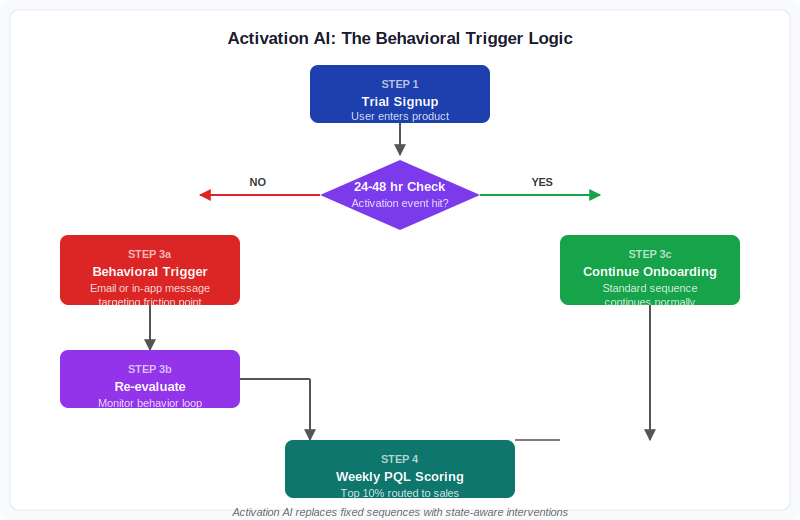
Working on activation for my advisory client in the crypto vertical, I found that drop-off between trial signup and first meaningful product action was concentrated entirely in those first two days. Most churned users had never completed the activation event. Not once. The issue was not features, not pricing, not messaging. The gap between signup and first value moment had no intervention. Once behavioral triggers were mapped to specific in-app events and began firing for users who had not completed the activation event at the 12-hour and 24-hour marks, the 14-day trial engagement rate increased by roughly 26% over the following 60 days.
PQL Scoring Without a Data Science Team
The second job Activation AI does inside a PLG motion is surfacing product-qualified leads before the trial window closes. Most small SaaS teams hear “PQL scoring” and assume it requires a data science hire and a BI stack. It does not.
Start with a manual rubric. Define three to five product behaviors that correlate with conversion in your specific product: number of logins in the first seven days, key feature activated, team member invited, integration connected. Assign a point value to each. Score your active trials weekly by hand. Route the top 10% to a direct outreach conversation before the trial ends.
Once the manual rubric is producing above-baseline conversion from that outreach, introduce AI. Use Amplitude or Mixpanel to automate the scoring. Use Intercom or a similar platform to trigger the outreach at the right moment. The AI accelerates the scoring frequency and personalizes the outreach. It does not replace the judgment about which behaviors signal intent. You build that judgment manually first. Only then do you hand it to a tool.
Fix. Three steps to implement Activation AI, in order:
- Map your activation event: identify the single in-app action that most strongly predicts a trial user converting to paid. Use your product analytics. Name it precisely. Everything downstream depends on this.
- Build one behavioral trigger: when a trial user has not reached that activation event within 24-48 hours, fire one targeted email or in-app message that addresses the specific friction at that step. Personalize it based on the user’s signup context or early behavior data.
- Score your trials weekly: rank active trials by product engagement (logins, feature usage, time in product) every seven days. Route the top 10% by engagement score to a direct, sales-assisted conversation before the trial window closes.
The free trial conversion benchmarks show the range achievable for opted-in trials and freemium models by industry. The distance between where most SaaS teams sit and where the top quartile sits is almost always an activation gap. Not a top-of-funnel gap. Not a content gap.
Demand-Gen AI Still Has a Job. It Just Is Not the One Most Teams Are Using It For.
Some teams read the argument above and overcorrect. Content does not drive SaaS growth. AI content is noise. Defund the content program and put everything into product activation. That overcorrect is also wrong, and it leaves real compounding potential on the table.
Demand-Gen AI applied with editorial judgment still produces returns. The mechanism has changed, not the opportunity. In 2023 and 2024, the AI content play was a volume bet: more posts, more rankings, more traffic. That window has closed. The content advantage in 2026 is not about how much you publish. It is about whether what you publish gets cited.
AI Overviews, Perplexity, and every LLM-powered answer engine are pulling from a shrinking pool of sources they consider authoritative. Generic, undifferentiated content is not in that pool. Content with a named framework, specific data, and a stated position often is.
Precision compounds. Volume does not.
At GrowthMentor, three years of content-led growth produced organic signups because every piece was built around a specific searcher situation rather than a keyword list. When I started incorporating AI tools into that workflow, the pieces that compounded were the ones where AI accelerated the research and structure, and human editorial judgment controlled the argument. The content that did not compound was the content where AI controlled the argument and human effort controlled the formatting. Same tools. Different decisions about where human judgment sat in the process. Completely different outcomes.
The AI content marketing adoption and ROI data shows where documented productivity gains are concentrated and, just as importantly, where they are not. The AI adoption in marketing benchmarks are consistent: the ROI gap is concentrated in teams with a deployment framework, not in teams with the most tools.
Three Demand-Gen AI applications that still compound for SaaS in 2026.
Use AI for ICP research before writing anything. AI tools now produce detailed behavioral profiles of specific buyer segments faster than any manual research process. Run ICP research in AI before you write a brief. The content that comes out of a research-first process is structurally different from content built off a keyword list alone. Different angle. Different depth. Different chance of getting cited.
Use AI to build content with citation authority. Content that appears in AI Overviews and LLM responses has specific characteristics: named definitions, specific data points, first-person proof, and a stated position on something. Use AI to build the framework and structure. Use human editorial judgment to write the argument. The argument is what gets cited. The structure is what makes it scannable.
Use AI for account-level outbound personalization. Intent signals fed into AI to produce personalized outbound sequences is a legitimate Demand-Gen AI application for SaaS. Job postings, funding announcements, G2 review patterns, and competitor category movements all feed a targeting model that reduces cost-per-precision rather than cost-per-volume. That is a different and more defensible investment than generating more cold emails faster.
Read next: AI content marketing adoption and ROI data
Most SaaS teams are not failing at AI marketing because they have the wrong tools. They are failing because they are using the right tools in the wrong layer of the funnel. Demand-Gen AI is visible, measurable, and easy to report on. Activation AI requires behavioral instrumentation, product data, and the willingness to look at trial conversion instead of traffic. It is a harder internal sell. It is also the one that actually moves MRR.
Here is the five-step diagnostic to run this week:
- Pull your trial-to-paid conversion rate for the 90 days before and after your AI stack went live. If conversion is flat, the stack is not solving the right problem.
- List every AI marketing tool in your current stack. Label each: Demand-Gen AI or Activation AI. Count what is in each column.
- Identify the single in-app action that most strongly predicts a trial converting to paid in your product. Name it. Write it down.
- Build one behavioral trigger that fires for trial users who have not reached that activation event within 48 hours. This is your first Activation AI investment.
- Score your active trials by product engagement every seven days. Route the top 10% by engagement to a direct, sales-assisted conversation before the trial window closes.